
Assembly automation
Faster with 22
Assembly automation. Martin Mechanic has developed the second generation of systems for the construction of damping systems for a customer in the automotive industry. The number of robots in the system was doubled from eleven to 22.
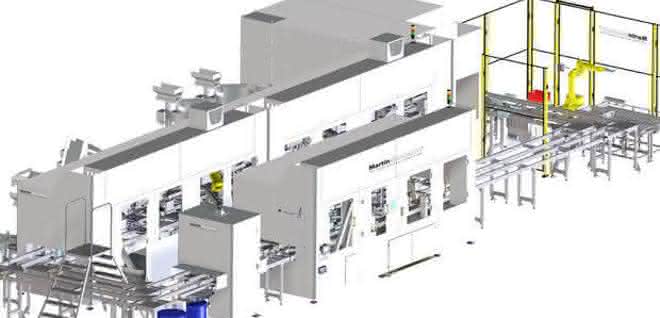
While its predecessor could only produce one variant of a damping system for doors and flaps, the new system can produce twelve different model variants in various sizes. A total of 19 Yamaha Scara robots and three Fanuc six-axis robots make the automation cell, which has grown to over 153 square meters of floor space, more efficient.
In principle, the system, which produces 1.1 million parts a year in three-shift operation, consists of four work cells, namely parts provision, component assembly, the test cell and final assembly. Its "brain" is the S7-1550F PLC controller from Siemens. The worker operates the PLC control system using a permanently installed screen and two mobile panels.
At the first work station, the six-axis Fanuc robot M 20iA picks up ten housings at a time with its surface suction cup and places them loosely on the infeed conveyor. At the downstream transfer station, a Scara robot places the housings in the separating station. A second Scara robot unclips the top of the housing with its vacuum gripper. The four-axis robot then removes the underside from the transfer station with its second gripper. The top and bottom sides can now be placed one after the other on the double-track workpiece carrier system and transferred to the production cycle. To achieve the extremely fast target cycle time of six seconds, two production lanes are always occupied alternately. The various components, which are inserted into the underside, arrive individually at the assembly stations via eleven feed pots. The hoppers are each filled by the worker.
At the subsequent stations, the bridge, the latching nose and the oil damper are fed in with the help of Scara robots, the latter via a step conveyor. They are then mounted in the insertion frame in an intermediate step. This is followed by the insertion of the tension spring, the positioning unit, positioning pins and the fitting of the cover cap as part of the assembly process.
After assembly, image processing is used to check whether all parts have been correctly positioned and installed. During final assembly, the housings are first placed in the cleaning station. A plasma nozzle cleans the surface. Another Omron robot places the cover on the underside. The fully assembled housing now travels in the workpiece carrier to the next station, where it is lifted so that the top and bottom can be pressed together. The parts are welded together using high frequency.
The kinematics of the latching nose, which was installed for the slow closing of the damping system, must now be lubricated. To improve its sliding properties, a dosing needle moves into the latching nose to apply the grease dot at 50 bar. To check the closing force, the component is pressed against a force sensor. All components that are OK are then labeled with a QR code. Finally, the Fanuc LR Mate 200 iD/7L six-axis robot is used. It places the labeled component on an outfeed belt, via which it moves directly to the next assembly station. as


You might also be interested in
ebm-papst is growing again thanks to AI and data centers
ebm-papst returned to a growth trajectory in fiscal year 2025/26. Air Technology, data center applications, and artificial intelligence are driving revenue and investment.
 read more...
SPE on the Verge of a Market Breakthrough
Single Pair Ethernet (SPE) has moved beyond the conceptual phase and is increasingly being implemented in industrial settings. The focus here is not only on higher data rates and simplified cabling, but above all on the issue of system integration...
read more...More than 900 exhibitors already registered
Around six months before the start of the trade fair, more than 900 companies have registered for SPS 2026 in Nuremberg. The trade fair focuses on industrial AI, cyber security and digital transformation.
read more...Virtual PLCs in practice: How vPLCs make production systems more flexible and scalable
The increasing networking of IT and OT is fundamentally changing industrial automation. The IT/OT Integration Summit shows how modern technologies can make production environments more efficient, flexible and future-proof. The event will focus on...
read more...Sales growth in a turbulent market environment
Thanks to innovations and a focus on strategic industrial markets, Sick was able to moderately increase its sales in the 2025 financial year. In a turbulent market environment, the company was able to maintain its position and gain market share with...
read more...Siemens presents new AI agent
Siemens is launching 'Eigen Engineering Agent', an AI for automation technology. The solution is integrated into the TIA Portal, has been tested with over 100 companies and is designed to significantly accelerate engineering processes.
read more...Schaeffler keeps sales almost stable
Schaeffler generated revenue of EUR 23.5 billion in 2025 and increased EBIT before special items to EUR 936 million. At 266 million euros, free cash flow was significantly above the prior year and forecast. Net income remained negative due to high...
read more...Advancing artificial intelligence together
Helukabel is stepping up its activities in the field of artificial intelligence and is now a member of the IPAI. The innovation and collaboration platform for companies, research facilities, institutions and administration has set itself the goal of...
read more...New impetus for ifm sales
Two new positions were filled at ifm at the start of 2026: Markus Wolf becomes Managing Director Sales Germany, Sven Quant takes over the position of Central Managing Director in the Process Sensors division within the ifm Group.
read more...