
Growing market
Robots for the healthcare sector
The technology group ABB wants to equip medical laboratories with collaborative robots. The technology will initially be used in a health care hub on the innovation campus of the Texas Medical Center (TMC) in Houston, Texas, which ABB plans to open in October 2019.
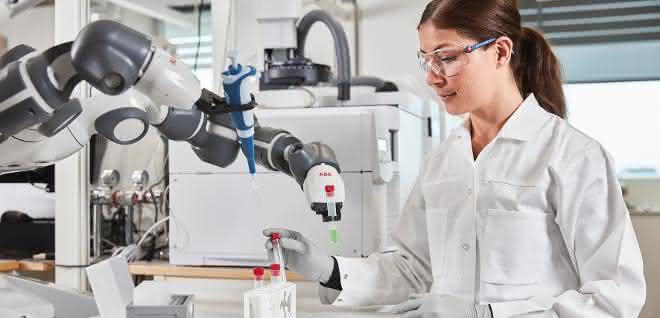
The lab is ABB's first facility specifically for healthcare research. ABB's research team will work with medical professionals, scientists and engineers at the TMC campus to develop medical robotic systems for non-surgical applications. This includes laboratory logistics and next-generation automated laboratory technologies.
Relief for repetitive tasks
Nowadays, highly qualified medical professionals spend a large part of their working day on repetitive and unchallenging tasks. This severely limits the number of patients that can be treated. By using robots for these tasks, medical professionals can focus on more demanding and productive work. At the same time, testing procedures are accelerated, allowing significantly more patients to be treated.
ABB has analyzed a wide range of medical processes that are currently performed manually in laboratories. ABB estimates that the number of tests performed each year could be increased by 50 percent through automation. By having robots take over repetitive tasks, it is also possible to automate activities that are associated with a high health risk for staff, such as repetitive strain injury syndrome.
Considerable market
According to an internal study by ABB, the global market is set to grow to almost 60,000 medical robots for non-surgical applications by 2025. This means that the market will almost quadruple compared to 2018
ABB's collaborative robots are already used in food and beverage laboratories around the world and are suitable for medical facilities as they can work safely and efficiently side-by-side with humans without the need for safety fences. The robots will perform repetitive, difficult and time-consuming tasks of various kinds. Among other things, they will dose, mix and pipette, assemble sterile instruments and load and unload centrifuges. dsc


You might also be interested in
Research at the Intersection of Fiber...
New Fiber-Optic Technology Reduces Energy Consumption in Photonic Computers
Frozen at -196 °C: A new liquid-core fiber combines light and sound with high efficiency, opening up new avenues for quantum computing and photonics.
 read more...
A quantum computer that performs calculations using oscillations
When it comes to storing information, quantum computers have so far run up against technical limitations. Instead of electromagnetic storage, researchers are now using mechanical vibrations. Their vibrating memory can store significantly more...
read more...Hydrogen Pipelines Put to the Test
New real-world lab tests safety and resilience
The Federal Institute for Materials Research and Testing (BAM) is opening a real-world laboratory to study pipelines and components for the safe operation of future hydrogen networks.
read more...Research Platform for the Energy Supply of the Future
For the first time, the Karlsruhe Institute of Technology (KIT) is bringing together key hydrogen technologies in a single research environment. The facility is intended to demonstrate how the production, storage, transport, and use of hydrogen can...
read more...When the quantum computer arrives
The Research Race to Ensure the Security of Critical Infrastructure
How can we protect our critical infrastructure from attacks by quantum computers in the future? As part of the QUEST project, Darmstadt University of Applied Sciences is researching new methods—post-quantum cryptography—designed to withstand even...
read more...VDE study on electrical engineering
More retirements than graduations
According to a VDE analysis, more than 30,000 electrical engineers will retire by 2029 without enough graduates to replace them. This is due to falling student numbers and high drop-out rates.
read more...Giving lightweight construction a profile
Pultrusion: A process that forms fibers under tension
Pultrusion is developing from a niche process into a key process for lightweight construction and sustainable fiber composite structures. The Fraunhofer IWU shows applications from energy to mobility.
read more...Green hydrogen directly from the sun and water
A start-up project at the Karlsruhe Institute of Technology (KIT) aims to fundamentally simplify the production of green hydrogen: Mass-produced photoreactor panels are to be used to produce hydrogen directly from sunlight and water - without...
read more...Fraunhofer shows industrial future between AI, data and new materials
At Hannover Messe 2026, the Fraunhofer-Gesellschaft will be presenting solutions for a resilient industry: from AI and data rooms to hydrogen technologies and material and recycling innovations.
read more...