
Interview with Andreas Haimer
"The demand for balancing devices is increasing"
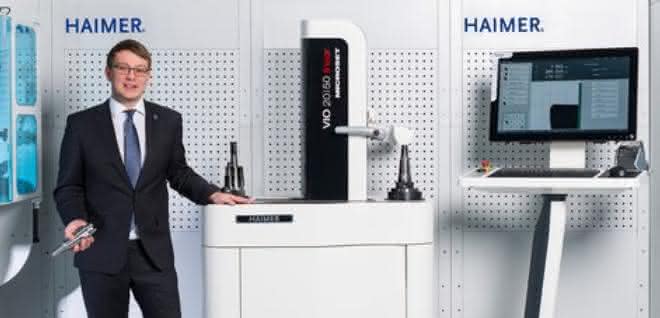
SCOPE: How widespread is tool balancing in the industry?
Andreas Haimer: The importance of balanced tools has increased significantly in recent years: Tool holders, milling and drilling tools, for example, are already largely purchased "precision-balanced" as individual components. In addition, more and more shrink chucks are being used, which inherently provide a repeatable balancing quality.
When we at Haimer talk about balanced tools, we always mean a tool system consisting of the tool holder, the accessories and the actual cutting tool after assembly. This is because the balancing quality and therefore the dynamic concentricity properties of the complete tool during machining are crucial for a productive machining process.
The more demanding the machining operations become or the greater the imbalance of the complete tool, the more important and necessary it becomes to balance the tool system after assembly. We have noticed that with the introduction of modern machining strategies such as HSC and HPC machining and the associated high speeds, the need for balancing devices has increased year on year.
This trend is supported by machine tool manufacturers, who are increasingly moving towards monitoring the unbalance of the tools even in the machine. If this is too high for the speed used, the spindle stops. This is because the unbalance would jeopardize process reliability and the trouble-free operation of the machines due to vibrations. In this respect, balancing is a guarantee for process-reliable "green light machining" and protects against expensive spindle damage.
SCOPE: What can happen if a tool is not balanced?
Haimer: There are many consequences that arise from an unbalanced tool system. The resulting centrifugal force puts a strain on the spindle bearings, which experience has shown reduces the spindle service life by around 50 percent. This can result in expensive and unplanned machine downtime.
The centrifugal forces cause vibrations when the spindle rotates. These are transferred to the machine and especially to the cutting tool, which can significantly shorten the service life of the tool. Based on experience, the service life of an unbalanced tool system, tool holder with cutting tools, nuts, collets, screws, inserts, etc., is reduced by at least ten percent. The result is higher costs for cutting tools and unplanned tool set-ups. A major American car manufacturer was able to reduce the number of unplanned tool changes by over 60 percent by introducing a balancing process.
SCOPE: What influence does the balancing of tools have on the production process or on the machine?
Haimer: Vibrations don't just damage the spindle and the cutting tool. They impair the entire process. They create chatter marks that have to be removed by additional fine machining or other reworking. Alternatively, many machinists reduce the rotational speed, feed rate and cutting depth, but this leads to a lower metal removal rate and therefore to poorer productivity.
Balancing the tool systems improves their concentricity and thus reduces the resulting vibrations. This is particularly important for complete tools that consist of many variable components and accessories (such as pull studs or coolant pipes). Tools with an asymmetrical modular design, PCD tools, boring heads or tools with an uneven cutting edge pitch are also unbalanced due to their geometry and must be balanced in order to achieve stable processes, predictable tool set-up and optimized machining results. Balanced tools are also essential for the highest possible feed rates and speeds - and therefore high cutting rates and short machining times. This means that critical machining operations in the production process can be optimized using precision-balanced tools and significant productivity improvements of up to 20 percent can be achieved, depending on the application.


You might also be interested in
New Trade Show for the Turned Parts Industry
The Association of the German Turned Parts Industry has given a positive assessment of the first Make-to-Order (MTO) Days: With 184 exhibitors and approximately 1,400 trade visitors, the inaugural event proved to be a successful platform for...
 read more...
In-house exhibition Bielefeld 2026
How DMG Mori thinks about the factory of the future
DMG Mori will be showcasing turning and milling expertise, automation solutions and additive manufacturing along the Machining Transformation (MX) at the Bielefeld 2026 in-house exhibition.
read more...Association of the German Turned Parts...
Turned parts industry looks cautiously to the future
Rising order intake, new members, cautious optimism: the members of the Association of the German Turned Parts Industry are confident. At the spring conference in Leipzig, around 150 participants discussed current market developments, strategic...
read more...World premieres at the EMO 2025
From September 22 to 26, 2025, Grob will be presenting several innovations at EMO Hannover. The focus of the trade fair appearance will be on the latest 4- and 5-axis universal machining centers and the associated automation solutions.
read more...Efficient complete machining
Index-Werke will be bringing the Index G220 turn-mill center and the Traub TNA400 universal lathe to Intec.
read more...Digitization of process chains
CAM system Hypermill in practice
At EMO 2023, Open Mind will focus on turning, milling and the importance of CAM software and MES in networked production environments.
read more...High-speed spindle in handbag format
Modules for milling and turning
At Weiss, the focus is on the new 1.5 kilogram micro-mill spindle, which rotates at up to 60,000 revolutions per minute.
read more...Handling and workpiece clamping
Networked production starts with the component
Schunk is coming to Hanover with a 360-degree portfolio covering all aspects of machine tools. The focus will be on more sustainable production, connectivity and e-mobility.
read more...Stroll through the city
DMG Mori is inviting visitors to take a stroll through the city at EMO: In a specially constructed DMG Mori City, the machine tool manufacturer is concentrating on its focus topic of Machining Transformation (MX).
read more...