
Machining centers with top axes
Special solution for clear requirements
At AlphaFluid in Pliezhausen, Baden-Württemberg, hydraulic adjustment units are manufactured as ready-to-install assemblies for a stepless, hydrostatic drive. To increase productivity, two machining centers were each expanded with two top axes from Hofmann.
The hydraulic adjustment unit from AlphaFluid is part of a continuously variable hydrostatic drive for self-propelled agricultural and construction machinery, such as wheel loaders, telescopic handlers and forestry machines. With this drive, the entire speed range can be run continuously without interrupting the tractive force. It offers a high stepless conversion range from "0" to maximum transport speed, automatic adjustment of the power requirement and simple reversal of direction and torque. This allows vehicles to cover longer distances at the highest possible speed. This travel drive is currently available in five performance classes and is used in series production by many equipment manufacturers.
Initially, the hydraulic adjustment unit was manufactured on a conventional NC dividing head/rotary axis. This only had a clamping option for workpieces on one side, which meant that only one workpiece could be machined. About four years ago, the increasing quantities could no longer be handled with the existing capacity of the machining center in its conventional design. As investing in an additional machining center was not an option at the time, it quickly became clear that the only way to increase the machine's productivity was to install a new, optimized rotary axis.
Hofmann Mess- und Teiltechnik was quickly found as a partner for the implementation. The requirements were clearly defined: The 5th axis of the machine should be able to perform multi-sided machining of the workpiece; it should be possible to drill holes with different angles. In addition, the existing working space of the Heller machining center was to be optimally utilized. The only problem was that the cubic work area in the machine was too small for four or more spindles. Even two spindles mounted next to each other were not feasible.
Thanks to Hofmann's experience with customer-specific special solutions, it was possible to present a solution tailored precisely to the customer's requirements, which was characterized in particular by the following features:
- Dividing spindle in double-sided design to accommodate two hydraulic clamping devices: one at the front and one at the rear of the dividing head
- Adaptation of the housing dimensions to the confined space conditions
- Efficiency increase in the productivity of a machine system already in use
- Simultaneous machining of two workpieces in one clamping operation
- Real 5-sided editing possible
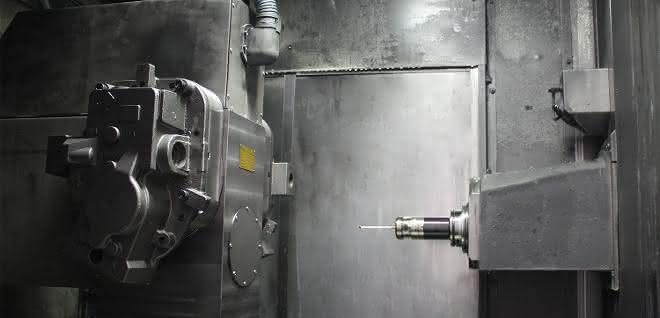
The special feature of this double-spindle machine is that the workpieces are not clamped next to each other, as is normally the case, but opposite each other due to the lack of space in the machining center. In addition, true 5-sided machining is possible and the entire workpiece is finished with just two clamping operations. The top axis is a special design according to customer requirements based on a Hofmann RWNC-220 dividing head using proven and reliable components such as worm drive and bearings from Hofmann standard machines.
Due to further increases in quantities, the company has since invested in another machining center. A machining center with the same technology that has proven itself. Only the rotary axis was modified. In order to achieve greater accuracy, the rotary axis was equipped with a direct measuring system.
The cost benefits should also not go unmentioned: Thanks to multi-sided machining, the workpiece can be machined in just two clamping operations, which means a reduction in non-productive times with corresponding cost savings.
Hofmann Mess- und Teiltechnik offers its customers solutions that are precisely tailored to their requirements and cannot be realized with standard solutions from other manufacturers. The portfolio includes special features such as special servo motor attachments, connections to machine-side energy supply systems or the number and design of workpiece holders. The focus is always on close dialog with the customer in order to provide them with an optimum solution for the respective application.


You might also be interested in
Housing and inserts for plenty of power
Lapp presented the expansion of its Epic Power series at SPS 2023: four new M23 circular connector inserts and three new M23 housings. The special feature: all housings can be combined with any of the four inserts.
 read more...
News and product updates from Smartgas
Portable gas analyzers for outdoor use
Smartgas is starting the second half of the year with a series of updates to existing products and a number of new products. Portable analyzers expand the range of applications, while new accessories such as protective housings and heating modules...
read more...Everything accurate in switch cabinet construction
To ensure smooth work processes, tools for processing enclosures and housings must function flawlessly and reliably. Häwa rounds off its punching range with the Multi-Press 500.
read more...Shafts and conversion parts
The Rodriguez range includes ball bushings including matching housings, shaft brackets, crossbars and supports.
read more...Cooling and temperature control units
Hygienic packaging sells safely
In few industries are the requirements for hygiene in the production process as strict as in the food sector - the health of consumers has top priority. This results in enormous challenges for all machines and components involved, especially in...
read more...Simple tool change in seconds
With the CMS, Schunk is launching a user-friendly, manual change system for quick component replacement. In addition to its simple and convenient operation, the CMS also stands out with its extensive range of optional modules and complementary end...
read more...Motion controller for small drives
Medium power range covered
Faulhaber has another housing-less and compact motion controller in its range, which is particularly suitable for integration in device construction and medical technology applications.
read more...Welding solutions in the name of resource efficiency
At the Welding & Cutting trade fair in Essen (September 11-15), Fronius will be focusing on the major drivers in welding technology. Quality requirements are increasing in all industries, but the required welding specialists are scarce. In...
read more...Safe solutions for cable installations
From thick power cables to thin sensor lines, cables and lines must be routed safely through systems and machines. A challenge that should not be underestimated, explains Jörg Sokat, Head of Product Management at Pflitsch.
read more...