
Digitally supported machining process
Less waste thanks to digital support
Machining errors during internal turning can quickly lead to poor quality or even rejects. Vibration and force sensors embedded in the boring bar, in conjunction with digital support, help to record information from the machining process and identify process anomalies.
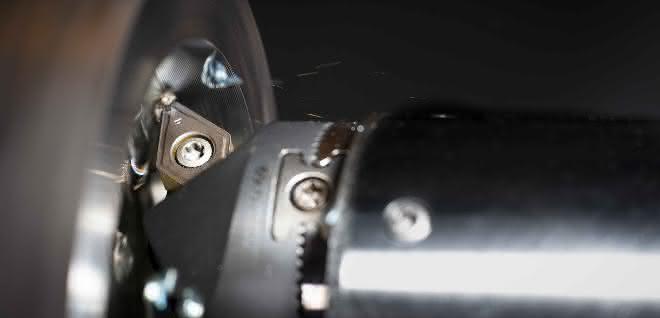
When producing large and expensive components, such as those used in the aerospace or oil and gas industries, manufacturing companies often slow down internal turning processes to protect the components being machined - as machining errors can be very costly. One way to both speed up machining and avoid scrap is to regularly check what is happening inside the machine tool. Knowing what is happening inside the component during internal turning can lead to significant increases in efficiency and reduced scrap, especially when machining long, slim components. In collaboration with users worldwide, Sandvik Coromant has developed the Silent Tools Plus boring bars, which can speed up the internal turning of high-quality components. This is possible because the integrated sensor technology can identify process anomalies, i.e. deviations from the specified machining parameters, and make them visible to the operator.
While the Silent Tools technology is around 50 years old, the current innovation is based on a new development that includes vibration and force sensors embedded in the boring bar. This technological advancement makes it possible to capture accurate information from the machining process and visualize it in real time via easy-to-understand and intuitive dashboards. Operators can see what is happening inside the component being worked on behind the closed doors of the machine tool.
Improve processing efficiency and decision-making
The vibration-damped boring bars have connectivity that provides information such as "in-cut" indication, vibrations, displacement of the cutting edge or the temperature within the damping system. With the help of such data, process reliability and machining efficiency can be optimized and damage to the machine and component, including surface damage, can be avoided. The result is less downtime due to tool breakage and the ability to machine expensive materials and complex components at higher cutting speeds.
The data displayed on a dashboard gives the operator an immediate picture of the machining process and a concrete idea of progress. If the machining process deviates from the specified parameters, for example in the form of excessive jolting or increased vibrations, the operator is immediately informed via the dashboard. In this way, he can react immediately and take appropriate measures to stop or adjust the machining process and thus avoid damage to the component and the machine.
To further improve decision-making at the machine door, the data also includes a history of the ongoing machining process. This is particularly important for manufacturing companies that realize projects for demanding sectors such as the aerospace or oil and gas industries.
Increase process reliability and machine utilization
The aim of making the machining process significantly more reliable and reducing the reject rate to a minimum is particularly important if the components to be machined are extremely expensive in terms of materials or if a high level of added value has already been achieved towards the end of the process chain. If, for example, digital technologies can prevent high-value components from having to be scrapped or reworked in the case of aircraft landing gear or underwater components, the investment pays for itself within a short period of time.
Better utilization can be achieved, among other things, by eliminating "air cuts" because it is always visible whether the cutting edge is engaged. Quick-change devices between the adapter and cutting head can also contribute to this through simple handling and precise changes.
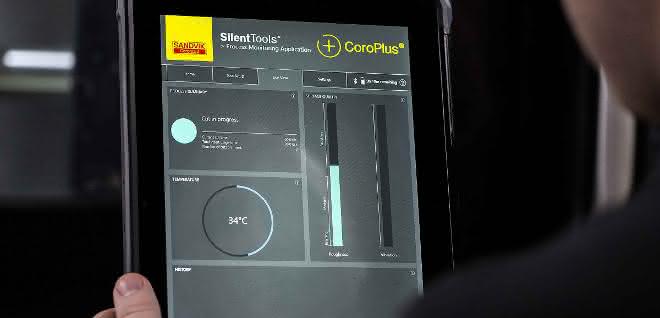
As the center height of the indexable insert can be adjusted via the display, operators can set the correct position before starting machining. The result is improved process performance, longer tool life and reduced set-up times. Because the data provided also covers other important aspects such as surface quality, the operator can adjust the settings to optimize the machining parameters.
Vibration, surface roughness, "in-cut" data (indicating whether the cutting edge is engaged or not), temperature and the center height setting are displayed as standard. The application-specific Silent Tools Plus solutions also provide information on cutting pressure and displacement. The standard range is suitable for boring bar diameters of 60, 80 or 100 mm and overhangs up to 10 × boring bar diameter. Customized solutions are available for boring bar diameters of over 100 mm and can be used up to an overhang of almost 18 × boring bar diameter.
During internal turning, the Silent Tools Plus solutions essentially act like eyes and ears inside the component - in other words, where the tool is not actually visible to anyone. This means that the operator knows exactly what is happening inside the component during machining - especially whether there are any faults compared to the specified parameters. He can make decisions based on current process data and thus increase machining reliability and productivity. The resulting opportunity, namely the acceleration of the machining process, brings benefits for manufacturing companies that need to minimize waste in terms of costs, delays and increased customer satisfaction.
Transition to the digital path
The boring bars are part of the CoroPlus product range. The networked, Industry 4.0-ready solutions enable the transition to digitally supported machining processes and were developed with the aim of supporting manufacturing companies along their digital journey.
Jens Nannen, Sales Director Digital Machining Central Europe at Sandvik Coromant / ag


You might also be interested in
Force Sensors for Precise Measurement Applications in the Automotive and Mechanical Engineering Industries
GTM introduces its K-Series force transducers for measuring tensile and compressive forces in test stands, production processes, and applications in the automotive and mechanical engineering industries.
 read more...
From sensor to intelligent system
Sensors, measurement technology and artificial intelligence are merging to form intelligent systems. From June 9 to 11, 2026, Sensor+Test in Nuremberg will showcase the most important trends in a changing industry.
read more...Dr. Volker Frey becomes CTO
On May 1, 2026, there were personnel changes in the top management of the ifm group of companies. Dr. Volker Frey succeeds Benno Kathan as CTO, who has retired.
read more...Sales growth in a turbulent market environment
Thanks to innovations and a focus on strategic industrial markets, Sick was able to moderately increase its sales in the 2025 financial year. In a turbulent market environment, the company was able to maintain its position and gain market share with...
read more...Precise sensor technology for mobile machines
Compact singleturn Hall-effect encoder with IP65
The Megatron MP1612 is a wear-free Hall effect single-turn encoder with 12-bit resolution, IP65 metal housing and extremely compact design (Ø12 mm, depth 11.5 mm). Ideal for joysticks, AGVs and agricultural machinery.
read more...New impetus for ifm sales
Two new positions were filled at ifm at the start of 2026: Markus Wolf becomes Managing Director Sales Germany, Sven Quant takes over the position of Central Managing Director in the Process Sensors division within the ifm Group.
read more...Werner von Siemens Fellows 2025
Five research talents honored
Five outstanding research talents have been honored as Werner von Siemens Fellows 2025. The Werner von Siemens Ring Foundation recognizes researchers whose work has made an exceptional contribution to the advancement of science and technology in...
read more...Biodegradable label makes transportation conditions traceable
Researchers are developing a smart, compostable label that measures temperature and humidity and detects when limit values are exceeded.
read more...Digitization of the entire value chain
At SPS 2025, ifm will be demonstrating how the digitalization of the entire value chain can be implemented in practice. In an interview, Michael Marhofer, CEO of the ifm group of companies, explains which technologies are in focus, which industry...
read more...