

Laser systems for tool measurement
Reliable measurement of tools
Laser measuring systems for tool measurement and monitoring in machining centers make a significant contribution to efficient production. A measuring system presented at EMO Hannover not only detects tool breakage and concentricity, but also records the condition of the spindle bearings and the individual cutting edges.
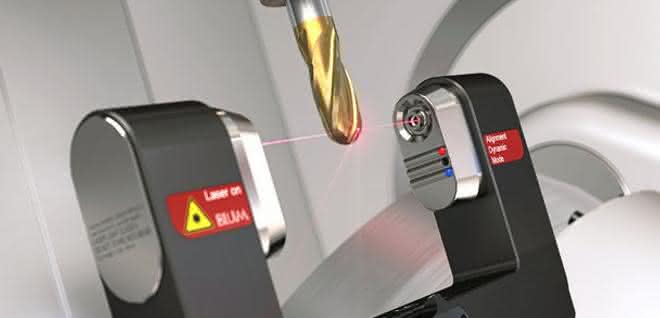
Laser systems for measuring tools have been used since the late 1980s. After the first test set-ups from 1987, the first of its kind was launched on the market by Blum in 1991 and was used for tool breakage detection. The fourth generation is now on the market and the range of functions extends beyond the detection of tool breakage.
From 2003, a microprocessor was integrated into the laser measurement system. Immediately marked with the addition NT (New Technology), the new generation was also able to carry out pulling measurements. This further reduced the influence of cooling lubricants on the measurement. This was followed in 2007 by the NT-H 3D hybrid system, which combined a laser system with a measuring probe, enabling the complete tool spectrum of turning and milling centers to be measured and monitored for the first time. Apart from internal improvements, the hardware of the laser measuring systems has practically not changed since 2007, but many new functions such as fast concentricity control or the detection of micro chipping, i.e. microscopic cutting edge chipping, have been implemented through the further development of the software.
Thousands of readings per second
With the LC50-Digilog, Blum presented the latest generation of the laser measuring system at the EMO Hannover in September last year and with it a number of innovations. Previous digital-switching laser measuring systems with NT technology generate a signal when the tool penetrates the laser beam at a certain degree of shadowing. For example, the measuring pulse is generated when the laser beam is 50 percent shadowed and transmitted to the control system to record the axis positions. Digilog laser measuring systems, on the other hand, generate many thousands of measured values per second by dynamically adapting the measuring speed according to the nominal speed of the tool. Depending on the tool and the measurement being carried out, the measuring time can be reduced by up to 60 percent, partly by eliminating the need for fine measuring sets. The "digilog" measurement also records a continuous profile of each cutting edge as it rotates through the laser beam. The laser measuring system measures each cutting edge individually instead of just determining the value for the highest cutting edge, which makes it possible to compare the shortest to the longest cutting edge. As a result, concentricity errors, for example caused by dirt on the cone of the tool holder, are also automatically detected. Another advantage of the high number of measured values per cutting edge is that the LC50-Digilog now automatically detects dirt and cooling lubricant build-up on the tool and calculates it out of the result.
The axis compensation measurement, which is repeatedly required over the course of a day, is also around 60% faster with the new technology and even more precise thanks to the integrated concentricity measurement. Another example is the wear measurement of an end mill including concentricity control - here, too, the measuring time has been reduced by over 55 percent.
More functions via software
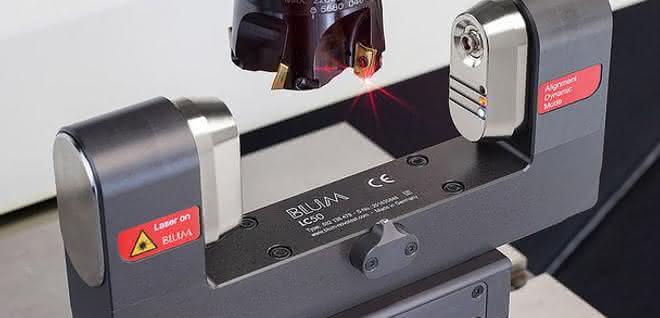
Blum not only revised the hardware, but also expanded the range of functions with the help of software. Examples include integrated concentricity control and concentricity error correction, recording of the signal curve (sine) and the elimination of outliers, as well as the measurement and visualization of tools.
Digilog cycle "3D ToolControl" enables the recording of complete tool contours, which was previously only possible with expensive image-processing systems. The associated LC-Vision visualization software allows a quick target/actual comparison and a direct assessment of the tool on the control screen. The laser measurement technology enables very large contours to be scanned.
Other new features include the "SpindleControl" and "Fast single cutting edge control" functions. With the former, the laser measuring system can record the condition of the spindle bearings and indicate bearing damage and the resulting inaccuracies in machining at an early stage. This data can also be used for preventive maintenance - a spindle can be overhauled in good time before a total failure and unplanned machine downtime occurs.
The "Fast individual cutting edge check" function, on the other hand, enables individual tool cutting edges to be monitored for chipping. The check is carried out at working speed and not at a fixed number of revolutions dependent on the number of cutting edges.
Modular system
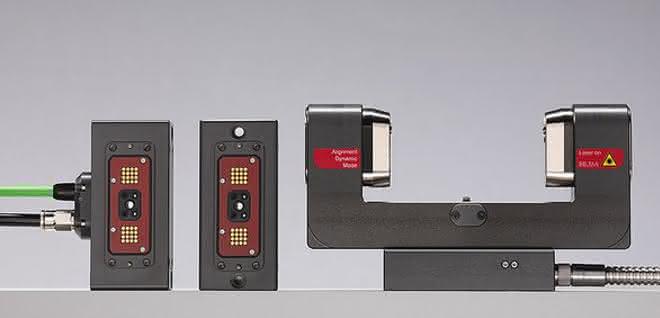
The Blum smartDock is also new. This standard interface serves as the basis for all new carrier systems and contains all the necessary pneumatic valves in addition to the electrical, mechanical and pneumatic connections between the machine and laser measuring system. This means that instead of three pneumatic lines for tool cleaning, lens sealing and sealing air, only a single armored line for air and a further line for the electrical connection are required. The separate pneumatic unit required for the LaserControl NT can even be dispensed with completely if the compressed air quality complies with ISO 8573-1 class 1.3.1. When developing the smartDock, the company placed particular emphasis on a space-saving and user-friendly design. In the event of a replacement, the laser measuring system can be replaced quickly, as there is no need for mechanical alignment using a dial gauge and it only needs to be recalibrated after replacement.
The blowing nozzle for tool cleaning has also been redeveloped from scratch. The HPC cleaning nozzle can now be mounted on both sides of the measuring system, with the shape preventing chips from accumulating on the nozzle housing. The air flow has been optimized by means of flow analysis and the cleaning pressure has been increased by 25 percent compared to the previous nozzle.
The dirt shields have also been completely redeveloped. The new shape increases the effective width of the laser measuring system, allowing up to 30 percent larger tools to be measured, depending on the version. The new shape is also advantageous when measuring tools that are clamped for a short time, as the tool holder can be positioned deeper between the system's transmitter and receiver. In addition, the dirt shields can be attached and removed without tools thanks to the bayonet lock.
Laser optics revised
The heart of a laser measuring system is the optics it contains, and these have also been adapted in the new LC50-Digilog to increase absolute accuracy. For example, the beam diameter has been reduced by 30 percent and the beam shape has been optimized, enabling greater measuring accuracy for tools with corner radii, such as ball cutters. The homogeneity of the laser beam has also been further improved, which has further reduced the influence of coolant mist, for example.
According to documents from Blum-Novotest / ag
Blum-Novotest celebrates its 50th anniversary

It all began as a one-man engineering office in 1968, when aerospace engineer Günther Blum founded an engineering office for the machine tool industry in Schmalegg. He took on contract designs for machine tool manufacturers and developed rotary transfer machines and swivel chucks, among other things.
From the 1970s onwards, the young company was also involved in electrical planning and introduced the first semiconductor-based adaptation control for machine tools. In the 1980s, the company moved into production and laser measurement technology and expanded its portfolio for machine tools. The one-man engineering office became a family business with three divisions: testing technology, measuring machines and measuring components.
At the end of the 1990s, the company took its first step into the wider world. The first subsidiaries were founded in the USA, Japan, France, Italy and the United Kingdom.
After Alexander Blum took over the operational management in 2001, the "Sales & Service Roll-out" followed; further branches were opened in Singapore, Korea, Taiwan, China and Spain, thus expanding the network across the whole world. Since 2008, the company, headquartered in Grünkraut, Baden-Württemberg, has focused on local coverage.
Branches have been established in India, Poland, Russia and Turkey, among others. The family-owned company now employs more than 550 people worldwide. For the current financial year, those responsible are also expecting turnover to grow above the normal market trend to over 80 million euros. Production capacity is also being expanded: In Grünbach, production capacity is being doubled with a new assembly building (5,500 m2), while a new 600 m2 assembly hall is also being built in Willich.


You might also be interested in
Predictive maintenance in retrofit
Predictive maintenance pays off. This is because early detection of impending failures means that systems can be serviced in a targeted manner before production downtime occurs. But how complex is it to integrate such a maintenance concept into an...
 read more...
Maintenance instead of replacement
The circular economy starts with the machinery
Sustainability in industry starts with machines, says our guest author from Deguma: How maintenance, modernization and the 5R strategy save resources, energy and CO₂.
read more...3D printing for unplanned requirements
The material fails and the machine suddenly stops? Then you need to take the right measures to be able to resume production quickly. Material failure in the form of faulty components or material wear in the frame are a risk for any production.
read more...High demands in terms of safety, application and robustness
Demanding work in the electrical trade and energy supply as well as smooth processes in production require innovative and customized measurement technology that scores points for safety, ease of use and resilience.
read more...Car meets e-bike: riding with lubrication-free polymer bearings
Studies show that the proportion of pedestrian and bicycle traffic is increasing in urban areas. With the JetBike, JetBike GmbH from Braunschweig presents a mixture of e-bike and car and relies on lubrication-free polymer bearings from Igus.
read more...Hydraulic hub for more efficient servicing
Bosch Rexroth presents a digital toolbox for service and maintenance. With a comprehensive range of digital services, the Hydraulic Hub simplifies and accelerates the service and maintenance of hydraulic products and increases machine availability.
read more...Arnold Umformtechnik expands after-sales...
Faster help with VR glasses
Arnold Umformtechnik is expanding the after-sales service for its machines to include digital remote services. The focus is on data security, simple operation and clear processes.
read more...147,000 euros per hour: high costs for German companies due to unplanned downtime
According to the "Value of Reliability" study, 67% of industrial companies in Germany experience unplanned downtime at least once a month. This costs the German economy 147,000 euros per hour. Nevertheless, reactive maintenance concepts are not...
read more...Maintenance starts with a maintenance planner
Legal requirements stipulate that machines and systems must be serviced regularly. The maintenance work serves to ensure occupational safety and economic efficiency.
read more...