

Multitasking machines
Joint multitasking
A tool that can do everything: What would it be like to pack cutting, grinding, additive laser deposition welding and laser hardening into just one machine? Okuma and Trumpf show how it can be done.
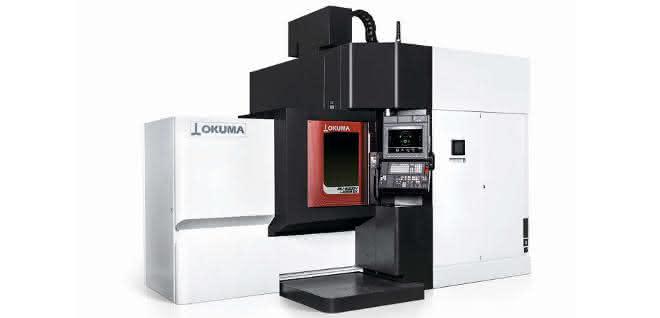
Okuma, headquartered in Oguchi, Japan, is one of the world's leading CNC machine tool manufacturers. The company specializes in so-called multitasking machines. These combine several production methods in just one machine, for example turning, milling and grinding. So far, however, only such subtractive processes. "By integrating an additive process, we would have a super multitasking machine, the likes of which have never been seen before," explains Seiei Yamamoto from Okuma.
Yamamoto has mainly focused on users in the aerospace industry, tool and mold making and manufacturers of cast and moulded parts. When it comes to complex parts in small batches, process reliability and the highest production quality are the most important factors. Okuma also saw great potential for the laser in production processes: "For example, in applications such as 3D molding, i.e. the application of protective coatings made of heat-resistant or wear-resistant alloys, such as the application of material for the repair of turbines, blisks or die-cast parts. Instead of using different machines for additional work steps, the "done-on-one" principle would be of great benefit.
But Okuma has thought further: if it is going to integrate a laser, then it should also be able to do something else. "So we had the idea of adding laser hardening to the machine to save an additional post-processing step."
The search for a partner
It quickly became clear that they did not want to reinvent the wheel. Yamamoto: "We wanted to work with a partner who had experience with additive technology and was willing to combine their expertise with our tried-and-tested machine components and our self-developed control system." The quality requirements were high, and Yamamoto also wanted to keep the trial phases as short as possible. "When I spoke to Antonio Candel-Ruiz from Trumpf, it was clear to me that we had found our partner."
The common denominator
Candel-Ruiz set to work. The surface deposition expert looks back: "It was exciting, because machining processes are fast. Can LMD, or laser metal deposition, keep up? And how can Okuma's range of requirements be covered? Filigree structures should be just as possible as wide-area deposition. And then there was hardening. There was actually only one type of laser that came into question: the disk laser."
The disk laser that was ultimately selected has a relatively high laser power of 4 kW and an extremely high beam quality, exceeding Okuma's requirements by a factor of two. Candel-Ruiz: "Now it was time for the optics. Flexibility was also required here, as Okuma understandably wanted to avoid changing the optics." In the end, an optic was chosen in which the laser spot diameter can be varied along a movement of 0.4 to 8.5 mm.

"LMD was new territory for us. That's why we were delighted with the well-coordinated laser equipment. Equally important, however, was the know-how that the Trumpf experts have in the field of additive manufacturing processes. Together, we managed to build up a lot of knowledge in a short space of time," recalls Yamamoto. The experts from both companies initially sat down together, looked at the range of parts and defined parts that could be processed using LMD. Candel-Ruiz reports on this collaboration: "Okuma built some prototype systems and we developed application examples on site. The focus was on questions regarding suitable materials and optimum geometries. Parameters such as laser power and gas quantities depending on the powder used were just as much a part of our know-how transfer as the development of suitable exposure strategies."
One for everything
The calculation worked out, and Okuma has implemented its super multitasking concept on two new types of machine: they mill, turn, grind and enable laser deposition welding as well as heat treatment of workpieces of different sizes and shapes. Yamamoto is very satisfied: "Hardening in the machine with the laser is faster and causes less deformation than the previously used inductive process. And bundling all processes on one system pays off: Noticeably reduced throughput times enable our customers to produce significantly faster than before."
More and more designers are already aware of the benefits of hybrid manufacturing processes and are incorporating the technologies into their production planning from the outset. "And we supply the right machines for this. I am sure that there will soon be parts that are produced and processed exclusively on multitasking machines," says Yamamoto.
According to documents from Trumpf and Okuma / ag


You might also be interested in
New Trade Show for the Turned Parts Industry
The Association of the German Turned Parts Industry has given a positive assessment of the first Make-to-Order (MTO) Days: With 184 exhibitors and approximately 1,400 trade visitors, the inaugural event proved to be a successful platform for...
 read more...
In-house exhibition Bielefeld 2026
How DMG Mori thinks about the factory of the future
DMG Mori will be showcasing turning and milling expertise, automation solutions and additive manufacturing along the Machining Transformation (MX) at the Bielefeld 2026 in-house exhibition.
read more...Association of the German Turned Parts...
Turned parts industry looks cautiously to the future
Rising order intake, new members, cautious optimism: the members of the Association of the German Turned Parts Industry are confident. At the spring conference in Leipzig, around 150 participants discussed current market developments, strategic...
read more...World premieres at the EMO 2025
From September 22 to 26, 2025, Grob will be presenting several innovations at EMO Hannover. The focus of the trade fair appearance will be on the latest 4- and 5-axis universal machining centers and the associated automation solutions.
read more...Efficient complete machining
Index-Werke will be bringing the Index G220 turn-mill center and the Traub TNA400 universal lathe to Intec.
read more...Digitization of process chains
CAM system Hypermill in practice
At EMO 2023, Open Mind will focus on turning, milling and the importance of CAM software and MES in networked production environments.
read more...High-speed spindle in handbag format
Modules for milling and turning
At Weiss, the focus is on the new 1.5 kilogram micro-mill spindle, which rotates at up to 60,000 revolutions per minute.
read more...Handling and workpiece clamping
Networked production starts with the component
Schunk is coming to Hanover with a 360-degree portfolio covering all aspects of machine tools. The focus will be on more sustainable production, connectivity and e-mobility.
read more...Stroll through the city
DMG Mori is inviting visitors to take a stroll through the city at EMO: In a specially constructed DMG Mori City, the machine tool manufacturer is concentrating on its focus topic of Machining Transformation (MX).
read more...