
Digitization
What automation can do today
Many companies shy away from automating and digitizing their production. Machine manufacturer DMG Mori helps its customers to overcome these obstacles and supports them in mastering new challenges.

In many places, machining is still the method of choice for manufacturing components. This explains the unbroken demand for CNC machines. Whereas in the past, large series were often produced on these machines and multi-year framework agreements between machining companies and OEMs were the standard, the trend today is often towards smaller batch sizes. Volatile markets and shorter response times are also shaping the economy. This results in changes at all company levels, especially the technical level. Industry 4.0 is probably the most popular term for these changes. The Industry 4.0 Research Advisory Board recently published "Blind Spots in the Implementation of Industry 4.0". The study focuses primarily on the obstacles for which the industry needs prompt solutions.
In their analysis, the researchers identified three categories of obstacles: a lack of impetus for digitalization, a lack of strategic capabilities and internal implementation problems. Examples of a lack of impetus could be an impending generational change or simply a lack of need to digitize. According to the study, a reluctance to digitize is also evident in sectors characterized by long-lasting capital goods: "Once procured equipment has paid for itself, there is hardly any interest on the part of companies in digital innovations to existing equipment, such as predictive maintenance or the rapid replacement of equipment with a new digitized generation. Accordingly, there are hardly any demands on machine and plant manufacturers to (subsequently) digitalize their products."
Skills shortage as a serious factor
The category of lacking strategic capabilities includes obstacles such as the unclear economic benefits of digitalization projects. For example, sufficient data must be available for the automation of production planning and control. This in turn requires sensors on machines and corresponding storage and analysis capabilities - both of which are often lacking. The shortage of skilled workers is one of the most serious factors when it comes to internal implementation problems. For the metal industry alone, a shortage of 40,700 workers was forecast a few years ago, and the trend is rising. Over the past decade, the number of female employees in the 60+ age group in the metal and electrical industry alone has risen from 85,000 to just over 300,000. The decline in the 40 to 49 age group is a further alarm signal that the shortage of skilled workers has not yet reached its peak.
In addition, improvements are not expected in the near future due to a lack of young talent. Ralf Riedemann, Director and CTO at DMG Mori, adds another obstacle to the three mentioned: "Many companies are afraid of making a static investment with automation and digitalization. Those responsible usually focus on the question of whether a purchase can really cover all requirements - today and in the future." However, this approach does not make sense. Instead, you have to ask yourself which form of automation will bring the decisive added value in the long term.
But how do companies deal with this mixture of challenges? How do they remain competitive and sufficiently flexible? How can they withstand the pressure of globalization? How can they remain resilient regardless of geopolitical developments? How do companies free themselves from dependencies such as batch sizes and a wealth of variants? Ralf Riedemann explains: "Automation and digitalization should be seen as an investment in the future and, if necessary, a partner should be brought on board. In the long term, in addition to the economic benefits, this also provides arguments for attracting young skilled workers." However, the main direct benefit for the companies is the reduction in the workload of the ageing machinists thanks to an increase in the level of automation. Another advantage is that the indispensable know-how of these employees can be kept within the company for as long as possible.
Automated production line
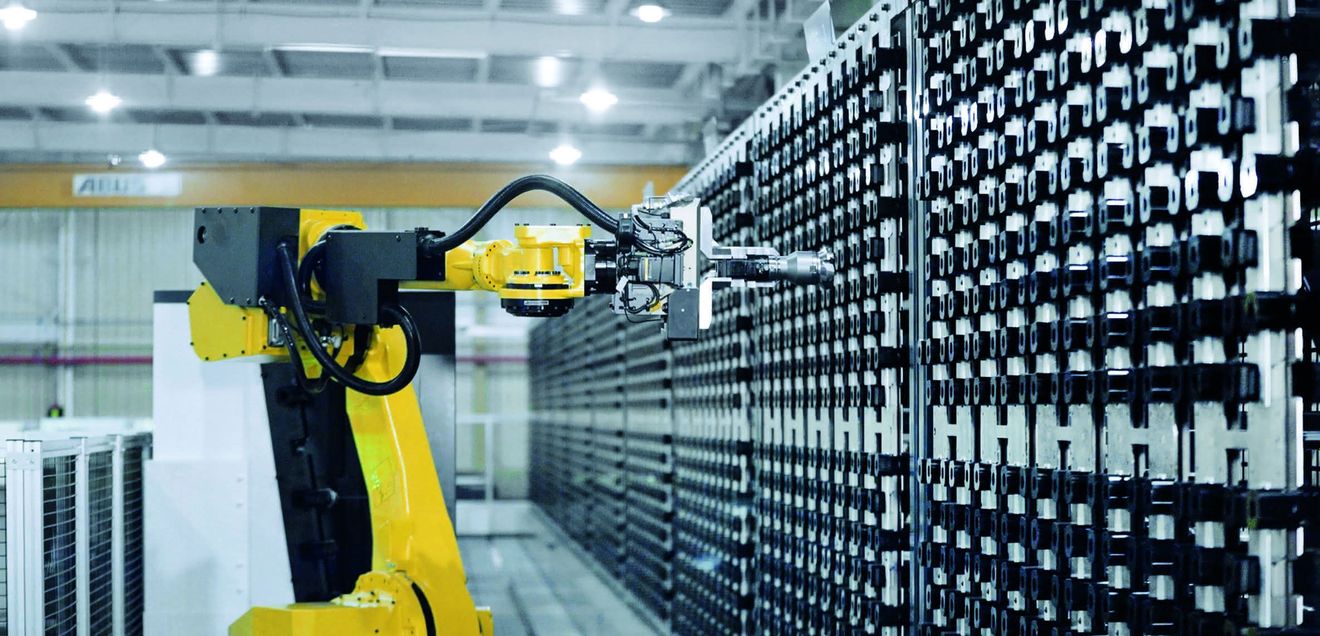
A prominent example of automated and future-oriented manufacturing is Hydac. The company, based in Sulzbach, manufactures components and systems for industrial and mobile hydraulics and also uses a highly automated production system from DMG Mori for this purpose. It is used to manufacture hydraulic components for mobile and stationary applications. The range of parts includes over 3,000 different workpieces in a wide variety of batch sizes. The highly automated cell operates six NHX 4000 horizontal machining centers via a pallet pool system. The LPS 4 host computer, which controls the entire system and manages information on orders, status and tools, among other things, offers a bidirectional interface to Hydac's ERP system. The novelty: a central tool store for up to 4,000 tools including corresponding control software from DMG Mori, connected to a cross-company tool management system of the customer. Hydac also had the same solution implemented at its plant in China and has since integrated four more NHX4000s and an additional pallet system into the plant in Sulzbach.
Traditional boundaries are transforming
Automation refers to the assumption of tasks, for example by robots or software, that were previously carried out by humans. Digitalization can be less clearly delineated and defined. Among other things, it describes the networking of machines and production systems. Digitalization and Industry 4.0 are changing production and therefore communication relationships. The previously valid boundaries of the classic automation pyramid from the field level to the corporate management level are dissolving or transforming into cyber-physical production systems. Their key attributes are efficiency, flexibility and adaptability.
"The basic prerequisite for this change and future-proof automation is always stable production processes," explains Riedemann. Consistent raw part quality, tool monitoring, chip and cooling management and repeatable clamping processes are just some of the many factors that need to be taken into account. However, he also clarifies: "When we talk about automation at DMG Mori, these are solutions that are used in addition to and as a supplement to the handling of workpieces, tools and clamping devices." For the engineer, the basic understanding includes solutions consisting of machine and automation that are scalable and can be expanded. This turns individual solutions into systems in which CNC machines, peripheral technologies and control systems are networked with each other.
DMG Mori has a network of partners to serve automation requirements of all kinds. Even today, standardized interfaces are an essential part of DMG Mori's technology development. History, interdisciplinary expertise, a large machine and automation portfolio and individual financing options make the machine tool manufacturer a partner with whom companies can overcome the obstacles outlined above and face new challenges.


You might also be interested in
Machine Tool Manufacturing Offers Hope
New orders are rising significantly again for the first time
New orders in the machine tool industry are rising significantly again for the first time. However, production, exports, and employment continue to decline.
 read more...
The bottom of the valley is no place to linger
Where the precision tool industry stands now
At the press conference of the VDMA Precision Tools Association, the precision tools industry presents the annual balance sheet for 2025: production decline, export development, shortage of raw materials and outlook for 2026.
read more...VDW forecast: production to grow again in 2026
After two weak years, the German machine tool industry expects slight production growth in 2026, driven by a recovery in domestic demand. At the same time, structural changes and international competitive pressure, particularly from China, are...
read more...German machine tool industry: incoming orders fall in the third quarter
In the third quarter of 2025, incoming orders in the German machine tool industry fell by 5%. Domestic demand in particular fell sharply, while foreign orders remained stable. Dr. Markus Heering from the VDW explains the current trends and regional...
read more...New life for old machines
"When we talk about retrofitting, for us it's about giving a machine tool a second life that lasts just as long as the first," emphasizes Ralf Glatzeder, Head of the Reman department at Liebherr-Verzahntechnik in Kempten.
read more...Industrial AI: Siemens launches data alliance for manufacturing
Siemens and several mechanical engineering partners are pooling their machine data to use generative AI for automated NC programs and adaptive manufacturing processes - the basis for a new, industry-specific AI model.
read more...Optimized machine movement
Rollon's portfolio includes linear motion solutions for machine tools with high precision, rigidity and load capacity, even under demanding operating conditions.
read more...The machine thinks for itself
Artificial intelligence is finding its way into machine tools and is not only changing production, but also the maintenance of machines. AI is becoming the control center for efficient, sustainable and competitive production. How AI is...
read more...Precision in a new size
Kern Microtechnik is presenting the Kern Fortis HD, a 5-axis machining center, at EMO. The company is also presenting a Micro HD+ designed for series production and the Femto E3 laser machining center.
read more...