
Machine Tool Manufacturing Offers Hope
New orders are rising significantly again for the first time
After three difficult years, the German machine tool industry is showing the first signs of recovery. New orders rose by 15 percent in the first quarter of 2026. However, production, exports, and employment continue to decline. At the same time, the conflict in the Middle East is causing additional uncertainty and rising costs—factors that are dampening many companies’ willingness to invest.

“We’ve likely passed the lowest point—but we’re still a long way from a clear turnaround. The coming months will show whether the recovery takes hold,” says Bernhard Geis, Head of Economics and Statistics at the German Machine Tool Builders’ Association (VDW).
A plus, with reservations
The increase in orders was driven by both domestic and international markets. Orders from Germany rose by 18 percent, while those from abroad rose by 14 percent.
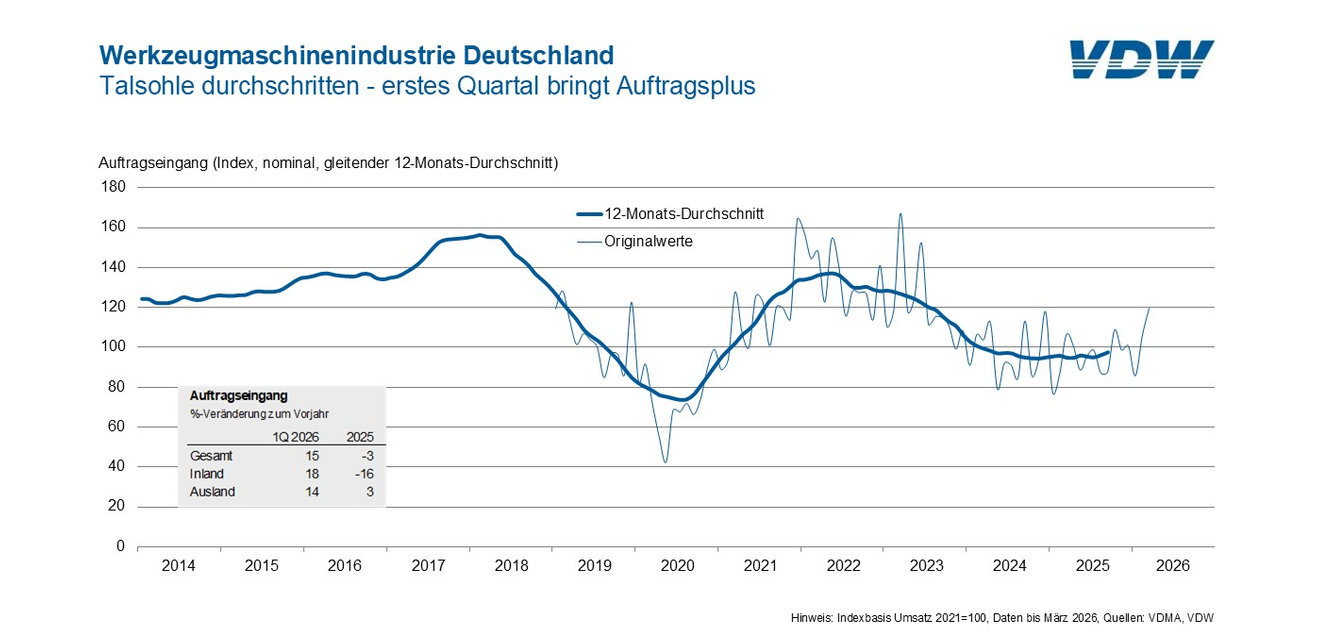
However, the figures tell only part of the story. The starting point was low, particularly in the domestic market. In addition, individual large orders and project-based business had a noticeable impact on earnings. According to the association’s assessment, therefore, there is not yet any sign of a broad-based recovery in demand.
Service and retrofit business continues to provide support. At the same time, the picture varies greatly across the individual customer sectors. While the aviation, defense, medical technology, and electronics sectors are providing momentum, the metalworking and mechanical engineering sectors—and, above all, the automotive and supplier industries—remain weak.
Production and exports continue to decline
The industry’s difficult situation is reflected in the production figures. In the first quarter, production fell by 11 percent to 2.8 billion euros. Domestic sales, which declined by 13 percent, fared worse than export sales, which fell by 10 percent.
The trend also varies by region. The U.S. remains a growth engine, with exports up 8 percent. Europe, on the other hand, saw a decline of 11 percent. The decline was even more pronounced in Asia, where exports fell by 18 percent. The main factor was the sharp drop in exports to China, which fell by 32 percent.
Against the backdrop of intensifying price competition, the “local for local” principle is becoming increasingly important for German manufacturers with their own production facilities abroad, according to the VDW. India, on the other hand, is experiencing dynamic growth and has now risen to become the industry’s third-largest market.
Weak Investment in Germany
Import figures also reflect the weak level of investment in Germany. In the first three months, imports fell by 8 percent. However, they performed slightly better than domestic sales. Japanese manufacturers, in particular, were even able to increase their sales on the German market.
Overall, domestic consumption fell by 10 percent. For the association, this is further evidence of the ongoing weakness in investment in Germany.
The Crisis Hits the Job Market
The downturn is also becoming increasingly evident in capacity utilization and employment. Production capacity utilization recently fell to 73 percent. The necessary adjustments are now clearly evident in the industry’s labor market.
In March, the German machine tool industry still employed 60,600 people, just under 9 percent fewer than a year earlier.

Despite ongoing challenges, Geis views the rise in new orders as an important sign: “The increase in orders in the first quarter is an important sign, but it’s not yet cause for celebration. A stable upward trend requires renewed confidence in investment—and more reliable economic conditions.”


You might also be interested in
The bottom of the valley is no place to linger
Where the precision tool industry stands now
At the press conference of the VDMA Precision Tools Association, the precision tools industry presents the annual balance sheet for 2025: production decline, export development, shortage of raw materials and outlook for 2026.
 read more...
VDW forecast: production to grow again in 2026
After two weak years, the German machine tool industry expects slight production growth in 2026, driven by a recovery in domestic demand. At the same time, structural changes and international competitive pressure, particularly from China, are...
read more...German machine tool industry: incoming orders fall in the third quarter
In the third quarter of 2025, incoming orders in the German machine tool industry fell by 5%. Domestic demand in particular fell sharply, while foreign orders remained stable. Dr. Markus Heering from the VDW explains the current trends and regional...
read more...New life for old machines
"When we talk about retrofitting, for us it's about giving a machine tool a second life that lasts just as long as the first," emphasizes Ralf Glatzeder, Head of the Reman department at Liebherr-Verzahntechnik in Kempten.
read more...Industrial AI: Siemens launches data alliance for manufacturing
Siemens and several mechanical engineering partners are pooling their machine data to use generative AI for automated NC programs and adaptive manufacturing processes - the basis for a new, industry-specific AI model.
read more...Optimized machine movement
Rollon's portfolio includes linear motion solutions for machine tools with high precision, rigidity and load capacity, even under demanding operating conditions.
read more...The machine thinks for itself
Artificial intelligence is finding its way into machine tools and is not only changing production, but also the maintenance of machines. AI is becoming the control center for efficient, sustainable and competitive production. How AI is...
read more...Precision in a new size
Kern Microtechnik is presenting the Kern Fortis HD, a 5-axis machining center, at EMO. The company is also presenting a Micro HD+ designed for series production and the Femto E3 laser machining center.
read more...Innovation for a strong SME sector
Small and medium-sized suppliers face tough national and international competition. These companies can achieve the required flexibility in production with digitalized manufacturing and automation solutions. Financing models and after-sales service...
read more...