
Automated mold making
Unmanned production with maximum precision
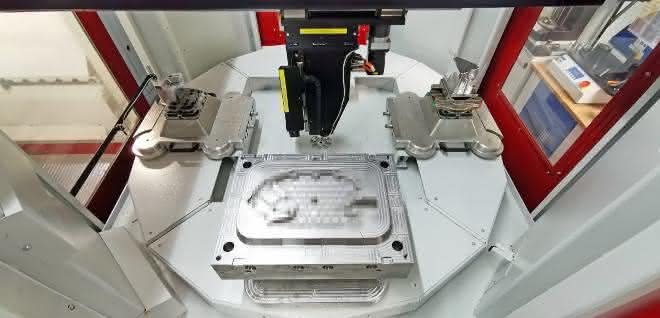
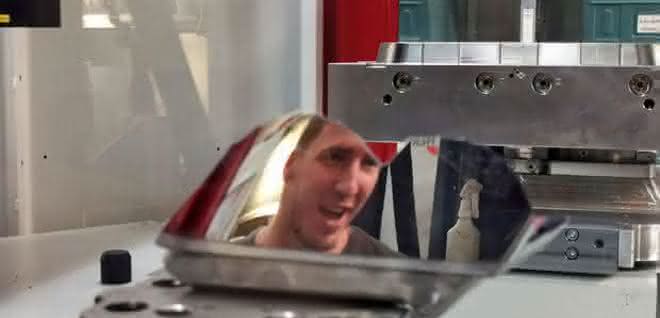
Injection molds for the production of plastic parts for high-tech industries are manufactured by Dieter Wieglemann GmbH in Olsberg-Bruchhausen. Marc Wiegelmann, owner and managing director, runs the family business founded by his father in 1980 with 40 employees and supplies customers from the aerospace and electrical engineering industries as well as manufacturers of cars, medical technology products and household appliances with sophisticated molds. Most of these are intended for large-scale production and are therefore made of steel. For prototypes or small series of up to a few 10,000 pieces, however, cheaper molds are also produced from aluminum. With the right choice of material and machining process, it is even possible to produce a mirror finish with almost no manual polishing.
"The injection molding process is complicated and follows very specific laws," explains Wiegelmann. The geometry and quality of an injection-molded component therefore do not always meet the designer's expectations straight away. In order to avoid negative surprises, a team of experienced specialists in the fields of injection molding and toolmaking is available to support customers as a development partner on request. The range of services extends from manufacturability analysis, filling simulation and warpage analysis to injection molding technology. For this purpose, the experts have a selection of powerful programs at their disposal, both on the design side (Catia V5, Cimatron and WorkNC) and for simulating the actual injection molding process (Simcon Cadmould). The main extras that can be offered to customers also include a technical center with a total of seven injection moulding machines with clamping forces of 500 to 16,000 kN.
Automated production
"We also have a particularly wide range of machinery in the area of actual tool production," says Wiegelmann. In addition to a total of six 3- and 5-axis milling centers, the company also has die-sinking EDM technology, a deep-hole drilling machine with drilling depths of up to 1,250 mm as well as polishing and spotting technology. Naturally, this also includes the necessary quality inspection equipment such as coordinate measuring machines and optical measurement using 3D camera systems. This equipment also enables fast, flexible reactions to "fire department operations". This can occur, for example, when injection molds that the user had previously purchased cheaply from the Far East are urgently reworked but do not meet the production requirements.
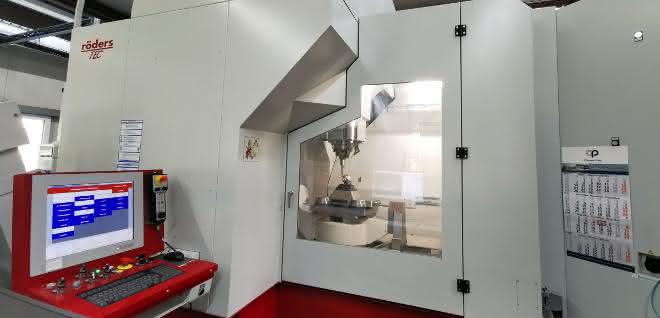
"In 2015, after several years of deliberation, we decided that we would use a different supplier for our next machining center," reveals Wiegelmann. The aim was to achieve higher workpiece qualities when milling. This seemed possible due to the progress made in the machines and tools used for milling. The new system should be suitable for roughing on the one hand, and on the other hand be able to carry out the finest finishing operations with high demands on surface quality, enabling complete machining operations in a single clamping. After a visit to the manufacturer and a test machining there, the decision was made in favor of an automated 5-axis milling machining center RXU 1001 DSH from Röders in Soltau. This also meant that the type of control used for the milling machines had to be changed.
The new production cell
"The new milling machine has an extremely rigid "Quadroguide" Z-axis with a total of 16 guide shoes on four rails arranged at the corners," says Wiegelmann. With the selected HSK63F spindle, this robust design enables high-performance roughing operations with cutter heads up to a diameter of 25 mm at a maximum speed of 30,000 rpm. Thanks to high-resolution scales and a control cycle of 32 kHz, the RXU1001 achieves accuracies in the µm range as well as the highest surface qualities and can perform even the finest finishing operations with cutter diameters down to 0.2 mm. The selected spindle is therefore a good balance between rigidity and torque for good roughing performance as well as speed and smooth running for optimum finishing results even with the smallest tools.
The new machining center is coupled with a Röders RCE2 quadruple pallet changer so that several workpieces can be stored in parallel during machining and processed unmanned, especially at night or at weekends. The cell is controlled by the Röders RMSMain job manager. The machine and its interaction with the CAM software are so good that the employee can leave the machine after set-up and pursue other tasks - a welcome advantage in times of pressing staff shortages and not inconsiderable personnel costs.
"My employees and I are completely satisfied with the new system and the support provided by the manufacturer," summarizes Wiegelmann. After all, the changeover from the previously familiar environment to Röders' own Windows-based RMS6 control system meant that the employees had to learn and operate another control system. However, the support during this changeover was just as excellent as it had been previously during the in-house consultation and test runs. Due to the ease of operation, it was no problem for the operators to work with the Röders in addition to the previous machines, according to the Managing Director. The Röders employees proved to be very competent and helpful during the training and subsequent consultation. Together with the machine delivery, changes were also necessary at the CAM level: In order to use the full performance of the machine and control, not all previous NC programs were adopted 1:1, but often newly generated. Röders provided valuable tips here, which made the conversion of the machining strategies to the possibilities of HSC machining and the familiarization of the employees much easier.
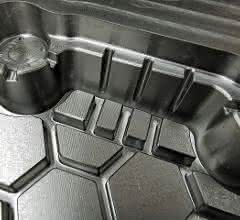
Once the programs and strategies had been changed, the new system resulted in increased productivity. It is significantly faster than its "colleagues", with this advantage becoming all the greater the more intricate the work to be carried out. The high path accuracy means significant improvements in both contour accuracy and surface quality and therefore less reworking. The Röders machine also requires significantly less power due to its linear direct drives and the resulting lack of friction, which made it possible to obtain an efficiency subsidy loan from the KfW bank. Another aspect is the very easy-to-use tool management system integrated into the Röders control system, which you can tell was written by practitioners.
Summing up, Marc Wiegelmann emphasizes that his expectations when he started using HSC milling have been fully met. The fast and precise machining of even hard steels by milling has made it possible to shift more and more machining operations from die-sinking EDM to faster and more economical milling and also to significantly reduce the amount of manual reworking required. Eroding is now usually only used where milling is not possible, for example for very deep pockets or ribs, or where sharp inner edges are required. The decision to automate the machine from the outset also proved to be the right one, as this resulted in very high productivity with the associated cost benefits.
Klaus Vollrath, freelance journalist


You might also be interested in
In-house exhibition Bielefeld 2026
How DMG Mori thinks about the factory of the future
DMG Mori will be showcasing turning and milling expertise, automation solutions and additive manufacturing along the Machining Transformation (MX) at the Bielefeld 2026 in-house exhibition.
 read more...
Up to 50 percent higher cutting speeds
The current market situation is putting pressure on companies that rely on carbide tools: Rising raw material costs, volatile supply chains and limited predictability are putting pressure on the industry. Fette Werkzeugtechnik, a member of the LMT...
read more...A robot for all occasions
Industrial robots take on many tasks. Even milling with accuracies in the sub-millimeter range is now possible.
read more...High metal removal rate for high maneuverability
Large module gears for ship drives place high demands on machining. Switching from skiving to 5-axis simultaneous milling with high-feed tools considerably shortens the roughing process. Process parameters and a well thought-out tool selection are...
read more...Schunk shows flexible systems for electronics production
Schunk Electronic Solutions will be exhibiting modular, flexible systems for electronics production at Productronica 2025 - from stand-alone depaneling systems to fully integrated inline solutions.
read more...Hydraulic 4-jaw chuck for automated workpiece clamping
HWR Spanntechnik presents a hydraulically actuated 4-jaw chuck for automated workpiece changing. The clamping device is designed to enable short set-up times, precise clamping and high productivity in automation.
read more...Corner, face and plunge milling
Paul Horn is expanding the DA milling system for corner, face and plunge milling. With the DA65 variant, the system offers a larger cutting insert compared to the existing DA62.
read more...World premieres at the EMO 2025
From September 22 to 26, 2025, Grob will be presenting several innovations at EMO Hannover. The focus of the trade fair appearance will be on the latest 4- and 5-axis universal machining centers and the associated automation solutions.
read more...Flexible and efficient processing
New high-performance CNC series
Fanuc's presentation at EMO will focus on the new FS500i-A CNC series. The new CNC generation offers high user-friendliness, process optimization as well as digital and network technologies.
read more...