

Collaborative rope balancer
Handling in the digital factory
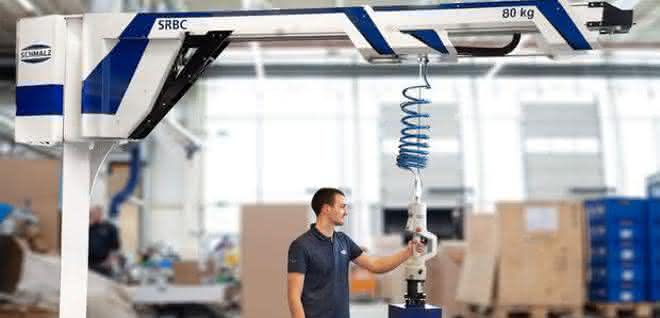
SRBC collaborative rope balancer. Digital production also has an impact on handling processes. Increasingly individualized products go hand in hand with increasing process complexity - the handling of goods must also adapt to this. Schmalz now offers the SRBC collaborative rope balancer.
With constantly changing workpieces, weights and changing pick-up and deposit stations, the demands on the operator and handling device increase: handling also changes depending on the configuration of the workpiece to be handled. At the same time, there are applications where the focus is on high dynamics, for example. Companies must therefore increasingly adapt to diverse handling scenarios. "With our lifting devices and crane systems, we offer the right solution for all scenarios," says Michael Schlaich, Head of Business Development Process Handling at Schmalz. The company's portfolio includes devices that are used, for example, when lighter loads need to be handled in high cycle rates. Intelligence is also finding its way into such devices: they record real-time data from the handling process and provide information that can be used to optimize work and service processes. For example, displays on filter status and operating hours are used for preventive maintenance, while information on whether a workpiece has been gripped directly supports the user in the work process. Data such as the number of workpieces moved is also recorded and stored by such devices for statistics and evaluation - ideally directly on the smartphone.
Rethinking manual handling
Production processes of the future are increasingly based on new systems, structures and procedures. New devices are required in order to exploit the full potential of Industry 4.0 in handling technology. Schmalz now offers the SRBC collaborative rope balancer - a new class of lifting devices that has been developed from the ground up for use in the digital production environment. "Collaborative" means here: The electric rope balancer "thinks" for the user. "The system knows exactly what it has to do in which situations," says Michael Schlaich.
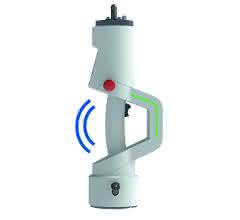
The rope balancer is always used when workpieces weighing up to 80 kilograms need to be picked dynamically or positioned precisely. Mechanical, electrical, pneumatic and vacuum load handling devices are available for handling, for example grippers for handling starter batteries. The device reacts to the movement impulses of the load carrier: three motors - in the swivel bearing, for the trolley and for the lift - help the user to move and brake loads with virtually no effort and therefore ergonomically. The operator does not have to press any buttons to lift, lower, swivel or move the load. The SRBC recognizes and supports the operator's directional request on the guide. It adheres to predefined limits when swiveling: Working ranges can be defined for each gripper, and damage caused by moving the boom too far is ruled out. Thanks to RFID-based gripper recognition, the rope balancer always knows which type of gripper is connected.
Intelligent system functions
The SRBC automatically reads out important process parameters - such as operating hours or the maximum permissible load. Software ensures that the operator can concentrate fully on the task at hand and that system operation is intuitive. The software checks whether objects may be lifted or deposited, recognizes spatial limits and adjusts the dynamics of the longitudinal movement to the weight. Depending on the application, it also performs other safety functions: For example, operators can only pick up loads with the vacuum gripper if the vacuum value is correct. It also prevents the load from falling.
The user can adjust system limits, other storage positions or handling methods directly on the handle. This allows fragile glass panes, for example, to be positioned carefully and precisely, while the component frame is quickly lifted to its installation location directly afterwards. The entire behavior of the handling system can be changed to suit the specific object with the aim of achieving simple and, above all, safe handling for the operator and component.
Part of the digital factory
Schmalz has designed the new handling system to meet the requirements of digitalization: Equipped with various sensors, it records status and performance data that can be made available in future via IO-Link and Ethercat when integrated into a digital process landscape. This enables functions such as condition monitoring and predictive maintenance to improve the overall system. The system reports any errors directly to the display in the operating handle. The semi-automated handling system improves ergonomics at the workplace and ensures a safe overall process chain. pb


You might also be interested in
Filtration and sound attenuation in circuits
In liquid or air circuits, filter housings and silencers protect measuring devices, ensure particle-free vacuum and pneumatic systems, keep cooling circuits clean and reduce noise.
 read more...
KSS ultrafine filtration for grinding oils
Modular concept for pure oil
In order to grind economically, reliably and with the highest quality, extremely clean grinding oils are required. Filter manufacturer Vomat offers the metalworking industry high-performance and customized concepts for the filtration of cooling...
read more...Up to 95 percent less flue gas thanks to direct extraction
The requirements for occupational safety measures and safety technology are also constantly increasing in welding technology. The Technical Rules for Hazardous Substances (TRGS) stipulate that welding fumes and harmful substances must be extracted...
read more...Everything accurate in switch cabinet construction
To ensure smooth work processes, tools for processing enclosures and housings must function flawlessly and reliably. Häwa rounds off its punching range with the Multi-Press 500.
read more...Cooling and temperature control units
Hygienic packaging sells safely
In few industries are the requirements for hygiene in the production process as strict as in the food sector - the health of consumers has top priority. This results in enormous challenges for all machines and components involved, especially in...
read more...Efficient and sustainable
Rotary screw compressors are the reliable backbone of industrial compressed air generation. The innovative CSD/CSDX series from Kaeser Kompressoren with its numerous features produces them efficiently and saves energy costs. This also reduces theCO2...
read more...Healthy air during welding
Welding produces fumes and gases that are hazardous to health. Extraction is necessary to comply with the occupational exposure limits and is even mandatory when welding high-alloy steels.
read more...Wire mesh filters in medical technology
In hardly any other industrial development sector are the demands placed on products as high as in medical technology. After all, human lives depend on the performance and reliable quality of medical devices.
read more...Energy efficiency and sustainability in the smallest of spaces
With the StingR ultra-fine filter system, Lehmann-UMT has created a solution for the energy-efficient and precise treatment of fluids during tool grinding for extended tool life and high tool quality.
read more...