

Presses
System technology for fuel cells
Together with its partners, Schuler supplies the presses, dies and complete automation for the production of bipolar plates as required in fuel cells for electric vehicles.
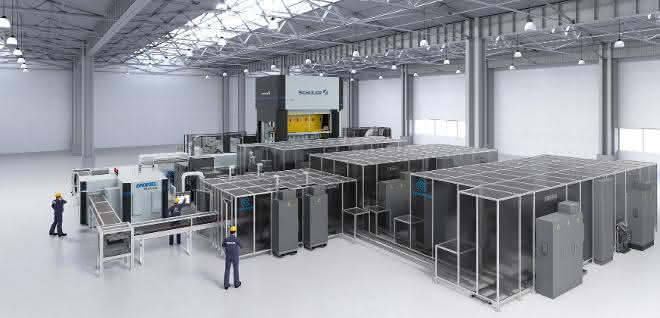
Fuel cells are used in hydrogen-powered vehicles, in the construction industry, in the future also in the aircraft industry or as electrolyzers for hydrogen production in the steel industry - to name just a few applications. The automotive market potentially accounts for a large share of this. Hydrogen is also suitable as a storage option for energy generated from renewable sources with large fluctuations. It is therefore no wonder that, according to a study by McKinsey, more than 30 governments have announced hydrogen strategies. In addition to Europe, the study sees China as the main market for hydrogen-powered vehicles, as well as Japan, Korea and North America.
Press manufacturer Schuler has now signed a cooperation agreement with Thyssenkrupp Automation Engineering - as part of Thyssenkrupp System Engineering - and Andritz Soutec to jointly offer the complete process chain for the production of fuel cells. Schuler will supply servomechanically or conventionally driven knuckle-joint presses from the Triton series as well as automation and dies for manufacturing the bipolar plates that make up a fuel cell, among other things. Sister company Andritz Soutec will supply laser welding systems for gas-tight welding of the bipolar plates and Thyssenkrupp the technology for seal application and component transport.
The systems for bipolar plate production are scalable and designed for a capacity of up to 50,000 fuel cells per year with an output of around one bipolar plate per second. Each fuel cell - also referred to as a "stack" - is fitted with 300 to 400 bipolar plates. The anode side is responsible for the hydrogen supply, while the cathode side supplies the air. They form the basic mechanical structure of the fuel cell, regulate the electrical series connection and ensure separation of the cells and thus the membrane electrode assemblies (MEA) as well as the gas diffusion layer and its cooling.
Produce anode and cathode in one stroke
The first process step of the production line is the forming technology for stamping and trimming bipolar plate halves made of 70 to 100 µm thick stainless steel sheet. Schuler offers mechanical and servomechanical knuckle-joint presses with press forces of up to 2,500 tons for this purpose. The innovative Intratrans transfer system enables the simultaneous production of both bipolar plate halves - anode and cathode - in one press stroke. Material is fed from both sides of the press and transported through the individual die stations to the center of the press. There, the plate halves can be brought together and pre-joined using a spot welding process so that both halves are fixed to each other.
In the following process step, the bipolar plates are precisely welded gas-tight using remote laser welding. Andritz Soutec offers continuously operating laser welding systems for this purpose. Several laser beam sources working in parallel weld the bipolar plates. A subsequent leak test of the bipolar plates guarantees consistent quality. A seal is then applied with high precision to both sides of the bipolar plates in systems from thyssenkrupp Automation Engineering, dried and visually checked for correct quality. In addition to an innovative system for transporting the bipolar plates between the plant sections, thyssenkrupp offers systems for producing the MEA (membrane electrode assembly) and for stacking the MEA and bipolar plates to form the final fuel cell stack, including testing technology. In addition, a comprehensive track & trace system enables the traceability of the individual bipolar plates, starting from the coil material, as well as all other production data of a fuel cell assembly.


You might also be interested in
Gateway with improved fault diagnosis
Schmersal is launching a new version of the SD gateway for its SD bus. According to the group, users benefit in particular from the improved fault diagnostics that the new SDG Fieldbus Gateway enables.
 read more...
AI trends for engineers: where is the journey heading?
According to Gartner, companies that have adopted AI engineering practices have a competitive advantage: by 2026, they could outperform their competitors by around 25 percent in terms of the number and time required to operationalize AI models....
read more...Industrial-grade version of the Raspberry Pi
"The more performance, the more use cases"
The new version 4 of the open source IPC "Revolution Pi" (RevPi) from Kunbus is set to be launched as an industrial-grade version of the Raspberry Pi in mid-2023.
read more...Digital assistance systems make manual production easier
Increasing productivity in the face of a shortage of skilled workers and a growing number of product variants is a challenge for many medium-sized industrial companies. Software-based assistance systems such as elution two assembly from Elabo offer...
read more...Platform for hydrogen and fuel cells
Around 500 companies presented their solutions for the production, transportation, infrastructure, storage, refuelling and consumption of hydrogen at the Hannover Messe.
read more..."Using DC technology consistently"
The DC-Industrie2 project recently came to an end and the follow-up project, ODCA, has been launched. In an interview with Andrea Gillhuber, Dr. Hartwig Stammberger and Dr. Jan Stefan Michels spoke about the potential of DC technology and its...
read more...Artificial intelligence in Germany
AI arrives in the industry
At the start of the Hannover Messe, Microsoft's Head of Germany Marianne Janik called for greater use of artificial intelligence (AI) in Germany.
read more...Feinmess Suhl at the Control 2023
High-precision testing equipment and monitoring systems
At the Control international trade fair for quality assurance, Feinmess Suhl will be presenting innovations in the field of test equipment for product measurement and systems for test equipment monitoring.
read more...Continuously developing innovations
In the run-up to the Hannover Messe, Andreas Mühlbauer spoke to Oliver Winzenried, CEO of Wibu-Systems, about the innovations the company is presenting in Hannover and the technological trends at the trade fair.
read more...