

Servo press
Smooth communication
Automating the loading and unloading of machines increases efficiency in production - especially if the subsequent manual visual inspection is also carried out automatically. AI-pro develops individual solutions for this and adds robots and artificial intelligence to machines such as the servo press from Tox Pressotechnik.
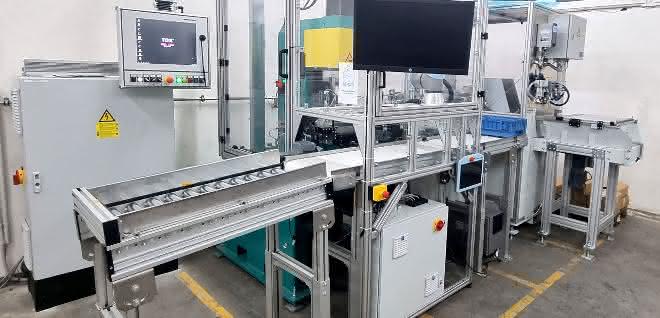
The greatest potential lies in small products, high quantities and short cycle times," says Pascal Lettmann, Managing Director and founder of AI-pro. In an industrial environment, he often observes workers inserting and removing individual parts from machines in short cycle times. This is monotonous work that is relatively easy to automate - unlike the downstream manual visual inspection. "From a technological point of view, it is difficult to have rule-based camera systems take over the operator's inspection when removing parts, and this is often associated with high costs," explains Lettmann. This is because the system quickly reaches its limits, for example in fluctuating lighting conditions or geometric deviations. In addition, such camera systems have to be operated by specially trained employees, which shifts the effort and responsibility for detecting faulty products onto the user.
This is precisely where AI-pro comes in, offering visual inspection including automation from a single source. "We limit ourselves to straightforward processes such as the insertion and removal of small components in machines with short cycle times and supplement these with reliable inspection technology including programming," explains the company founder. The special feature: the start-up from Stemwede in North Rhine-Westphalia buys the system to be automated and adds the necessary handling, control and testing technology. "Our customers don't have to deal with setting up the test programs or communication problems between the robot and the machine," says Lettmann, listing the advantages.
A current project shows what this looks like in practice: a customer wanted to replace manually operated hydraulic presses for upsetting ball sleeves and automate the process as part of this. The machines previously used had no sensors to detect faulty parts, the sleeves kept getting stuck in the tool after pressing and the maintenance costs for the hydraulics were also too high.
Stability and control
For the actual work process, AI-pro was looking for a stable press with a servo drive that enables a short cycle time, measures the press-in depth X and thus monitors the process. As soon as the X value is exceeded or not reached, the system should detect the faulty part and eject it. After extensive research, Lettmann opted for a C-frame press from Tox Pressotechnik. Lettmann had already had good experiences with the Weingarten-based family business in the past. "The comprehensive advice I received in advance and the standard modular system on offer reinforced my decision to buy the press from Tox," adds Lettmann.
The drive is provided by the Tox-ElectricDrive type EX-K. A planetary roller screw precisely converts the rotational movement into a linear feed that presses the tool into the component with up to 200 kilonewtons. It is installed in a solid and torsion-resistant steel construction that provides sufficient stability to withstand the force applied during the pressing process. As soon as a ball sleeve is seated in the tool, the drive lowers the ram. The distance required for the force-displacement protocol is recorded by a resolver directly on the servo drive, while an integrated force gauge contributes the pressing force applied. The Tox software thus monitors the control value X and can immediately detect any faulty parts.
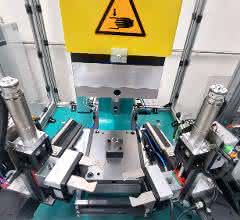
AI-pro added two linear-guided grippers to the Tox servo press, which alternately insert a component into the tool, fix it in place after pressing and before the punch moves up again and then remove it. They then hold the component in front of the lightweight robot again, which picks it up from the inside and passes it on. Thanks to the alternating operation of the two feed units, AI-pro significantly reduces non-productive times. "The robot takes the finished component alternately from one unit or the other," explains Lettmann. After further processing, seven cameras and a micrometer check the finished ball sleeve optically and geometrically.
Neural networks
AI-pro uses neural networks for this: "They enable our inspection system to reliably detect grooves, scores and chatter marks - even on reflective surfaces. It is also possible to check certain features or alignment," explains Lettmann. This works via classifications, finding similarities at pixel level and is only possible for AI-based visual inspection thanks to the availability of the corresponding computing power, which also makes sense from a cost perspective. AI-pro selects all components individually: from the camera and lighting to the feeder and the algorithm for the visual inspection. "In the end, the customer basically just has to press a button," says Pascal Lettmann.
No problems at the interface
Communication between the robot and the press takes place via the higher-level control system using Profinet. The pressing process itself is initially configured via the Tox HMI once or when changing parts, and maintenance is also carried out directly via the Tox panel. The AI-pro automation then provides the start and stop signal and also reacts to fluctuations in the process. "Our system simply picks up the data from the Tox software and sends it to the PLC," explains Lettmann. In this way, the robot also queries the last measured values for quality control and knows whether it needs to place the finished component in the in-order or out-of-order box. In addition, AI-pro can send this process data, for example about good and bad parts, to its AI computer, which then saves this data in an SQL database. "Normally, data exchange from the PLC to higher-level control systems such as ERPs is relatively difficult. However, our computer speaks precisely these languages," explains Lettmann.
The signal exchange between the press, robot and the rest of the automation runs smoothly. One reason for this is the good communication in advance: "Tox Pressotechnik advised us on the options for communication with the press and provided us with the complete documentation for this very early on in the project. We therefore had no interface problems at all," confirms Lettmann.


You might also be interested in
ebm-papst is growing again thanks to AI and data centers
ebm-papst returned to a growth trajectory in fiscal year 2025/26. Air Technology, data center applications, and artificial intelligence are driving revenue and investment.
 read more...
SPE on the Verge of a Market Breakthrough
Single Pair Ethernet (SPE) has moved beyond the conceptual phase and is increasingly being implemented in industrial settings. The focus here is not only on higher data rates and simplified cabling, but above all on the issue of system integration...
read more...More than 900 exhibitors already registered
Around six months before the start of the trade fair, more than 900 companies have registered for SPS 2026 in Nuremberg. The trade fair focuses on industrial AI, cyber security and digital transformation.
read more...Virtual PLCs in practice: How vPLCs make production systems more flexible and scalable
The increasing networking of IT and OT is fundamentally changing industrial automation. The IT/OT Integration Summit shows how modern technologies can make production environments more efficient, flexible and future-proof. The event will focus on...
read more...Sales growth in a turbulent market environment
Thanks to innovations and a focus on strategic industrial markets, Sick was able to moderately increase its sales in the 2025 financial year. In a turbulent market environment, the company was able to maintain its position and gain market share with...
read more...Siemens presents new AI agent
Siemens is launching 'Eigen Engineering Agent', an AI for automation technology. The solution is integrated into the TIA Portal, has been tested with over 100 companies and is designed to significantly accelerate engineering processes.
read more...Schaeffler keeps sales almost stable
Schaeffler generated revenue of EUR 23.5 billion in 2025 and increased EBIT before special items to EUR 936 million. At 266 million euros, free cash flow was significantly above the prior year and forecast. Net income remained negative due to high...
read more...Advancing artificial intelligence together
Helukabel is stepping up its activities in the field of artificial intelligence and is now a member of the IPAI. The innovation and collaboration platform for companies, research facilities, institutions and administration has set itself the goal of...
read more...New impetus for ifm sales
Two new positions were filled at ifm at the start of 2026: Markus Wolf becomes Managing Director Sales Germany, Sven Quant takes over the position of Central Managing Director in the Process Sensors division within the ifm Group.
read more...