
Press plant optimization and servo presses
The networked pressing plant
Schuler presented its newly developed MSP 400 servo press to a wide audience for the first time at Euroblech. The 400-ton press will be followed by servo presses with press forces of up to 12,500 kN. The focus of their development was on networking.
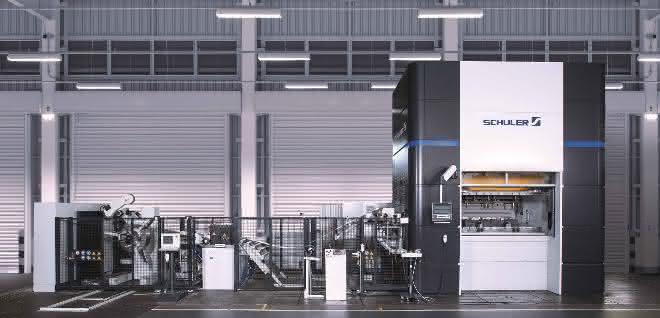
Increasing efficiency and effectiveness in production and making yourself fit for the future at the same time: This is the challenge currently facing all automotive manufacturers, suppliers and other press shop operators. Schuler offers a possible solution with the fully networked MSP 400 servo press. The 400-ton press, which is suitable for both progressive die and transfer operation, can perform up to 70 strokes per minute in a pendulum stroke. It could be seen live for the first time at Euroblech. Schuler's experts needed three weeks to set up and commission the MSP 400 in Hall 27 at the Deutsche Messe exhibition center in Hanover. After the trade fair, it will be sent to an automotive supplier in Saxony.
In the run-up to the trade fair, the company announced that the MSP 400 will not be the only servo press, but that the series will be expanded further: The MSP 800 with a press force of 8,000 kN is already available, the MSP 1000 with 10,000 kN press force and the MSP 1250 (12,500 kN press force) are about to be launched.
Schuler has designed the control of the servo press in the style of an intuitive smartphone app: Operators can choose from predefined movement curves as well as program them freely. Due to the kinematics of the knuckle-joint drive, forming at the lower reversal point is also slower by itself, so readjustment by the servo drive is not absolutely necessary.
Intuitive control with integrated process monitor
The "Smart Assist" software guides the operator step by step through the set-up process, supported by short videos and text modules. The electronic assistant optimizes the transfer and ram curves for maximum output depending on the clearance curves - a complex process that used to take a lot of time.
The process monitor integrated into the control system offers comprehensive monitoring options. In this way, overload protection is guaranteed over the entire press force curve and the entire movement curve; a minimum and maximum force can be defined to effectively protect the tool. The reaction times of the electronic overload protection are in the range of a few milliseconds, i.e. faster than with hydraulic overload protection. The press can be used again immediately after an overload is detected.
Low mass moments of inertia in the drive train enable short stopping distances and reaction times. While standard presses generally reduce the force in the event of an overload and continue to move the ram through the lower reversal point to the upper reversal point, according to the company, the MSP 400 has a "Smart Release" function: Here, the ram automatically moves back a defined distance after an overload is detected, thus relieving the tool and press.
Comprehensive condition monitoring
The integration of additional sensors - for acceleration, vibration or pressure, for example - enables comprehensive condition monitoring of the system, which can be displayed in the visualization of the control system. This is based on frequency spectra, which provide information about possible wear in the gearbox, bearing or motor. This prevents unplanned downtime and increases the productivity of the system. In addition, the process and status data allow for comprehensive quality control of the components produced.
Unlike a conventional press, the pressure points on the MSP 400 are not located above the ram, but outside the actual table area. This allows the machine to absorb very high eccentric loads, and around 25 percent more press force is available on both the infeed and outfeed sides, according to the company. In this way, even high-strength materials can be formed in the first tool stage.
The geometric arrangement also results in a high mechanical tilting rigidity of the plunger. In addition, the spring deflection of the overall system is reduced because the drive is located far out in the head piece. This means that forming is gentle on the tool and higher component quality can be achieved. The electronic coupling enables force-independent parallel control: in the event of an off-center load, the drives are only readjusted on one side without any loss of force, and the ram is thus kept parallel.
Virtual press shop planning
Press shops also have to adapt to today's market requirements. It is now important to meet the required flexibility - short-term orders and decreasing batch sizes - and not at the expense of profitability. In order to sustainably increase efficiency in the press shop, there is no way around holistic optimization, including the entire material flow. Optimizing the presses is of course an important field of action. The "Overall Equipment Effectiveness" (OEE) can be determined by examining availability, efficiency and quality. By increasing the OEE using a wide range of measures, existing potential can be exploited and productivity increased.
One measure is software support. With the help of software tools, die and production parameters can be digitally optimized and the movement curves of the slide and transfer can be adapted to the respective die in order to fully exploit the possibilities of the presses. An increase in the number of strokes or a reduction in set-up time frees up a large number of production hours over the course of a year. With this additional time, more parts can be produced with the same equipment, batch sizes can be reduced or the time gained can be used for preventive maintenance. This reduces unplanned downtime and increases availability and delivery capacity.
Identifying optimization potential through a holistic approach
A holistic view of the press shop shows, for example, that frequent set-up reduces profitability. This is because the greater the number of variants and the larger the batches, the greater the storage volume and therefore the capital commitment. In order to reduce batch sizes, internal set-up must be shortened. Improved methodology and preparation, as well as appropriate employee qualifications, often offer enormous potential in set-up. It is just as important to store the tools in a well-maintained condition in order to be able to react flexibly to short-term changes in the production plan.
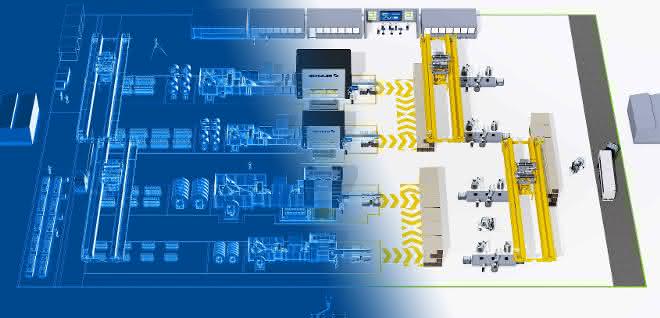
Together with the lean management consultancy Staufen, Schuler, as a system manufacturer and process consultant, offers an analysis of the press shop. The basis is the so-called Quick Check, which makes the individual performance visible. The analysis includes the complete value stream mapping of the material flow from incoming goods to outgoing goods and provides individual recommendations for action to increase efficiency. In addition, new ideal or real layouts of the pressing plant can be developed on the basis of the actual and target value stream, both for a new pressing plant (greenfield) and for existing production halls (brownfield). The order behaviour of internal and external customers is crucial for optimization. Ideally, the pressing plant should produce in line with customer cycles and be able to react flexibly to fluctuations in demand even without large inventories. If successive stations work in the same cycle as far as possible, no large stocks build up and the throughput time remains short.
A sustainable increase in efficiency always takes priority over short-term one-off effects. There is often great potential not only in production, but also in administrative areas such as production planning and control as well as container and store floor management. In the latter, managers are not only required to maintain regular communication, but also to manage with key figures and control the processes.
According to documents from Schuler / ag


You might also be interested in
Predictive maintenance in retrofit
Predictive maintenance pays off. This is because early detection of impending failures means that systems can be serviced in a targeted manner before production downtime occurs. But how complex is it to integrate such a maintenance concept into an...
 read more...
Maintenance instead of replacement
The circular economy starts with the machinery
Sustainability in industry starts with machines, says our guest author from Deguma: How maintenance, modernization and the 5R strategy save resources, energy and CO₂.
read more...3D printing for unplanned requirements
The material fails and the machine suddenly stops? Then you need to take the right measures to be able to resume production quickly. Material failure in the form of faulty components or material wear in the frame are a risk for any production.
read more...High demands in terms of safety, application and robustness
Demanding work in the electrical trade and energy supply as well as smooth processes in production require innovative and customized measurement technology that scores points for safety, ease of use and resilience.
read more...Car meets e-bike: riding with lubrication-free polymer bearings
Studies show that the proportion of pedestrian and bicycle traffic is increasing in urban areas. With the JetBike, JetBike GmbH from Braunschweig presents a mixture of e-bike and car and relies on lubrication-free polymer bearings from Igus.
read more...Hydraulic hub for more efficient servicing
Bosch Rexroth presents a digital toolbox for service and maintenance. With a comprehensive range of digital services, the Hydraulic Hub simplifies and accelerates the service and maintenance of hydraulic products and increases machine availability.
read more...Arnold Umformtechnik expands after-sales...
Faster help with VR glasses
Arnold Umformtechnik is expanding the after-sales service for its machines to include digital remote services. The focus is on data security, simple operation and clear processes.
read more...147,000 euros per hour: high costs for German companies due to unplanned downtime
According to the "Value of Reliability" study, 67% of industrial companies in Germany experience unplanned downtime at least once a month. This costs the German economy 147,000 euros per hour. Nevertheless, reactive maintenance concepts are not...
read more...Maintenance starts with a maintenance planner
Legal requirements stipulate that machines and systems must be serviced regularly. The maintenance work serves to ensure occupational safety and economic efficiency.
read more...