
Nesting processes
Nesting in sheet metal processing
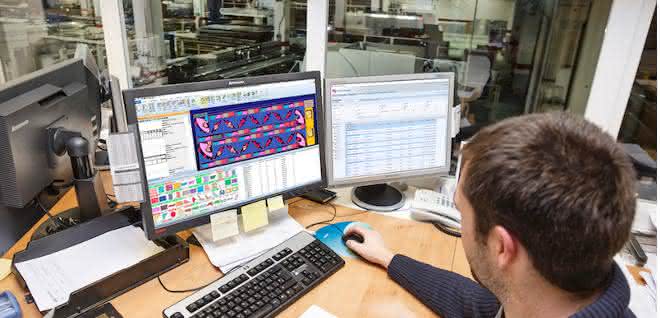
Lantek and the Basque Center for Applied Mathematics, or BCAM for short, have signed a cooperation agreement. Together, they want to investigate the calculation of the nesting of parts on the sheet metal and develop new applied mathematical models and algorithms.
The requirements in sheet metal processing are also becoming increasingly complex. This also includes the optimum arrangement of 2D cut parts on a sheet in order to reduce metal scrap to a minimum. Solutions are therefore required that allow machine capacities to be utilized to the maximum, even if the calculation of the machining processes and the optimization of material consumption are extremely complicated.
First step: New procedures for nesting
In the first phase of the project, new methods for the nesting itself are to be found. To this end, researchers from BCAM's Computational Mathematics department are contributing their expertise in geometric modelling and optimization. Four goals have been defined in this first phase: the development of an efficient algorithm for the 2D nesting of metal parts, the design of discrete boundary measurements based on the juxtaposition of local shapes, the improvement of the current method, which maps the surfaces (pixels) themselves via the representation of the boundary, and the development of software that enables both the calculation time to be shortened and the material utilization to be optimized. The focus of the methods currently used is on improving the geometric representation of objects and optimizing local solutions between the corner points of different parts.
According to the project participants, the biggest challenge from a mathematical and computational point of view is to find precise solutions while keeping the grid as small as possible in order to simplify the algorithm and avoid excessive computing times.
Doctoral student wanted
Another point of the agreement concluded is the announcement of an international study place for a doctoral student. He or she will work with Lantek researchers to investigate the various approaches and determine which algorithm options are the best in terms of their applicability and the results of the concept studies. At the end of the four-year project, a doctoral thesis will be published.
According to documents from Lantek / ag


You might also be interested in
Sustainability Through Simulation
Digital material selection reduces CO2 emissions by 40 percent
The use of digital material simulations can significantly reduce CO₂ emissions during the development and manufacturing of components. A real-world project by Schunk and Cadfem demonstrates how data-driven material selection can yield savings of up...
 read more...
From ERP System to AI Platform
RNA, based in Aachen, manufactures up to 2,000 custom-designed feeding systems annually and handles all order processing through a central ERP platform.
read more...Cybus Brings in Siemens Executive Stefan Schwab to Lead the Company
The Hamburg-based software provider Cybus will have a dual leadership structure going forward: Stefan Schwab will join co-founder Peter Sorowka as co-CEO.
read more...Artificial Intelligence for the Physical Space
Alibaba Expands Qwen Model Family with a Robotics Suite for Physical AI
Alibaba is expanding its Qwen model family with a robotics suite for Physical AI. The three models—for manipulation, navigation, and simulation—are designed to assist autonomous robots with complex tasks in real-world environments.
read more...5 Challenges for AI Projects in Manufacturing
Manufacturing companies have high hopes for AI. IFS highlights the five most common reasons why AI projects fail.
read more...Implementing Manufacturing Software: 5 Practical Tips
To remain competitive in the market in the future, more and more companies are considering digitizing their CNC manufacturing processes. The right software solutions can make process knowledge transparently accessible and significantly reduce the...
read more...AI automation specialist reorganizes...
Generation change at Insiders Technologies
After almost 30 years at the helm, Werner Weiss is handing over the management of Insiders Technologies. Andree Albrecht takes over the management after a transition phase.
read more...Intelligent brownfield networking
Many industrial companies are struggling with established plant structures and proprietary interfaces. Stefan Klaus' presentation will show in a practical way how brownfield environments can be efficiently networked with open technologies and made...
read more...Factory-X in practice
How can set-up processes in highly variant production be automated efficiently? Markus Benndorff from soffico shows how Factory-X, industrial data rooms and modular architectures create new possibilities for flexible production concepts.
read more...