
Interview with Bystronic CEO Alex Waser
"Service means proximity to the customer"
Flexible systems are crucial for modern production processes. Bystronic CEO Alex Waser explains where integrated automation and new software solutions for laser cutting and bending are leading.
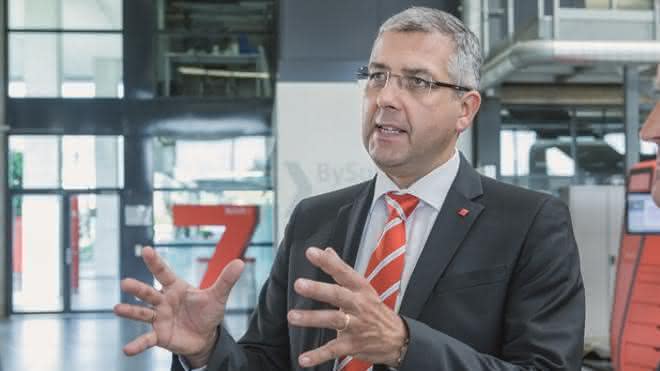
SCOPE: Mr. Waser, what do you think are currently the most interesting technology trends in sheet metal processing?
Alex Waser: The integration of automation solutions and digital networking into the user's process steps. And this is combined with impulses from Industry 4.0. I'm thinking of modular material handling solutions for laser cutting. Compact systems that grow in line with customer requirements and increasing laser power.
When it comes to bending, I am thinking of flexible automation systems that enable rapid switching between automated and manual production. All these systems can be integrated into a transparent and maximally optimized production flow using the possibilities of digital networking. They are controlled by powerful software solutions that are easy to operate.
SCOPE: What are these trends changing for users?
Waser: Digital solutions and automation are helping users to make fluctuating order situations producible on flexible systems. They also create more transparency in the production process. With software solutions such as the MES from Bystronic, users will be able to create quotations more quickly in future, plan their production efficiently and make the best possible use of their resources. Live monitoring systems such as our ByCockpit app are an additional component. They provide users with real-time information from their production during ongoing production. All of this leads to cost and process optimization. And these in turn are the prerequisites for sustainable competitive success.
SCOPE: What role will service play in the sheet metal processing of tomorrow?
Waser: Behind optimized process solutions, you still need a reliable partner with a comprehensive range of services. Service means proximity to the customer, proximity to their needs and challenges. The best processes are of no use to customers without the corresponding know-how of technology experts, trained service technicians and well-networked infrastructures. Bystronic will therefore continue to focus on consulting and training services in our modern training centers with the latest equipment. And, if required, we can also train our customers on site.
SCOPE: To what extent will the possibilities of digitalization change the service offering of the future?
Waser: Customers already have the opportunity to access digital service solutions today. In future, these services will support customers' process steps even more profoundly than before. And they expand the range of services offered by the integrated machine systems. Depending on the configuration, this will lead to more versatile or faster processes. The topic of predictive maintenance will also continue to develop. With the possibilities of digitalization, we are bringing intelligent functions to the service offering. This provides customers with information about the condition of their systems and the service life of components that are susceptible to wear. This allows them to schedule maintenance at an early stage. Bystronic is then quickly on site with the right spare parts.


You might also be interested in
CU-Flex copper processing center
Process copper in three stations
Boschert also presented the revised CU-Flex copper processing center with its three stations for punching, bending and shearing in Hanover. This allows users to completely manufacture copper parts in just one work process.
 read more...
Unlocking hidden CAD data potential
With the new version of the Classmate software suite, Simus has increased the user-friendliness and effectiveness of the modules. From structuring and cleansing databases to synchronization with SAP, the tools provide sustainable benefits in design,...
read more...Resource-saving bending as a competitive factor
Resource-saving, user-friendly and highly efficient - Schwarze-Robitec, the tube bending machine manufacturer, combines these advantages in an all-electric multi-radius tube bending machine with a newly developed cutting system.
read more...Sheet metal knowledge at the touch of a button
Optimate, a start-up spun off from Trumpf, wants to give sheet metal processing more process reliability in production. The key to this is a cloud-based web app solution for the analysis and optimization of sheet metal components.
read more...Speaking the same language
Tables have a long tradition in work planning. In the search for empirical values, work planners spend valuable time on values that are inaccurate and not very reliable in production practice.
read more...Precise and efficient bending technology
MicroStep Europe offers press brakes that are characterized in particular by numerous sensor-controlled assistance systems. These reduce the demands on the operator's specialist knowledge and also ensure the highest quality bending results in a...
read more...Fully automatic folding
The well-known Austrian window manufacturer G.S. Georg Stemeseder now also offers sun protection products. The Schröder Group has enabled an unprecedented level of automation for the new production.
read more...Prepared for increasing demand
In the first half of 2021, Stauff, a manufacturer of components for hydraulic piping systems, commissioned a new Riello rotary transfer machine.
read more...Networked pipe technology
Transfluid is coming to Blechexpo with a wide range of innovations. In addition to new system technology, the focus will be on networking.
read more...