

Quality control for hot forming
Forming with quality
Hot-formed body parts are significantly stiffer than traditionally manufactured parts and yet over 20 percent lighter. This helps to reduceCO2 emissions from vehicles. Automotive supplier Gestamp relies on an optical solution from Zeiss for quality assurance and production optimization. By Syra Thiel
The Spanish automotive supplier Gestamp produces more than 230 different "body-in-white parts" in Louny in the border region between Germany and the Czech Republic. Every year, the 560 employees at the state-of-the-art site produce over ten million body parts - partly because the company has mastered the supreme discipline of hot forming - tailored tempering.
In this process, sheets of different thicknesses and even different materials are formed into a complex part in a single operation. This means that different strength requirements, such as high-strength areas and crumple zones, can be implemented within a single component. Fernández Landa, Senior Engineer for Process Control Systems and Quality at Gestamp, mentions another advantage: "With hot stamping, we form components in a single operation that would otherwise have to be assembled from several parts." The so-called blanks are heated to 900 °C in a continuous oven. At the end of the oven, a robot picks up the red-hot sheets and places them in the press, which forms the material at around 750 °C. All this happens in just a few seconds, which leads to the formation of the martensitic microstructure in the steel that is responsible for the high hardness values.
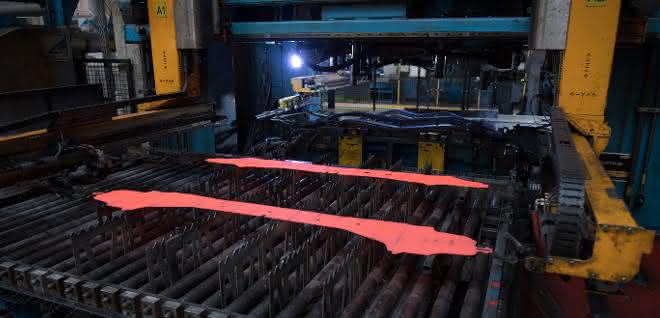
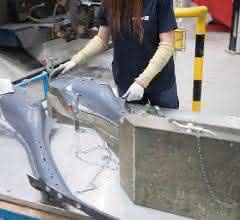
Due to this material change, it is difficult to drill holes using conventional machining tools. This is why the complex components are given their final shape in laser cells. On site, the workers check every 10th or 15th part manually.
In addition to the many advantages of hot stamping, however, there is one challenge that can affect the stability of the manufacturing process: The tool load in hot stamping is significantly higher than in cold stamping, which is why new molds have to be used much more frequently. In order to meet the increasing quality requirements of OEMs and to be able to monitor the manufacturing processes even more closely than before, Gestamp looked for a new approach to quality assurance in 2016. "Over the last few years, we realized that we needed to measure more parts in order to meet all the requirements," says Michal Pelc, vision expert in Louny. The goal of inspecting 33,500 parts a year could not be achieved with the existing coordinate measuring machine.
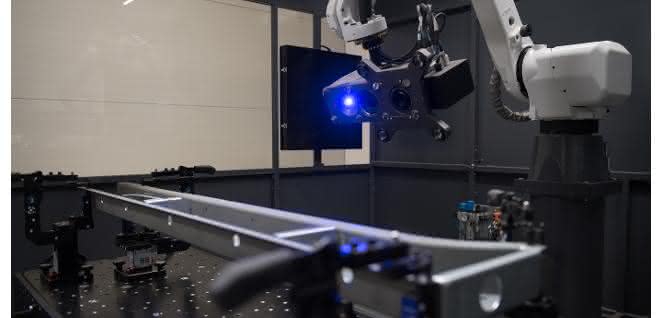
Gestamp also wanted to back up its decisions with big data analyses, which meant "that we had to collect, store and evaluate more quality data," says Landa. The challenge was therefore to find a system that would allow the parts to be measured more quickly and yet with high precision. After comparing competitive offers, Gestamp opted for the Zeiss package: an AIBox with the Comet Automated optical sensor, the PiWeb data management software, the measurement acquisition system with the feed solution and several weeks of on-site support during the system start-up.
Since 2017, up to 500 features of a component have been tested within 10 to 15 minutes. The sensor works with LED lighting and delivers highly accurate measurement results. Gestamp can therefore also guarantee a tolerance of ±0.3 mm. The system measures parts that have been processed by laser after hot forming as well as those that have been welded or assembled into systems.
The company determines the sample size according to the OEM's requirements and its own objectives. "Without the Zeiss system, we would have had to work with at least three tactile measuring devices to complete the same tasks," Pelc estimates. Although the system has only been in use for a few months, Landa also agrees with the positive conclusion: "We are happy with the solution, all our expectations have been met."
Accelerated assembly
Another reason for the good rating is that the solution speeds up the loading of the AIBox and saves space. The Zeiss Fixture Systems are used, which allow the customer to store all fixtures in one cabinet. Loading the AIBox is just as easy. The pallets with the fixtures are pushed onto a mobile table and go directly into the measuring area. "Without the loading system, Gestamp would have had to greatly expand the set-up area," explains Landa.
Gestamp also uses the sensor to generate a lot of data, which the company processes statistically using Zeiss PiWeb. "For example, we can now recognize earlier when our pressing tools need to be replaced," says Landa. The overall Zeiss package has also impressed the Gestamp management in Spain. The implementation of the Zeiss solution in a new factory in the West Midlands, UK, is now on the agenda.
Syra Thiel, PR journalist at Storymaker / am


You might also be interested in
Installation tester and current clamp
At Maintenance, Conrad will be providing an overview of its services as a solution provider in the field of technical procurement and showcasing a number of measurement technology innovations.
 read more...
Maintenance in Munich: Multimeters and...
Measurement technology for professional maintenance
The maintenance trade fair will take place on October 29 and 30 in Munich. At Conrad, the trade fair for industrial maintenance is all about efficient procurement solutions with a special focus on professional measurement technology.
read more...Digital pressure gauge
In addition to pressure and current value output via the display, the digital pressure gauge of the Keller LEO3 series also offers the additional function of reading out pressure values via the RS485 interface.
read more...Kistler appoints Head of Global Sustainability
The Kistler Group is realigning its sustainability strategy: Franziska Kunz has been appointed to the newly created position of Head of Global ESG and Sustainability. With this appointment, the company aims to strengthen its ESG activities.
read more...Precision measurement technology
Innovations for measurement technology
At the Steinmeyer Group's stand at Control, Feinmess Suhl will be showcasing an automated co-equipping solution for dial gauge test stations as well as the fully digitized 0800 micrometer series with a new data interface.
read more...Test equipment for automotive connectors
Rosenberger Hochfrequenztechnik, manufacturer of connection solutions in high-frequency, fiber optic and high-voltage technology, presents high-precision test equipment for automotive connectors.
read more...Test technology and accessories for test...
Leak and flow test
The range of test devices from Ceta Testsysteme includes leak testers, mass flow testers, volumetric flow testers and digital pressure gauges.
read more...Online tester for Profibus networks
Multifunctional device for maintenance
Indusol introduces the PB-Q One, a multifunctional measuring device that evaluates both the physics and the communication of a Profibus DP and PA network.
read more...The future of production: how laser and video projection is changing the industry
In today's fast-paced world of industrial manufacturing, technological innovations such as laser and video projection are driving the industry forward. Once considered futuristic visions, these technologies are now a reality and are revolutionizing...
read more...