
Electrical industry
ZVEI: German electrical exports set a new record
Despite the tense global economic situation, exports in the German electrical and electronics industry increased by 2.8% year-on-year to 16.2 billion euros in December 2019. Last year as a whole, the industry recorded an increase of 2.7% to 216.5 billion euros, setting a new record.
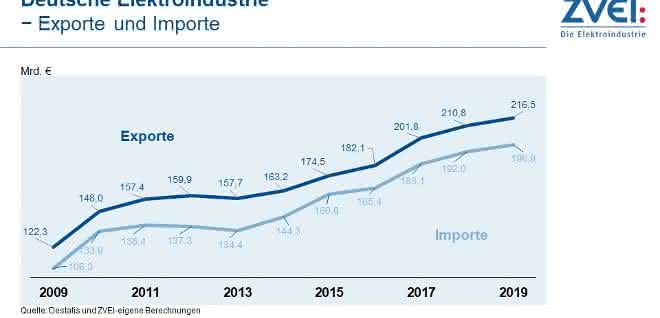
"Although this was the sixth record figure in a row, growth was significantly lower than in the two previous years. In 2018, the increase was still four and a half percent, in 2017 it was even eleven percent," says ZVEI Chief Economist Dr. Andreas Gontermann.
In December 2019, electrical imports to Germany increased by 3.4% year-on-year to 15.1 billion euros. Cumulatively from January to December, they rose by 2.5% to 196.9 billion euros. The export surplus increased by 800 million euros to 19.6 billion euros in 2019 compared to the previous year.
China and the USA were once again by far the two largest customer countries for German electrical exports last year. Deliveries to the People's Republic increased by 4.3 percent to 21.9 billion euros, while deliveries to America grew by 7.7 percent to 19.2 billion euros.
The third to tenth places are still occupied by European countries, four each from the eurozone and the rest of Europe. France remains the third largest customer, ahead of the Netherlands and Poland. Together, the ten largest export destinations account for almost half of all foreign deliveries by the German electrical and electronics industry.
German electrical and electronic exports to the so-called Visegrád states - i.e. Poland, Slovakia, the Czech Republic and Hungary - amounted to 30.6 billion euros in 2019. That was a seventh of total industry exports and an above-average 3.8% more than in the previous year. "Since 2009, industry deliveries to these four countries have more than doubled. Taken together, around 40 percent more was sold here last year than in China," says Gontermann.


You might also be interested in
Association of the Electrical and Digital Industry elects Daniel Hager as new President
Daniel Hager, a family entrepreneur, will head one of Germany's largest industrial associations in the future: The Chairman of the Supervisory Board of Hager Group has been elected as the new President of ZVEI e.V..
 read more...
ZVEI: Orders are declining
The German Electrical and Electronic Manufacturers' Association (ZVEI) is currently reporting fewer orders for the German electrical and digital industry. However, the order backlog remains high.
read more...Electrical and digital industry optimistic about 2022
2021 was a very successful year for the electrical and digital industry overall. "We were one of the few sectors to more than make up for the losses of the previous year," says ZVEI President Dr. Gunther Kegel, assessing the positive development.
read more...New Managing Director of the Electrical Drives division
Dipl. Ing. Bernhard Sattler has been appointed as the new Managing Director of the Electrical Drives Division of the ZVEI Automation Association.
read more...Dr. Gunther Kegel takes over as head of the association
Dr. Gunther Kegel is the new ZVEI President. He was appointed to the position by the ZVEI Executive Board for three years.
read more...Hannover Messe 2020 canceled - date for 2021 set
The Hannover Messe will not take place this year. This is due to the increasingly critical situation caused by the Covid-19 pandemic and a prohibition order issued by the Hannover Region.
read more...ZVEI expects stable development at best in 2020
The German electrical industry only recorded growth in exports in 2019. Production, sales and incoming orders, on the other hand, declined, the association announced in Frankfurt.
read more...ZVEI: Economy subdued in spring
According to the ZVEI, the German electrical industry received 7.0% fewer orders in April this year than a year earlier.
read more...ZVEI Power Tool Association: Board of Directors confirmed in office
The current board of the ZVEI Power Tools Association was confirmed in office by the general meeting.
read more...