
Electromagnetic compatibility
Goodbye EMC problems
If a machine goes on strike or the robot stops, electromagnetic interference can also be the cause. Many mysterious failures can be avoided if high-quality components are used for the connection technology.
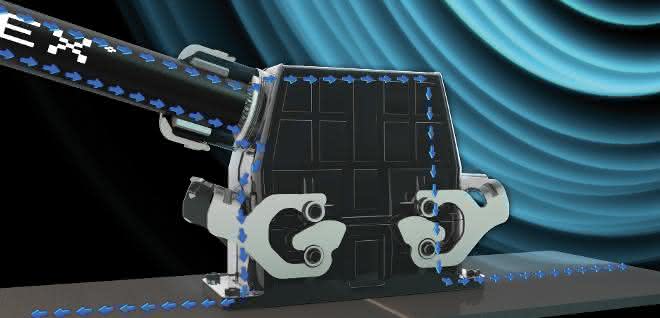
Electromagnetic compatibility, or EMC for short, is an ongoing issue in industry. Wherever high currents flow, the risk of interference from electromagnetic fields is omnipresent - especially when more and more data lines are laid in factories as a result of digitalization. A system is electromagnetically compatible if its function is not disrupted by electromagnetic fields from other systems and does not interfere with them. In practice, however, there are enough gaps through which interference radiation can enter or leave a system. The most common causes are poorly shielded connections, especially in the cable gland or connector, but also unsuitable components or improper workmanship.
The most important barrier against electromagnetic fields in cables is the shielding, a braid of highly conductive wires that are braided around the cores inside like a plait, or metallized foil that is wrapped around the cores. Both act like a Faraday cage.
Unfortunately, some users forgo shielding in order to save a few euros. This can cost them dearly, for example if cables for high currents lie close to data cables, which can lead to interference and production downtimes. There are differences in the quality of shielding. The braiding is only dense enough to form an effective barrier to electromagnetic fields from a coverage level of around 80 percent.
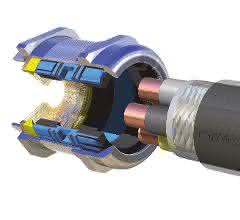
For moving cables in drag chains with many alternating bending cycles or in robotics, where the shielding has to withstand torsion as well as bending, the shielding must be designed in such a way that this degree of coverage is also achieved in the bent state, i.e. there are no gaps in the braid. This can be controlled via the braiding angle. For moving applications, the wire is braided around the cores at a more obtuse angle. The degree of coverage is therefore higher and the elasticity better. However, more copper is also required, which increases the costs.
The structure of the cores inside the cable also influences the EMC behavior. Individual cores in the cable can be additionally shielded with aluminum-laminated foil around the insulation. Ideally, the protective conductor should be divided into three conductors and distributed symmetrically to earth around the core bundle.
Zero resistance
Exemplary EMC behavior does not end with the cable. The connector and the cable gland are also an important, but unfortunately often the weakest link when it comes to protection against interference. From an EMC perspective, the perfect connection of cable, cable gland and connector has an electrical resistance close to zero between the cable shield and earth potential. This requires a large contact surface. This is not possible with a shielding braid twisted into a sausage and soldered to a connector lug. Instead, the cable shield should be in contact all around the transition from the cable gland to the plug without any gaps so that the Faraday cage continues from the cable to the plug and interference signals are blocked out. This shield contact must be made at both ends of the cable and connected to earth potential.
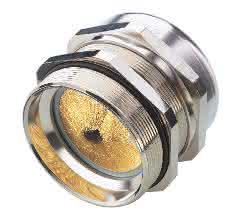
Large metallic surfaces and continuous electrical connections with good conductivity are favorable for shielding - as with the Epic Ultra rectangular connector from Lapp. This has a nickel-plated metal housing and the seal is on the inside so that the two metal housing parts touch over a large area. The Skintop MS-M Brush cable gland is available to match, as the transition from the connector to the cable must also be tight for a well-shielded overall system. Normally, the shield is fixed in place with a spring, but here this is done by ring-shaped brush hairs. The variable clamping range makes assembly, disassembly and assignment easier and faster. A single operation centers, fixes, relieves strain and hermetically seals the cable. Currents induced by interference signals flow away via the highly conductive surrounding brush shielding. Even when the cable is twisted and bent, the contact surface between the shielding braid and the brush insert remains intact. This is useful at the front of a robot arm, for example, where several power and data cables run in a very confined space.
Error in the switch cabinet
When the experts from Lapp open an electrical enclosure, they can usually see immediately if there are any problems. For example, if earthing straps are missing from the doors. Or if there is a tight space in the switch cabinet and the recommended bending radii of the cables are not met. Then the cables are kinked directly behind the cable outlet and the shielding braid does not cover a large area or slips out. Power cables with high currents can scatter strong electromagnetic pulses and cause interference in the system. EMC problems therefore do not always have a technical cause. Sometimes the fitter cuts too deeply when stripping and damages the shielding. He can then repair the damaged area with a conductive shielding tape.
Bernd Müller, freelance journalist from Bonn / am


You might also be interested in
New Trade Show for the Turned Parts Industry
The Association of the German Turned Parts Industry has given a positive assessment of the first Make-to-Order (MTO) Days: With 184 exhibitors and approximately 1,400 trade visitors, the inaugural event proved to be a successful platform for...
 read more...
In-house exhibition Bielefeld 2026
How DMG Mori thinks about the factory of the future
DMG Mori will be showcasing turning and milling expertise, automation solutions and additive manufacturing along the Machining Transformation (MX) at the Bielefeld 2026 in-house exhibition.
read more...Association of the German Turned Parts...
Turned parts industry looks cautiously to the future
Rising order intake, new members, cautious optimism: the members of the Association of the German Turned Parts Industry are confident. At the spring conference in Leipzig, around 150 participants discussed current market developments, strategic...
read more...World premieres at the EMO 2025
From September 22 to 26, 2025, Grob will be presenting several innovations at EMO Hannover. The focus of the trade fair appearance will be on the latest 4- and 5-axis universal machining centers and the associated automation solutions.
read more...Efficient complete machining
Index-Werke will be bringing the Index G220 turn-mill center and the Traub TNA400 universal lathe to Intec.
read more...Digitization of process chains
CAM system Hypermill in practice
At EMO 2023, Open Mind will focus on turning, milling and the importance of CAM software and MES in networked production environments.
read more...High-speed spindle in handbag format
Modules for milling and turning
At Weiss, the focus is on the new 1.5 kilogram micro-mill spindle, which rotates at up to 60,000 revolutions per minute.
read more...Handling and workpiece clamping
Networked production starts with the component
Schunk is coming to Hanover with a 360-degree portfolio covering all aspects of machine tools. The focus will be on more sustainable production, connectivity and e-mobility.
read more...Stroll through the city
DMG Mori is inviting visitors to take a stroll through the city at EMO: In a specially constructed DMG Mori City, the machine tool manufacturer is concentrating on its focus topic of Machining Transformation (MX).
read more...