

Electromagnets
Floating hybrid actuator increases precision in guideways
For large machine tools with a large working area, the challenge is to maintain the shape tolerance of the guideway over the entire length of the guideway in order to achieve precision throughout the entire working area.
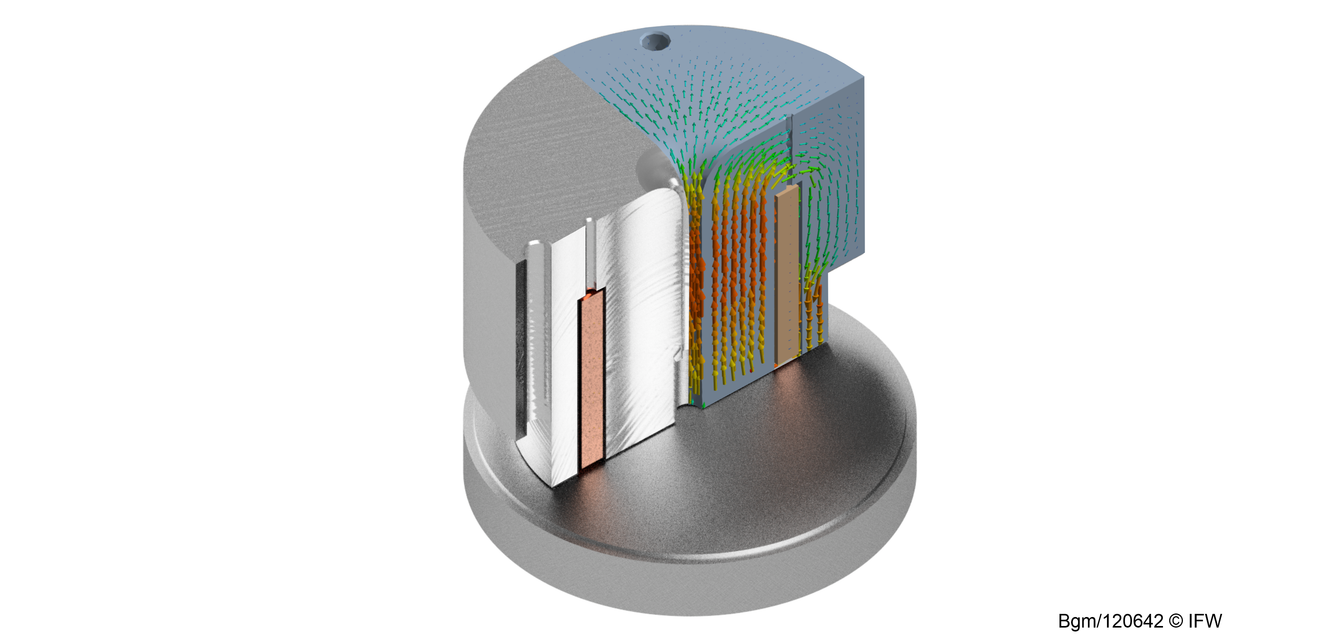
Even the smallest geometric deviations in the guide surfaces lead to a reduction in production quality and possibly to rejects. The production of high-precision long guides is therefore associated with high manufacturing and assembly costs. The Institute of Production Engineering and Machine Tools (IFW) at Leibniz Universität Hannover is therefore researching a new type of hybrid guide concept that is resilient to uneven guide surfaces. The guide concept is based on the combination of an air cushion with an electromagnet. Due to the floating of the sliding cushion and the stabilization by the electromagnet, larger shape tolerances are permitted on the guide surfaces with the same precision. This has the advantage of reducing the effort and costs involved in manufacturing the long guideways. The simulative design of the electromagnet for stabilizing a floating guide system is presented below.
Electromagnets for use in hybrid actuators
Machine tools with a large working area and high-precision guide systems are required for the precise machining of large components. The production costs for these guide systems are correspondingly high, as high-precision guide surfaces are required. In order to reduce production costs, the IFW is therefore developing a linear guide that allows higher form tolerances compared to known guide systems (e.g. roller guides). This is to be achieved by combining a sliding cushion with an electromagnet. The sliding pad consists of an elastic, rotationally symmetrical bellows. Outflow openings are fitted underneath the bellows so that an air cushion is created by the outflowing compressed air. The air cushion applies a compressive force that lifts the sliding cushion off the ground. The bellows can adapt to a potentially uneven guide surface so that no high-precision shape tolerances are required.
However, the sliding cushion is unsuitable for use as a guide system on its own, as the unidirectional force effect (compressive force) of the air cushion means that no bidirectional forces (tension-compression forces due to tilting moments) can be absorbed. For this reason, an electromagnet is integrated into the actuator system to apply a tensile force (reluctance force FR) against the compressive force of the sliding cushion. By applying tensile and compressive forces simultaneously, the sliding cushion can be braced so that the stiffness of the actuator is increased. The aim is to implement a hybrid actuator system that is as compact as possible. For this reason, the electromagnet is positioned in the middle of the sliding pad. Due to the geometry, a round magnet is used in order to make the best possible use of the available installation space. As the manufacture of magnets is associated with high costs, the achievable tensile force for different magnets is initially determined by simulation. The aim when designing the electromagnet is to maximize the tensile force within the available installation space in order to create the stiffest possible hybrid actuator system.
Optimization problem for electromagnets
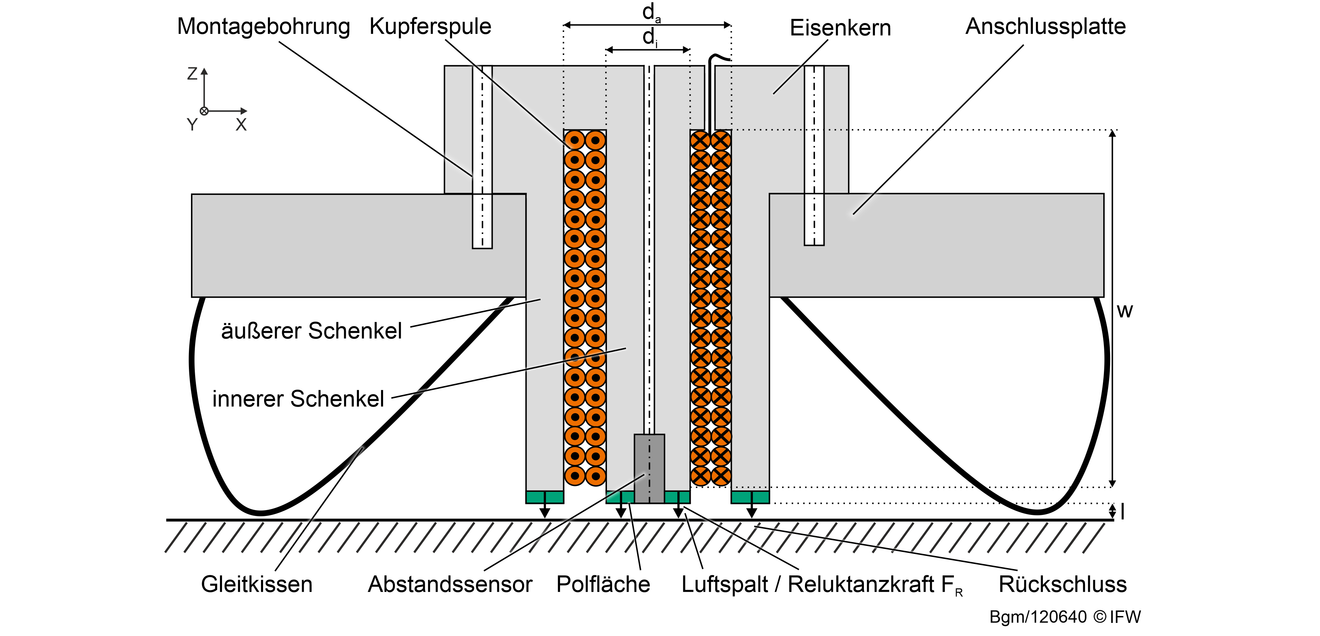
To maximize the reluctance force of the magnet acting as a tensile force, a simulative parameter study is carried out to identify suitable design parameters. An increase in the reluctance force can be achieved on the one hand by the core material used and on the other hand by optimizing the geometry of the magnetic core. The main criteria for selecting the core material are the maximum magnetic saturation flux density and the material costs. The saturation flux density indicates how strongly the material can be magnetized. A higher magnetizability enables a greater reluctance force and is therefore decisive when designing an electromagnet. Pure iron with a saturation flux density of Bs = 2.25 Tesla was selected as the core material for the magnet. Comparable core materials, such as cobalt-iron alloys with saturation flux densities of up to Bs = 2.3 Tesla, are not economically feasible due to significantly higher costs. The further design of the magnet is limited to the geometry of the magnetic core. The inner diameter (di), the outer diameter (da) and the height (w) of the copper coil are considered as design parameters of the magnet (Figure 1).
To maximize the reluctance force, the design parameters must be selected in such a way that the pole area of the magnet is as large as possible at a magnetic flux close to the saturation flux density. To achieve this, the iron core must be magnetically fluxed. The magnetic flux is increased by increasing the number of coil windings or by operating the coil with a higher current. However, a higher current requires a wider conductor cross-section of the copper wires, so that fewer windings can be used. An increase in the number of windings in the coil also increases the required installation space of the coil, making the magnetic core and the pole surface smaller. The conflict between the magnetic flux density and the size of the pole area poses an optimization problem in which the reluctance force must be maximized.
In order to solve the optimization problem, a simulative study was carried out to identify suitable design parameters. A near-net-shape CAD model of the magnet was used for realistic simulation results. This already contains the necessary cut-outs for cables and sensors, which restrict the magnetic flux and thus reduce the realizable reluctance force of the magnet. Based on the parameterizable CAD model, a simulative parameter study was then carried out to solve the optimization problem.
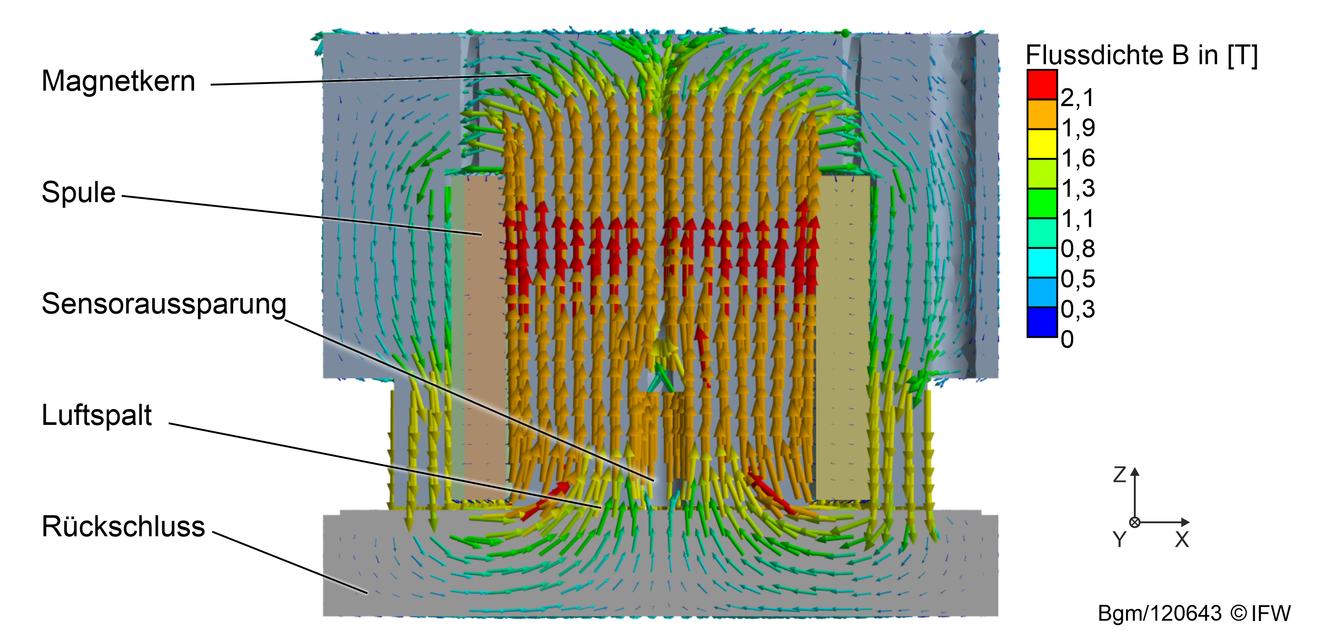
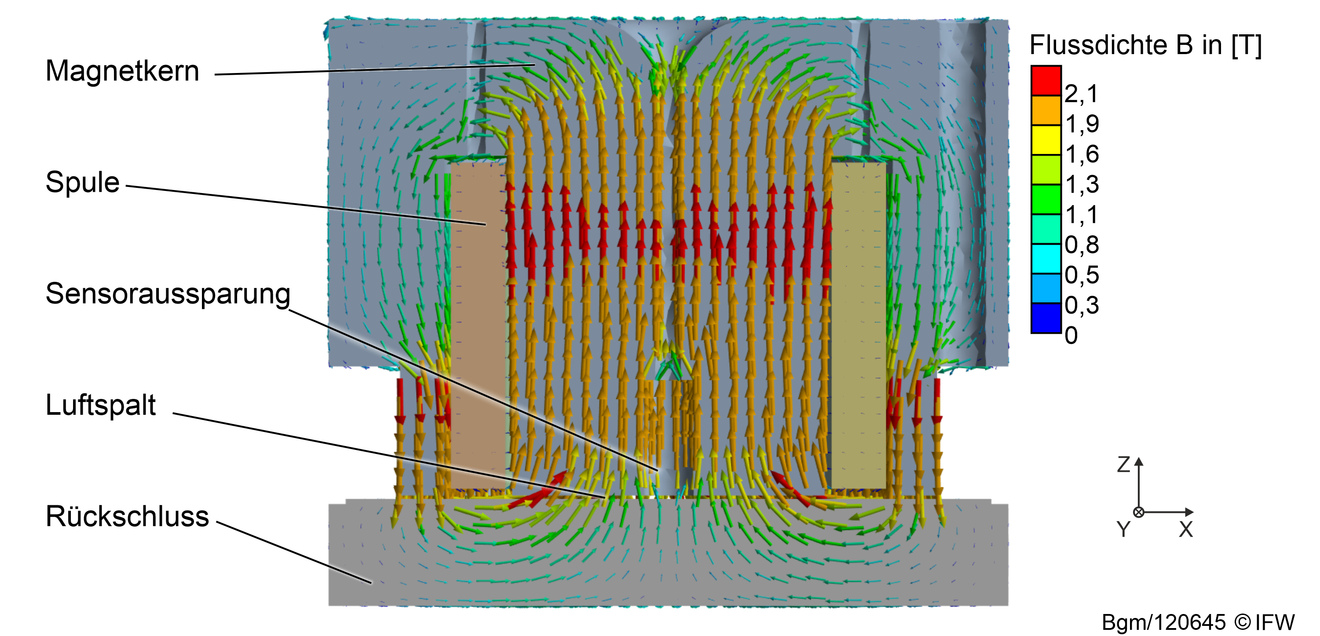
The parameter study was carried out in the ANSYS Magnetostatic simulation environment. For this purpose, the magnetic flux in the magnetic core and in the return (mating surface of the electromagnet) as well as the reluctance force between the pole face and the return were considered. The initial model for the simulation is a magnetic core with a diameter of the outer leg of dk = 79 mm. Here, the sliding cushion limits a further enlargement of the magnet. The diameter of the coil was selected so that the fluxed area of the inner leg corresponds to twice the fluxed area of the outer leg. This was implemented in this way because the inner leg is flooded twice as much as the outer leg due to the coil closing around it. The model forms a reference geometry (see Table 1), which is to be optimized by simulative adaptation of the design parameters. Figure 2 shows the magnetic flux B of the reference geometry. For the simulations carried out, a constant air gap of l = 250 µm and a constant current strength of I = 11 A with a cable cross-section of AK = 1 mm² were assumed.
The vectors in the image show the field lines of the magnetic flux. These are largely evenly aligned so that a realistic simulation result can be assumed. The simulated reluctance force in the air gap of the reference geometry is 3 kN along the z-axis. However, it is clear that there is no homogeneous magnetic flux within the magnetic core. It is therefore necessary to adjust the design parameters so that a homogeneous distribution with rectified magnetic flux density close to the saturation flux density is formed in the core. With the parameter study, the design parameters are varied within the intervals shown in Table 1 to increase the reluctance force.
|
Design parameters |
Interval |
Reference |
|
Inner diameter coil (di) |
40 mm - 48 mm |
44 mm |
|
Outer diameter coil (da) |
60 mm - 68 mm |
64 mm |
|
Coil height (w) |
38 mm - 58 mm |
48 mm |
Table 1: Design parameters for the FEM simulation
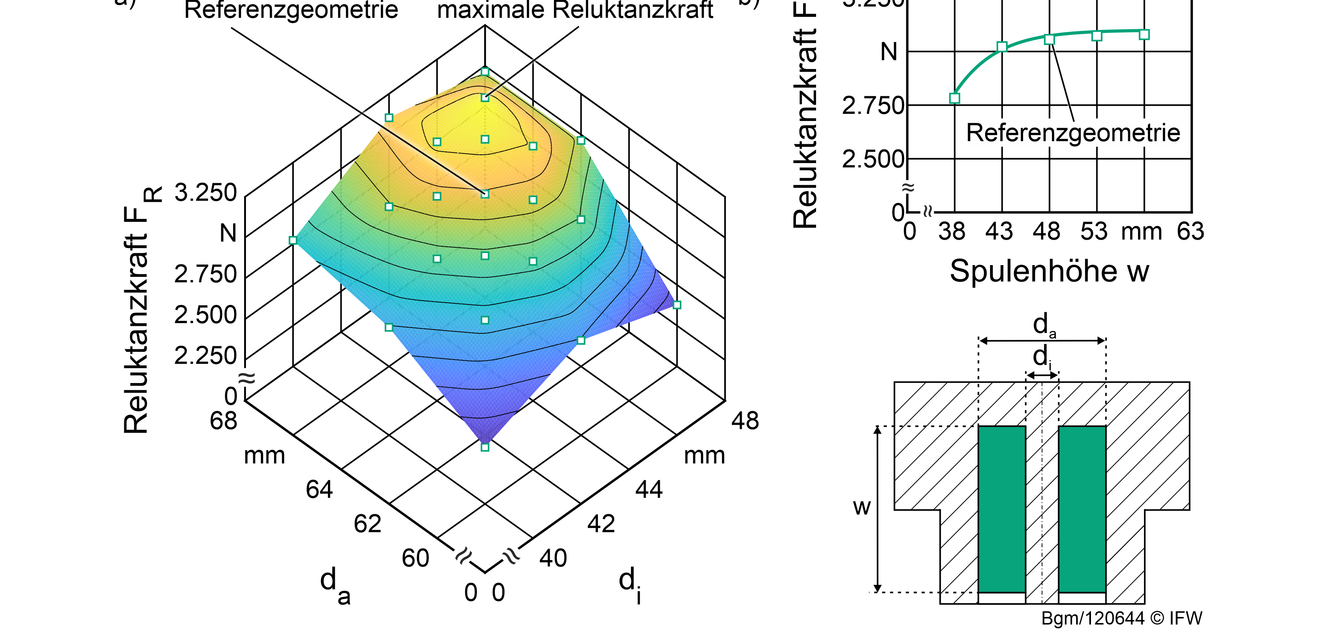
By varying the design parameters, the reluctance force also changes in addition to the magnetic flux density. Figure 3 graphically shows the effects of changing the various design parameters on the reluctance force.
The two diameter parameters di and da determine the width of the coil and thus the number of windings within the coil. On the other hand, the two parameters define the width of the inner and outer legs of the magnetic core (see Figure 1). The results of the simulations show that, based on the reference geometry, an increase in the inner and outer diameter increases the reluctance force. With an inner coil diameter di°= 46 mm and an outer diameter da = 66 mm, the maximum reluctance force of the solenoid (a) is achieved. By increasing the magnet height, the reluctance force is only increased up to a coil height w = 48 mm (b). A further increase in the size of the magnet has no significant effect on the resulting reluctance force. The optimum design parameters are therefore available for the defined parameter space. Figure 4 shows the magnetic flux for the optimized solenoid geometry.
A homogeneous distribution of saturation can be observed in both legs of this magnet. The optimization enabled a simulated reluctance force of FR = 3.2 kN to be achieved. This corresponds to an increase of 6 % compared to the reference geometry. A suitable geometry for the magnet was thus identified within the simulation. The identified geometry enables efficient use of the available installation space for a high area-specific reluctance force. Overall, the simulation provides a suitable basis for the design of an electromagnet.
Deviations between simulation and reality
In the future, the optimized magnetic core will be manufactured and wound. However, deviations are to be expected between the simulated behaviour and the real reluctance force due to idealized assumptions. For example, the relative magnetic permeability of the structural steel is assumed to be constant in the simulation. In reality, the permeability of a material is directly dependent on the magnetic flux. This results in a deviation between the simulated and the real magnetic flux density. The resulting simulated reluctance forces will therefore also deviate due to the correlation with the magnetic flux density. Due to the described inaccuracy of the simulation, the real tensile force of the magnet must be examined. For this purpose, the resulting reluctance force is determined experimentally at different air gaps and current strengths and recorded in a characteristic diagram. After testing, the magnet is then connected to the sliding cushion in order to create a prototype for the new actuator system.
The research project "Fundamentals of a non-contact actuator with bidirectional force effect for the construction of grip-free guidance systems of cutting machine tools" is funded by the German Research Foundation (DFG) - project number 60443824. The authors would like to thank the DFG for the financial support to carry out the project.
Prof. Dr.-Ing. Berend Denkena, Head of the Institute of Production Engineering and Machine Tools (IFW) at Leibniz Universität Hannover
M. Sc. Henning Buhl heads the Machines and Controls department at the IFW
M. Sc. Adrian Bergmann, employee at the IFW in the Machine Components department


You might also be interested in
Demand for Skilled Workers in the...
VDE Foresees a Recovery in the Job Market for Electrical Engineers
The job market for electrical engineers is recovering. The Association for Electrical, Electronic, and Information Technologies (VDE) sees rising demand but warns of a growing shortage of skilled workers in the electrical industry.
 read more...
New loyalty program at Conrad
With its platform economy, Conrad Electronic enables simple and fast procurement from a single source and acts as a solution provider to make it as smooth as possible for business customers to cover their technical needs.
read more...Sales growth and future investments in anniversary year
In the past 2025 financial year, the Wago Group achieved an eight percent increase in turnover compared to the previous year. The company is also expanding its product portfolio and entering the smart home market.
read more...VDE Association for Electrical, Electronic...
Christoph Kutter is the new President of the VDE
Change at the top of one of Europe's largest technology organizations: Prof. Dr. Christoph Kutter replaces the previous VDE President Alf Hendryk Wulf as VDE President. His presidency will focus on young people and the microelectronics of the future.
read more...New servo cables for cable drag chains
Helukabel is expanding its range of 'Heluchain' cables for highly dynamic use in energy supply chains to include the 'Heluchain Topserv 201-PVC UL/CSA' and 'Heluchain Topserv 211-PUR UL/CSA' servo cables, which are particularly suitable for gliding...
read more...Modular plant construction for corrugated board
Insight into the production of corrugators at BHS Corrugated: Automated, modular and equipped with Helukabel components.
read more...50 years of productronica - A trade fair preview
From November 18 to 21, 2025, the international electronics industry will meet in Munich for Productronica, which is celebrating its 50th anniversary this year. A preview of the trade fair.
read more...For the new Ecodesign Regulation
At SPS, ebm-Papst will be presenting innovative and energy-efficient fans for ventilation and air-conditioning technology, especially for control cabinet and electronics cooling.
read more...Automation, robotics and industrial networks
At SPS 2025, Rosenberger will be showcasing a broad portfolio of connectors and system solutions for reliable data and power transmission in automated production environments.
read more...