

The bottom of the valley is no place to linger
Where the precision tool industry stands now
Three years of crisis have left their mark. In the precision tool industry as well as in the mood of its players. At the start of 2026, the exhaustion is palpable - but also something like cautious confidence. "We have three difficult years behind us, but the bottom seems to have been reached," says Stefan Zecha, Chairman of the VDMA Precision Tools Association. A sentence that hints at hope without giving the all-clear. Because nothing is stable yet. And certainly not safe.

2025 ended with a drop in production of around 7% for the industry, with the volume falling to around 8.5 billion euros. For many companies, this meant job cuts, investment freezes and restraint across the board.
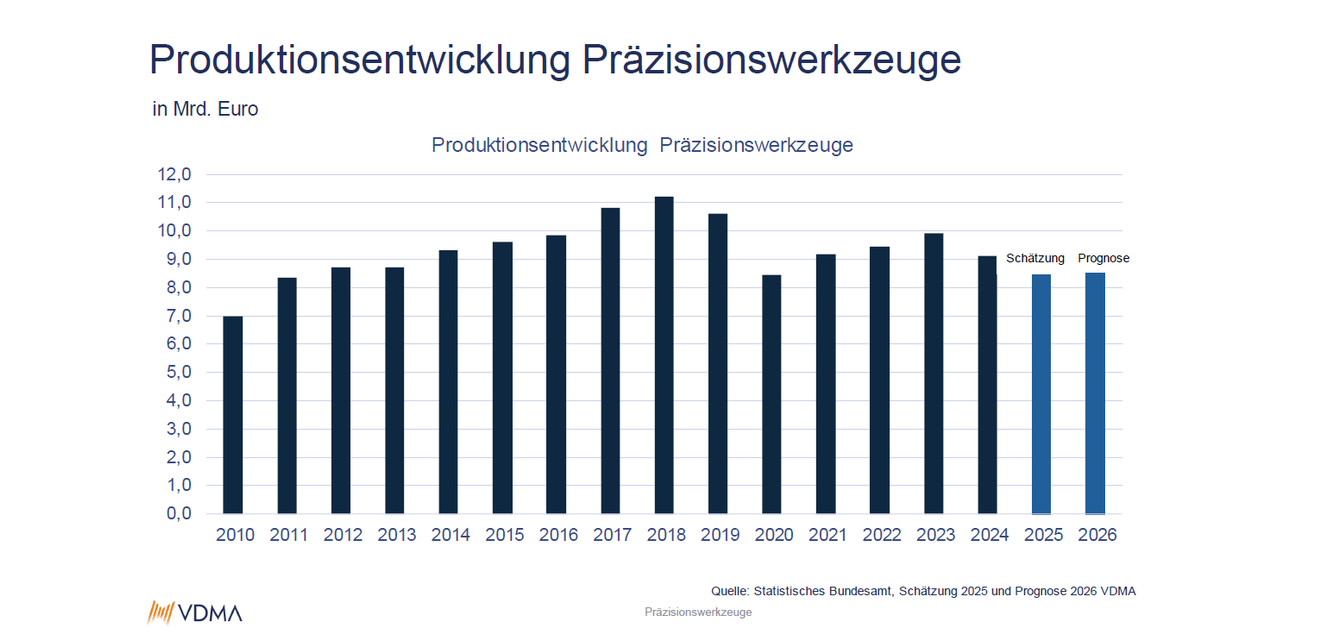
The domestic market was disappointing - driven by the weak mechanical engineering sector and an automotive industry that is itself still looking for direction. Growth impetus from the aviation, medical technology and defense sectors remained sporadic and was not enough to offset the losses.
Export: Stability with a sideways edge
A look abroad did not bring any real relief either. Within Europe, exports fell by 4 percent, while China lost a significant 9 percent. The USA, on the other hand, once again asserted itself as the most important foreign market - despite trade risks - and grew by 2%.
For 2026, the industry expects consolidation at today's level. Growth sounds different. But standing still would be progress after the past few years - provided there are no major geopolitical disruptions.
Bureaucracy as a competitive disadvantage
What slows companies down has long been known. And yet it is not getting any less. Bureaucracy and reporting obligations are tying up resources, while political uncertainty and weak customer industries are delaying or preventing investments. Zecha puts the industry's expectations in a nutshell: "Despite declining production and subdued demand, we are seeing the first signs of stabilization. However, the economy is still struggling with locational disadvantages. It is now crucial that politicians finally ensure improved conditions for business locations - through leaner procedures, less bureaucracy and digitalization that promotes resilience." Or, even more directly: "Companies are in an excellent technological position, but finally need political decisions that create predictability and relief!"
Machining: decline with an announcement
Manufacturers of cutting tools came through the year relatively unscathed, but still had to cope with declines. Domestic sales and exports were both around 5 percent down on the previous year.

High costs, subdued demand and increasingly critical raw material markets determined everyday life. Tungsten in particular became a strategic risk.
Tungsten becomes geopolitical
The tighter restrictions in China had a noticeable impact on the industry. Shortages, fragile supply chains and massive cost increases have brought the issue of supply security to the fore. Recycling is no longer a sustainability issue, but industrial policy. Take-back systems and the processing of carbide in Europe are well established - and continue to gain in importance. Zecha puts it emphatically: "We must therefore do everything we can to keep carbide scrap in Europe. Every gram counts! Carbide in Europe secures our sovereignty." For 2026, the companies are counting on a gradual recovery and are hoping for slight sales growth over the course of the year.
Clamping technology: lack of investment
In clamping technology, 2025 fell well short of expectations. Sales fell by a high single-digit percentage, particularly in workpiece clamping, which is directly linked to new machine investments.

Foreign business also developed negatively. An upward outlier: India with an increase of 10% - among the ten most important sales markets for the first time. A slight upturn is expected for 2026, but another slight decline in sales overall.
Toolmaking: question of existence
Toolmaking has been hit the hardest. Significant declines in production, insolvencies, weak domestic business and competitive pressure coming primarily from China.
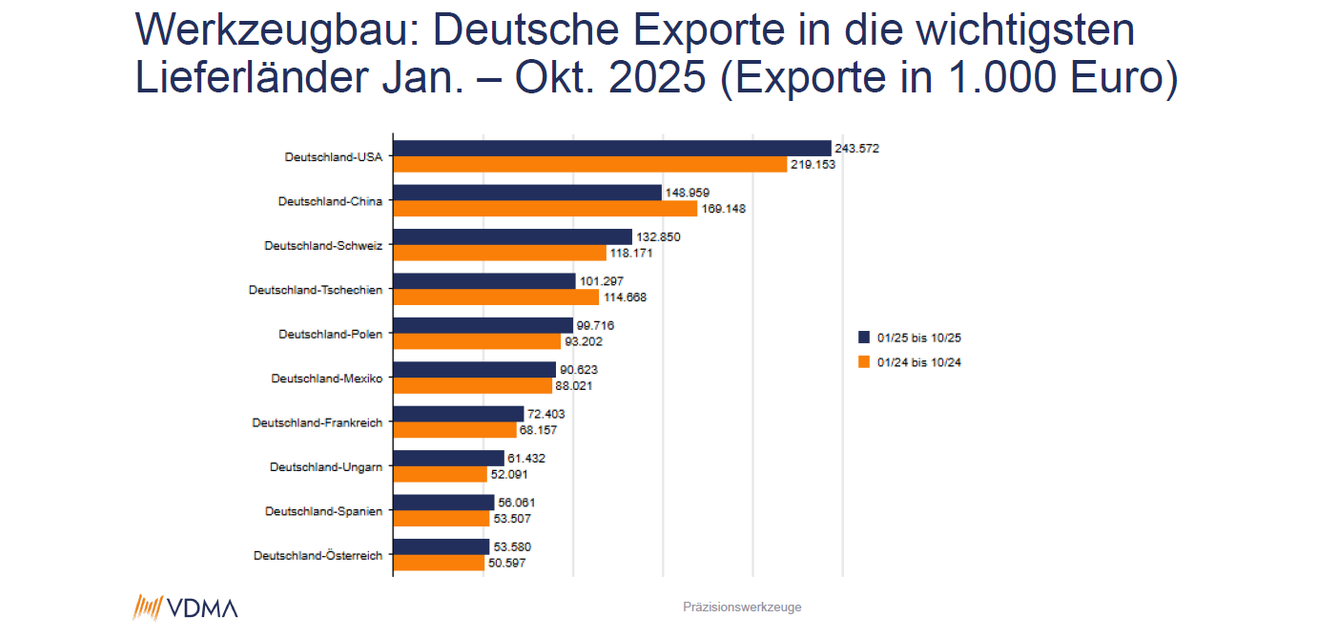
The general conditions are deteriorating along the entire value chain. The fact that the export business remained stable is more of a consolation than a trend.
Meeting places in uncertain times
The European Cutting Tools Conference (ECTC) from May 7 to 9, 2026 in Graz will bring together experts and decision-makers from all over Europe. This will be followed in September by AMB in Stuttgart (15 to 19 September 2026), Germany's leading trade fair for precision tools and machine tools - and perhaps a place that will show whether stabilization can be turned into new beginnings.
The VDMA Precision Tools Association represents the interests of European manufacturers of cutting tools, clamping technology, forming tools and mold making. An industry whose products are indispensable in almost all areas of metal and, in some cases, plastics processing.


You might also be interested in
Machine Tool Manufacturing Offers Hope
New orders are rising significantly again for the first time
New orders in the machine tool industry are rising significantly again for the first time. However, production, exports, and employment continue to decline.
 read more...
VDW forecast: production to grow again in 2026
After two weak years, the German machine tool industry expects slight production growth in 2026, driven by a recovery in domestic demand. At the same time, structural changes and international competitive pressure, particularly from China, are...
read more...German machine tool industry: incoming orders fall in the third quarter
In the third quarter of 2025, incoming orders in the German machine tool industry fell by 5%. Domestic demand in particular fell sharply, while foreign orders remained stable. Dr. Markus Heering from the VDW explains the current trends and regional...
read more...New life for old machines
"When we talk about retrofitting, for us it's about giving a machine tool a second life that lasts just as long as the first," emphasizes Ralf Glatzeder, Head of the Reman department at Liebherr-Verzahntechnik in Kempten.
read more...Industrial AI: Siemens launches data alliance for manufacturing
Siemens and several mechanical engineering partners are pooling their machine data to use generative AI for automated NC programs and adaptive manufacturing processes - the basis for a new, industry-specific AI model.
read more...Optimized machine movement
Rollon's portfolio includes linear motion solutions for machine tools with high precision, rigidity and load capacity, even under demanding operating conditions.
read more...The machine thinks for itself
Artificial intelligence is finding its way into machine tools and is not only changing production, but also the maintenance of machines. AI is becoming the control center for efficient, sustainable and competitive production. How AI is...
read more...Precision in a new size
Kern Microtechnik is presenting the Kern Fortis HD, a 5-axis machining center, at EMO. The company is also presenting a Micro HD+ designed for series production and the Femto E3 laser machining center.
read more...Innovation for a strong SME sector
Small and medium-sized suppliers face tough national and international competition. These companies can achieve the required flexibility in production with digitalized manufacturing and automation solutions. Financing models and after-sales service...
read more...