
Corona virus
Igus produces headbands for face shields
To protect medical personnel, private individuals and companies around the world are currently using 3D printing to produce face shields, among other things. Igus has turned its attention to a central problem in production and is donating the first 100,000 injection-molded headbands.
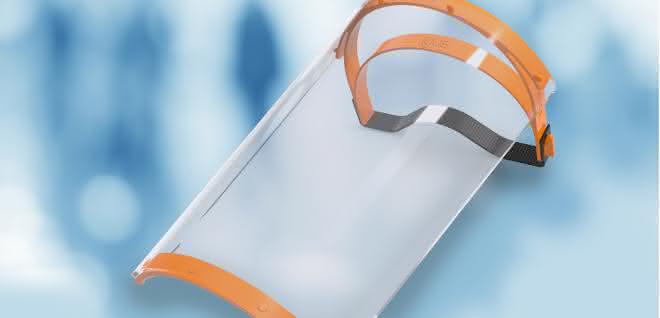
In order to protect doctors, nursing staff and other people who work directly with patients, 3D printer manufacturer Prusa has developed a face shield and made the design available online for free download. The aim is to produce the so-called "face shields" on as many 3D printers as possible. The project is already considered a success: individuals, maker networks and companies around the world are getting involved and additively producing the face shields. And initiatives such as "Operation Shields Up!" in the USA are bringing volunteers together on their platforms. Igus is participating in this global collaboration and is relying on the advantages of the injection molding process.
Mass production of face shields through injection molding
The design of a face shield is extremely simple: a 3D-printed plastic carrier holds a replaceable plastic film that shields the face. The face shields are not a substitute for a face mask, which is also worn. However, they do provide additional protection, especially for the eyes. They also reduce the natural reflex to touch the face and thus come into contact with the pathogen.
Despite the simple design, one key challenge remains. "Several makers have asked us whether we, as a tribo-filament manufacturer, can provide them with material for this," says Tom Krause, Head of Additive Manufacturing at Igus, looking back. "However, this does not solve the main problems: Manufacturing the headband as a central component is comparatively expensive in the 3D printer and takes more than two hours. This means that only a few parts can be produced per device per day."
Igus therefore relies on the advantages of another process, injection molding. The material used is recycled Iglidur A200. Dr. Thilo Schultes is head of toolmaking and says: "With an appropriate tool, over 10,000 headbands can be produced and delivered per week in the Cologne factory. This enables us to mass produce the headbands quickly and at significantly reduced costs."
Igus manufactures the tool at its own expense. The first 100,000 headbands are available free of charge, after which they are available at the manufacturer's cost. If net proceeds are generated, these will be donated. as


You might also be interested in
New Resin Opens Up 3D Printing for the Optics Industry
With BMF Clear, Boston Micro Fabrication has introduced an optically transparent photopolymer resin for micro-precision 3D printing that achieves a light transmittance of over 90 percent at layer heights of 10 micrometers or more and is suitable for...
 read more...
3D Printing in the Defense Sector
Formnext Launches 2026 Defense Summit
Formnext is expanding its program to include the security and defense sector and will host the first Formnext Defense Summit in 2026. The event will focus on the potential of additive manufacturing for resilient supply chains, industrial...
read more...UltiMaker Doubles Speed in Industrial 3D Printing
With the Factor 4 Plus, UltiMaker is introducing a new version of its industrial desktop 3D printing platform, which operates at up to twice the print speed of the standard model. The platform is designed for use in manufacturing and defense...
read more...Stratasys takes over MarkForged
Stratasys is acquiring MarkForged from Nano Dimension for USD 42.5 million, thereby expanding its portfolio in the field of fiber-reinforced composites. The acquisition also strengthens the company's software and materials expertise in industrial 3D...
read more...Timo Göbel, Head of BMW Additive Manufacturing
"Clearly on course for broad industrialization"
The BMW Group's Additive Manufacturing Campus (AMC) is setting the course for the next stage of industrialization. Under the leadership of Timo Göbel, additive manufacturing is being further integrated into all stages of the vehicle life cycle. In...
read more...Real-time control to make recycling materials economical
The Fraunhofer IAPT is researching AI-based closed-loop processes for industrial 3D printing with recycled plastics. The aim is to achieve less waste, greater process stability and profitable printer farms.
read more...Forum Solutions 4AMIndustry shows ways into industrial application
Additive manufacturing has developed dynamically in recent years and has long outgrown its status as a purely innovative technology in many industries. Nevertheless, companies still face the challenge of integrating AM into their production...
read more...Alliance aims to drive forward industrial 3D printing
Machine components, electrostatically shielded transport containers, large components for the automotive, rail and aviation industries or specific medical products straight from the printer - the potential applications of additive manufacturing are...
read more...Photonic microchips with 3D connector
How a 3D system makes photonic chips industrially viable
A research team from Heidelberg is developing a 3D-printed "connector" for photonic microchips. The solution promises a low-loss, standardized coupling of glass fibre and chip - and could fundamentally simplify the production of photonic integrated...
read more...