
Semiconductor chips
Bosch plans expansion of semiconductor production in Reutlingen
Bosch is planning to further expand its semiconductor production in Reutlingen with an additional investment of more than a quarter of a billion euros by 2025.
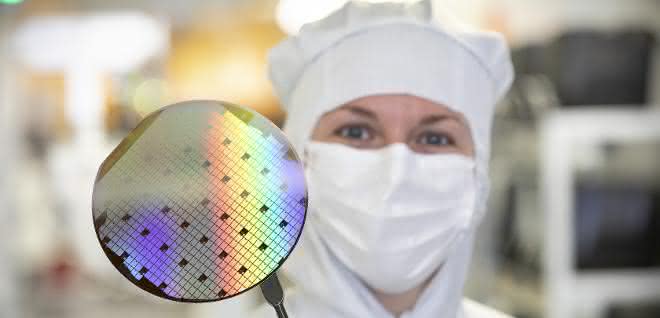
The money is to be invested in new space and the design of the clean room required for production. Bosch is thus preparing itself for the constantly growing demand for chips for applications in mobility and the Internet of Things. "We are systematically expanding our production capacities for semiconductors in Reutlingen. This will strengthen our competitiveness. We are investing for our customers and against the global semiconductor supply crisis," says Dr. Stefan Hartung, Chairman of the Board of Management of Robert Bosch GmbH. A new building section with an additional 3,600 square meters of ultra-modern cleanroom space is being constructed at the site. Semiconductors based on the technologies already established in Reutlingen are to be manufactured there from 2025. Bosch is also expanding an existing energy supply center. An additional building for media supply is planned to connect the existing and new production areas. Production in the new space is scheduled to begin in 2025.
In October 2021, Bosch announced that it would be investing more than 400 million euros in the expansion of its semiconductor sites in Dresden, Reutlingen and Penang, Malaysia, in 2022 alone. Around 50 million euros of this will flow into the semiconductor plant in Reutlingen. For Reutlingen, Bosch had already announced plans to invest a total of 150 million euros in additional cleanroom space in existing buildings between 2021 and 2023. The planned expansion of the site with a new building section for production will add to this. In total, the cleanroom area in Reutlingen is to be expanded from the current 35,000 square meters to more than 44,000 square meters by the end of 2025.
State-of-the-art semiconductor production
In Reutlingen, Bosch operates semiconductor factories based on 150 and 200 millimeter technology. In Dresden, the company manufactures semiconductor chips on wafers with a diameter of 300 millimeters. What all the production factories have in common is an ultra-modern approach to data-based production control. "Thanks to the combination of connectivity and artificial intelligence methods, Bosch is creating the basis for data-driven, continuous improvement in production and thus for ever better chips," says Markus Heyn, member of the board of management of Robert Bosch GmbH and chairman of the Mobility Solutions business sector. One example is the development of software for automated defect classification. Bosch is also optimizing the material flow with the help of artificial intelligence. The ultra-modern manufacturing environment in Reutlingen is intended to secure the future of the location and thus jobs with a high degree of automation.
Growing demand for semiconductors
Bosch has been developing and manufacturing semiconductors for more than 60 years, in Reutlingen for more than 50 years - both for automotive applications and for the consumer sector. The chips produced include application-specific integrated circuits (ASICs), microelectromechanical systems (MEMS sensors) and power semiconductors. The additional expansion of the site is primarily intended to meet the growing demand for MEMS for the automotive and consumer sectors as well as for silicon carbide power semiconductors. "Bosch is already a leading chip manufacturer for vehicles. We want to systematically expand this position," says Heyn. This also includes the development and production of silicon carbide chips, for which Bosch began series production in December 2021. Chips made from this innovative material will play an increasingly important role in electromobility in the future. Bosch is currently the only automotive supplier in the world that manufactures power semiconductors from silicon carbide itself.
Today, around 8,000 employees work at the Reutlingen site in the development and production of semiconductors and control units as well as in administration and in the eBike Systems division.


You might also be interested in
Sustainability Through Simulation
Digital material selection reduces CO2 emissions by 40 percent
The use of digital material simulations can significantly reduce CO₂ emissions during the development and manufacturing of components. A real-world project by Schunk and Cadfem demonstrates how data-driven material selection can yield savings of up...
 read more...
From ERP System to AI Platform
RNA, based in Aachen, manufactures up to 2,000 custom-designed feeding systems annually and handles all order processing through a central ERP platform.
read more...Cybus Brings in Siemens Executive Stefan Schwab to Lead the Company
The Hamburg-based software provider Cybus will have a dual leadership structure going forward: Stefan Schwab will join co-founder Peter Sorowka as co-CEO.
read more...Artificial Intelligence for the Physical Space
Alibaba Expands Qwen Model Family with a Robotics Suite for Physical AI
Alibaba is expanding its Qwen model family with a robotics suite for Physical AI. The three models—for manipulation, navigation, and simulation—are designed to assist autonomous robots with complex tasks in real-world environments.
read more...5 Challenges for AI Projects in Manufacturing
Manufacturing companies have high hopes for AI. IFS highlights the five most common reasons why AI projects fail.
read more...Implementing Manufacturing Software: 5 Practical Tips
To remain competitive in the market in the future, more and more companies are considering digitizing their CNC manufacturing processes. The right software solutions can make process knowledge transparently accessible and significantly reduce the...
read more...AI automation specialist reorganizes...
Generation change at Insiders Technologies
After almost 30 years at the helm, Werner Weiss is handing over the management of Insiders Technologies. Andree Albrecht takes over the management after a transition phase.
read more...Intelligent brownfield networking
Many industrial companies are struggling with established plant structures and proprietary interfaces. Stefan Klaus' presentation will show in a practical way how brownfield environments can be efficiently networked with open technologies and made...
read more...Factory-X in practice
How can set-up processes in highly variant production be automated efficiently? Markus Benndorff from soffico shows how Factory-X, industrial data rooms and modular architectures create new possibilities for flexible production concepts.
read more...