
Decentralized servo drives
The air must come out
Online trade is booming. However, standardized cardboard boxes are often too large, which also means that a lot of air is transported. A packaging specialist has developed a technical solution to reduce the volume. The company uses centralized and decentralized servo drive technology.
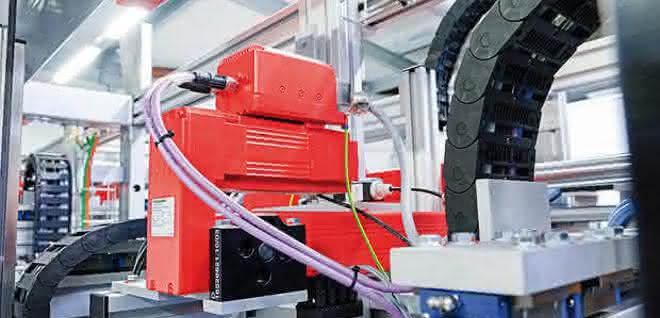
More than 50 percent of shipping parcels are said to consist not of the actual goods but of air and filling material. The situation is familiar and can be felt every day. At the latest when the parcel service arrives with the order, the joy of the delivery is followed by the annoying task of disposing of the packaging components and filling materials properly.
Opitz Packaging Systems in Kalefeld near Göttingen has developed the Vario 558 volume reducer to adapt standardized folding cartons. The device cuts open the sides of standard cartons so that they can be closed lower. Because the cutting depth has to be variable depending on the product, precise and dynamic servo technology is required. The shipping cartons of different widths, which are often far too large in online retail, are reduced to a minimum. In the first station, a camera or ultrasonic sensor measures the height of the product in the carton and uses this to determine the fold heights or the depth of the cuts at the four corners of the carton. The height of the product and the variable carton size determine how deep to cut and at which position the blades of the Vario 558 must stop in the corners of the standard cartons. The carton flaps are then folded in one after the other along prepared horizontal grooves, fixed at the correct height by a hold-down device and finally sealed.
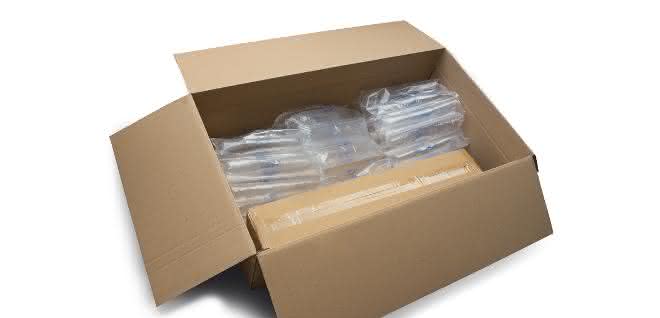
Opitz is an expert in wet adhesive technology, which, unlike plastic adhesive tapes, can fulfill important sealing functions. This property is particularly important for high-priced products, as it prevents unauthorized access to the package or at least makes it visible. The special feature of the volume reducer is that it can process cartons of different widths.
Opitz uses servo technology in a multi-axis system for the motion sequences in the Vario 558 due to the high demands on precision and dynamics. This motion control solution was developed together with SEW-Eurodrive on the basis of the Movi-C modular automation system. With the complete solution for automation tasks, the machine could be implemented with a tailor-made mix of centralized and decentralized drive technology without having to compromise on integration or interfaces.
The control cabinets are getting smaller
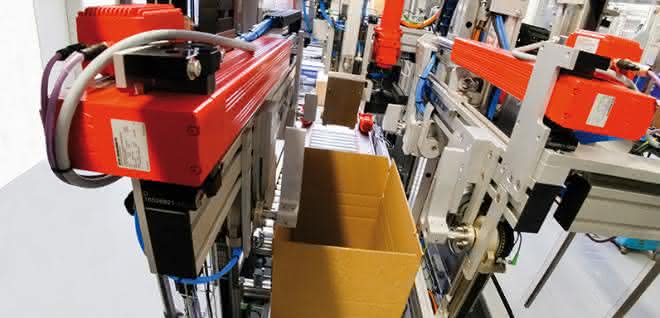
SEW-Eurodrive used the new Movi-C double-axis modules for the stationary tasks. They drive the cutting gantry and the material flow within the machine. The use of double-axis modules, which are connected to each other as a multi-axis system for optimum energy efficiency via the DC link, makes the installation significantly leaner and also reduces the required control cabinet space. "The control cabinet has become noticeably smaller. Space is a constant issue for our customers; it's actually always in short supply," explains owner Günther Opitz.
Another issue is energy efficiency. This is why the individual processes are coordinated in terms of timing. For example, the lifting units never raise at the same time in order to limit power consumption. Instead, the time offset means that the braking energy generated during lowering at one point is used for lifting at another work station. As a result, this network saves energy and cuts peak loads.
Opitz uses decentralized low-voltage drives CMP ELVCD (Extra Low Voltage Compact Drive) for the cutting process. Their task: the linear adjustment of the blade positions in conjunction with servomotor-driven electric cylinders. This solution is one of the key results of the collaboration between Opitz and SEW-Euro-drive in the early engineering and design phase of the drives. In the experience of programmer Helge Sünnemann, programming the motion functions within Movi-C was very easy: "SEW makes life very easy - especially with the prefabricated modules that I only have to wire up. That saves a lot of time."
Fewer cables thanks to decentralized technology
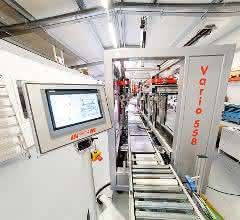
The decentralized servo technology initially reduces the entire cabling effort noticeably because no cables are required between the control cabinet inverter and the motor. In this case, drag chains would have been unavoidable. However, these are subject to wear, increase the frictional resistance and the mass inertia as well as the required installation space in the machine design. The ELVCD low-voltage servo drives on the gantries, on the other hand, weigh little, have sufficient power and are supplied via a looped-through power and communication bus.
This architecture opens up excellent opportunities for Opitz Packaging Systems to design modular packaging solutions. The use of decentralized servo drives paves the way for adding further drives to the network without having to question the general installation or touch the control cabinet plan. "We have room for the installation of additional axes," summarizes Technical Manager Florian Ahlert.
A look inside the volume reducer shows the benefits that can be achieved with an integrated system of centralized and decentralized drive technology. The Movi-C modular automation system also paves the way for future applications thanks to modern communication interfaces as well as modularity and openness for machine expansions towards complete systems.
Stefan Kattner, SEW-Eurodrive, Technical Office Kassel / am


You might also be interested in
Helu makes its first trade fair appearance under a new brand name
Helu Kabel will be presenting itself as Helu for the first time at Hannover Messe 2026, showcasing system solutions, Heluchain cables and new industrial luminaires.
 read more...
Strategic realignment with brand relaunch
In future, Helukabel will trade as Helu
The Helukabel Group is parting with part of its name: in future, the company will only operate under the Helu brand. With this step, the specialist for electrical connection technology is underlining its strategic development from a classic cable...
read more...Modular plant construction for corrugated board
Insight into the production of corrugators at BHS Corrugated: Automated, modular and equipped with Helukabel components.
read more...Best quality for the steel
Conditions in the steel industry are harsh and inhospitable. The machines used must be able to withstand the demanding environmental conditions in order to deliver the best quality at all times.
read more...If the standard cable is not sufficient
Lapp offers cables for countless applications - but not for all of them. From time to time, the developers have to modify a standard cable or develop a special cable.
read more...Slight decline in sales, strong investments
The Lapp Group has not been spared from the weakening global economy. However, the company only recorded a slight loss in the past 2024 financial year.
read more...Electrical connection technology
Cables and wires for industrial automation
Heukabel offers system solutions for cable routing from a single source. The subsidiary EKD Systems specializes in tailor-made cable drag chains made of steel, stainless steel and plastic, which are used in moving machines and systems as well as in...
read more...Lapp relies on Ultramid from BASF
Mobile charging of electric vehicles
The automotive industry is currently undergoing the biggest transformation in its history. The boom in battery electric vehicles in particular is presenting the industry with major challenges. Lapp, as a supplier of cables and connection...
read more...Cable handling application
At this year's Motek, ArtiMinds Robotics is showcasing a robot-based automation solution for the sensor-assisted assembly of flexible cables in connector housings.
read more...