

Packaging machines
Pressed on the tube
Linear motors in the pharmaceutical cleanroom. Linear motors are low-abrasion, only require minimal lubrication at long intervals and are easy to clean. This is not the only reason why they are an indispensable component of pharmaceutical production systems for the Swiss primary packaging manufacturer Hoffmann Neopac.
A few kilometers from the Swiss capital of Bern, Oberdiessbach is home to a hidden champion of the primary packaging industry: Neopac The Tube. When production of the first plastic tubes began there in 1958, hardly anyone could have imagined that the company would supply customers all over the world with high-tech products in the future.
Almost every consumer in Europe has come into contact with tubes from Oberdiessbach. The packaging specialist's customer base includes numerous companies from the pharmaceutical, cosmetics and dental sectors, as well as companies from the food, chemical and technology industries. In particular, the Polyfoil tube, which was invented back in 1965 and has been continuously developed, is still one of the preferred solutions when it comes to packaging sensitive products. As the name suggests, this type of tube is characterized by a multi-layer structure, with one of the inner layers consisting of aluminium. This acts as an integrated barrier layer and prevents oxygen from diffusing from the ambient air into the originally sealed product. This protects the sensitive ingredients and improves the shelf life of the products.
200 tube variants in the standard range
After entering the tube business, Neopac has continuously expanded its production facilities and capacities and created a comprehensive range of tubes and closures. It includes polyfoil tubes with diameters from ten to 50 millimeters. Neopac has also developed a standard range of different head and cap designs. These include heads in the form of cannulas with screw caps, closures with child safety locks or with first-opening seals. As a result, the user can choose from a total of 200 different variants. Neopac also offers customized solutions. It is also possible to have the tubes printed by the Swiss company so that users can tailor the packaging solution to their individual requirements.
Since 2003, Neopac has also been offering Polyfoil tubes with a diameter of ten millimetres for pharmaceutical applications. A clean room and a complete tube production line were set up for this purpose. Later, systems for the larger tube diameter were ordered for the production site in Hungary. The production capacities in Oberdiessbach were also expanded again with a clean room and another production line. The line, which was commissioned in 2017, is suitable for the production of sterile, printed and ready-to-fill polyfoil tubes in diameters of 10 and 13.5 with lengths between 30 and millimetres or 45 to 90 millimetres.
Before a tube can leave the cleanroom, it has to go through numerous production and testing steps. First, laminate film is welded into a cylindrical continuous tube and coated with polyethylene or polypropylene in an extrusion process. The continuous tube is then cut to length, a head is injected onto it and then the tube body is printed. At a further station, the tube sprue is cut off and the cap is screwed or crimped on. A packaging machine takes over the finishing of the tubes. Before the tubes leave the production room, they are checked again manually.
Batches of 10,000 to over millions
"The systems have to be extremely flexible due to the large number of variants that we offer our customers," explains Petar Djurdjevic, Project Manager at Neopac. "Short changeover times are important here, especially as the proportion of orders with small quantities of a few thousand tubes is increasing." A complete product changeover, which also includes the tube diameter, must not take longer than three hours, as Neopac has written into the system manufacturer's specifications. At the same time, the system must be able to handle batches of several million tubes in a few days.
These targets could not be achieved without the use of powerful linear motors in the capping machine.
Finishing 300 tubes per minute
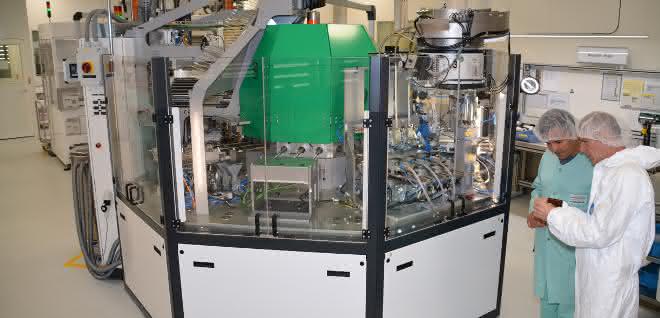
With a footprint of around three by three meters, the modular capping machine installed at Neopac offers space for up to six different processing stations arranged around a rotating carousel. The tubes, which are transported to the capping machine via chain pins, enter a vacuum drum. From there, a connected transfer station places them on rotating vacuum mandrels on the outer circle of the carousel, which then transport them through the machine and rotate the tube as required. In the first processing station, the sprue is cut off and the tube is then sealed in further stations in a rotating or expanding process and finally stripped from the vacuum mandrels in an unloading station for ejection. The entire process is monitored by numerous sensors and industrial smart cameras. Three tubes are transferred or processed in the stations at the same time with a cycle time of 0.6 seconds with the aid of Linmot linear motors. This corresponds to the capping machine's maximum output of 300 tubes per minute.
Flexible, powerful and fast thanks to direct drive technology
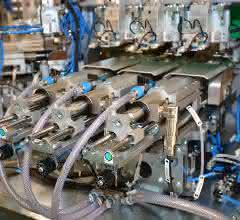
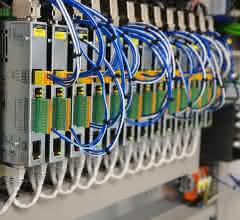
A total of 13 Linmot linear motors with a stator of type PS01-48x240F-C perform positioning and spreading tasks in the stations of the latest machine generation. Thanks to a special motor winding, the stator is capable of developing a maximum force of up to 572 newtons at a nominal force of 240 newtons. The maximum stroke is 1,830 millimetres, with maximum travel speeds of 2.9 meters per second. Correspondingly dynamic, powerful and fast movements can be realized with these motors. The axes in the capping machine are controlled by controllers from the C1150 series, which communicate with the machine controller via Profinet.
"From our point of view, one of the biggest advantages of linear motors is that movement and force curves can be freely programmed and monitored," says Petar Djurdjevic. "Thanks to this flexibility, we can design the stroke movement of the linear motor as required and adapt it flexibly to the requirements of the product, so that the mechanics around the motor can remain untouched when the product is changed." All that needs to be done is to enter the relevant parameters for travel paths and approach positions according to the product data sheet via the machine user interface or call them up via a prepared recipe.
"We can define our own tolerance fields for each parameter. If these are exceeded or not reached, there is an error message and we reject the tubes in question. In this way, the motors help us to ensure quality and traceability," adds Petar Djurdjevic.
As the motors can be operated with position or force control, it was also possible to use the same type of linear motor in both the screw-on station for positioning screw caps and in the press-on station for pressing on caps. This means less effort for the manufacturer and Neopac in terms of stock and spare parts management.
Suitable for use in cleanrooms
Another decisive factor for the production of tubes in cleanrooms is that, unlike linear motion with ball screw drives or a combination of servomotors and toothed belts, the linear motors produce virtually no abrasion. The Linmot linear motors and the supporting linear guides are FDA-compliant even without an enclosure and are also very low-maintenance. "We clean and check the motors and guides every four weeks," adds Petar Djurdjevic. "There is hardly ever anything to relubricate and if there is, then only tiny amounts."
F.J. Roßmann/as
Hall 8, Stand 8217


You might also be interested in
Lifting oven grates
Bharat Forge CDP is a supplier of forged chassis and engine components as well as non-automotive systems. Since 2020, the company has been working with Kito-ER2 electric chain hoists to lift furnace grates in the production hall.
 read more...
Mobile and intelligent handling solutions
Scaglia Indeva has been developing and producing industrial manipulators and handling solutions for more than half a century. The company will be presenting its latest products for logistics at LogiMat.
read more...Mink at the Hannover Messe 2023
Transportation on brushes
Technical brushes from Mink are suitable for the gentle transportation of sensitive workpieces. According to the manufacturer, the adaptability of the brushes to different surfaces ensures part quality and avoids rejects.
read more...Partial automation in wood processing
Rescue from the staff shortage
The Schnurr company in Nordrach in the Black Forest has been processing wood for almost 170 years. Today, the company is a sought-after partner when it comes to individual wooden packaging or sawn and planed wood.
read more...Products for better ergonomics
At Intec, Scaglia Indeva will be presenting innovative ergonomic products for intralogistics. The focus is on products for better ergonomics, smoother work processes and protection of employees against overload.
read more...New pallet roller for the warehouse
Conveyor technology specialist Rulmeca is expanding its range of conveyor rollers for pallets and other heavy goods with the XPS series.
read more...Individual energy management
When a Festoon cable carrier system for a crane system with a travel distance of 30 meters was to be replaced, Tsubaki Kabelschlepp designed a complete package consisting of chain and cables, guide channel including substructure and an individual...
read more...Plan and manage maintenance
The health and safety regulations and statutory inspection guidelines for operating equipment in companies are strict and extensive. As a result, it is not easy to keep track of all inspection regulations and periods in day-to-day operations.
read more...Fully automated conveyor system for battery systems
With a fully automated and flexibly expandable conveyor system for truck loading, a manufacturer of battery systems in the electric automotive industry is meeting the increasing demand.
read more...