

Drive technology
New drive for rotary kilns
After rolling bearing damage to a rotary kiln in a cement plant, the existing gear rim was badly damaged and had to be replaced. SEW-Eurodrive worked closely with the operator to supply a new ring gear and supported the commissioning. The project contributes significantly to the long-term operational reliability and efficiency of the plant.
The cement plant in Vác, around 35 km north of Budapest, is one of the most modern and important cement production facilities in Hungary. It is operated by Duna-Dráva Cement (DDC), a joint venture between the Heidelberg Materials Group and Schwenk Zement. Since its commissioning in 1963, high-quality cement clinker has been produced here - around 2,400 tons a day. The raw material is limestone from the nearby Naszály mountain.
The heart of the production facility is a rotary kiln with a diameter of 4.2 m, in which the clinker is fired at high temperatures. It is rotated by a gear rim, which is moved by a powerful drive system. An asynchronous motor provides around 350 kW, which is transmitted via an industrial gearbox. This is connected via a coupling to a separately mounted pinion, which engages with the gear rim and transmits the required torque. The connection between the ring gear and the kiln shell is made via leaf springs, which enable a flexible yet robust coupling.
The previous drive technology on the rotary kiln was getting on in years. Failure of the pinion's support roller bearing led to misalignment between the pinion and the ring gear. The resulting reduction in the contact surface caused increased wear on both components. To ensure the long-term operational reliability and efficiency of the system, DDC decided to replace the ring gear and drive pinion. SEW-Eurodrive was chosen because of its expertise in the development and manufacture of high-performance sprockets and drive systems.
Material with exceptional properties
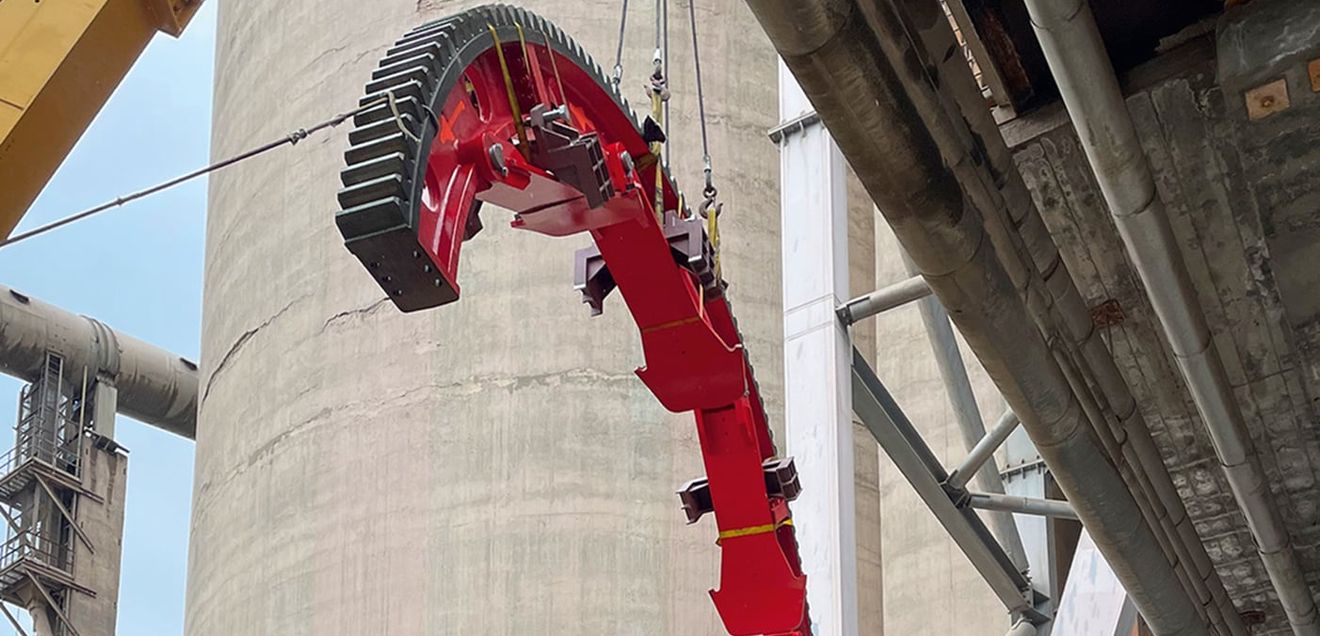
The new solution from SEW-Eurodrive is based on a segmented spider with an outer diameter of 6.1 m and a width of 300 mm. The module of the gearing (dimension for the tooth size) is 40 and the number of teeth has been reduced to 152. The use of high-strength, bainitic cast iron with spheroidal graphite, also known as Austempered Ductile Iron (ADI), is particularly noteworthy. This material offers considerable advantages over classic cast steel in terms of tensile strength, elongation and wear resistance. With a minimum tensile strength of 1,000 MPa and a minimum elongation of 5%, ADI meets the highest requirements for industrial applications under continuous load.
Targeted heat treatment is required to achieve these mechanical properties. It causes the desired microstructure to form in the material and gives the spider its high strength and load-bearing capacity. The contact fatigue strength resulting from the excellent work hardening properties makes the spider extremely resistant and practically wear-free in operation when correctly dimensioned, loaded and lubricated. In addition, the use of ADI cast iron enables a significantly more compact and lighter design of the spider compared to conventional cast steel solutions. This has a
This has a positive effect on handling, assembly and acquisition costs.
Segmented design for high precision
Another key feature of SEW-Eurodrive's gear rims is their segmented design. While conventional gear rims usually consist of two to four large-format segments, the Bruchsal-based drive specialist relies on a multi-part design with particularly compact individual segments. Depending on the overall diameter of the spider, these segments have dimensions of just 1 to 2 meters. This design enables significantly easier handling and consistently high production quality, regardless of the overall size of the spider. Each segment is individually cast, machined, heat-treated and finished. This process ensures the required dimensional accuracy and surface quality regardless of the diameter of the spider. The high initial pitch accuracy of the design corresponds to ISO 8 or AGMA 9 and ensures very good running behavior and even load distribution during operation.
The segmented design also offers advantages in terms of transportation, installation and maintenance. The compact segments can be transported in commercially available containers, eliminating the need for complex special logistics. On site, the segments can either be pre-assembled into two sprocket halves or attached individually directly to the drum. This is crucial when space is limited, as is often the case in existing systems. In the event of damage, it is also possible to selectively replace individual segments without having to dismantle the entire spider. This reduces downtimes and significantly lowers maintenance costs.
High-precision mounting and alignment
Assembly work began in May 2024 with the pre-assembly of the gear rim segments on site in Vác. The final work on the rotary kiln followed in June, including the so-called kiln shot - a process in which a section of the kiln is cut out and replaced with a new segment. The new ring gear was then installed and precisely aligned. The new drive pinion was also installed and brought into the optimum position in relation to the ring gear to ensure a uniform contact pattern. The alignment was carried out with the utmost precision in order to avoid unacceptable vibrations and minimize the mechanical load on the spider and periphery.
A key element of the project's success was the close cooperation between DDC and the experts from SEW-Eurodrive. These specially trained specialists supported the assembly, alignment and commissioning of the new drive unit. Their in-depth specialist knowledge, modern materials technology and efficient cooperation resulted in an economically convincing and future-oriented solution.
Constructive improvements
The advantages of the new spider made of ADI cast iron can be clearly quantified: The width of the spider was reduced from the original 500 mm to 300 mm. At the same time, the gearing module was increased and the number of teeth reduced. These design adjustments led to a significant reduction in material usage, which is reflected in lower investment costs and reduced expenditure on lubrication and maintenance. In addition, the high pitch accuracy of the design and the precise alignment help to reduce vibrations in the overall system. This minimizes the mechanical load on the spider and drive components.
DDC's decision to use SEW-Eurodrive split ring gears demonstrates how modern drive technology contributes to the optimization of industrial processes. The combination of innovative material, well thought-out design and precise manufacturing enabled a durable and low-maintenance solution that meets the requirements of a modern cement plant.
Christian Rüttling, Market Manager for Industrial Gear Units, SEW-Eurodrive
Maintenance, Stand 419


You might also be interested in
Predictive Maintenance in the Powertrain: Stöber Is Gradually Expanding Its Approach
Step by step, the company is continuing to develop predictive maintenance: from monitoring to predictive maintenance to smart powertrains.
 read more...
Eric Goos Appointed to the Board of Sumitomo Drive Technologies
Sumitomo Drive Technologies EMEIA continues to expand its leadership team: Eric Goos has been appointed to the board and will serve as managing director of Cyclo Drive Germany GmbH.
read more..."As rebar gets thicker, automation has to keep up."
Larger wire diameters, greater performance, higher efficiency: How can rebar processing machines be adapted to changing market requirements using new drive technology and an open automation architecture? A user report.
read more...Synapticon and Generative Bionics Partner Up
Synapticon and Generative Bionics have entered into a partnership to develop propulsion systems for humanoid robots. The goal is to establish a European supply chain for the development, manufacturing, certification, and integration of the...
read more...ebm-papst is growing again thanks to AI and data centers
ebm-papst returned to a growth trajectory in fiscal year 2025/26. Air Technology, data center applications, and artificial intelligence are driving revenue and investment.
read more...Preventing Interference from Harmonics
Harmonics are underestimated sources of interference in electrical power grids. Particularly in wastewater treatment plants and water treatment facilities, harmonic distortion leads to poorer power quality and associated costs: additional heating of...
read more...Drives for Extreme Conditions
Standard solutions quickly reach their limits under extreme conditions. Together, Ultra Motion and Faulhaber develop custom-designed actuators for deep-sea, space, and other demanding applications that place the highest demands on reliability and...
read more...Triton Partners takes over Flender
Global investment firm Carlyle has signed an agreement to sell Flender, a provider of mechanical drive technology, to Triton Fund 6, advised by Triton. The terms of the transaction were not disclosed and is expected to close in the fourth quarter of...
read more...New roller conveyor cover from Hema
Rolls faster & lasts longer
Hema brings speed to roller blinds: With the expansion of the product family for roller conveyor covers, the specialist for machine and equipment protection has improved travel speed by 30 percent.
read more...