

Koco Motion
Choosing the right stepper motor linear actuator
Stepper motor linear actuators are on the rise, especially when they can eliminate the need for costly pneumatic cylinders. At Koco Motion, their share of total sales has risen disproportionately in recent years. A reason to take a look behind the scenes of the portfolio.
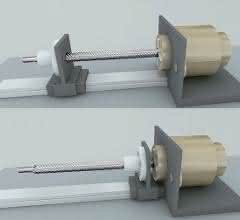
The reasons for using linear actuators are obvious: while the pneumatic cylinder requires a compressor and the necessary peripherals to generate the compressed air, the linear actuator only needs electrical energy to execute a movement. At standstill, the holding current is usually lowered, which saves energy. In addition, all intermediate positions of the maximum stroke can be approached directly. This minimizes changeover times, as the linear actuator can be used flexibly. End-position damping can be achieved by setting acceleration and braking ramps, whereas additional elements may be required to reduce the compressed air volume for linear actuators operated with compressed air.
The Dauchingen-based system house Koco Motion offers various linear actuators for applications that require a combination of precise positioning, fast movement and a long service life.
Customized solutions
While the portfolio includes numerous standard designs, the overall range is enhanced by customer-specific solutions. For example, customized spindle, motor and cable lengths, spindle end designs, individual spindle pitches, connectors, winding resistances and step angles or special nut and slot geometries are in demand.
The linear actuators have a global home. The drives are manufactured by the company Dings' in China or as "MDrive" or "Lexium MDrive" by Schneider Electric Motion in the USA. The third basic drive comes from the "KannMotion" modular system developed in collaboration between Koco Motion and the Liechtenstein engineering firm adlos. All the threads then come together in Dauchingen and the customer is advised by the drive specialists.
Based on stepper motor technology, the linear actuators are available in two technologies: "permanent magnet" (PM) and "hybrid".
PM stepper motor linear actuator for small dimensions
The rotor of the PM motor consists of a radially magnetized permanent magnet. This means that only a limited number of magnetic poles can be produced, resulting in a larger step angle. This technology is cost-effective and can also be implemented for smaller dimensions.
The PM stepper motor linear actuators have a round shape and are available in three sizes with diameters of 20, 25 and 36 millimetres. The resolution of the linear movement varies from 6.5 to 333 µm/step with a maximum thrust of 115 newtons - depending on the actuator size, spindle pitch and step resolution.
Hybrid stepper motor linear actuator for high pole counts
The hybrid stepper motor combines two drive technologies in one: It is a symbiosis of reluctance and permanent magnet motor. Toothed metal caps are attached to the axial permanent magnets. The offset by half a tooth width ensures that the north and south poles alternate. This technology allows a high number of poles and therefore very small step angles.
The hybrid stepper motor linear actuators are available in sizes NEMA 8, 11, 14, 17, 23, 24 and 34. Depending on the step angle and spindle pitch, the resolution of the linear movement varies from 1.5 to 127 µm/step with a maximum push/pull force of up to 2,400 newtons.
The movement is decisive
"We use the above data to determine the motor size and spindle pitch as well as the design of the spindle nut. Other important aspects are the possible self-locking, the available installation space and the control of the drive. The answer to the question: "What is moved how, in what time, where, with which control parameters and how often?" essentially provides all the information needed to select a drive," says Olaf Kämmerling, Managing Director of Koco Motion, explaining the procedure to end the agony of choice.
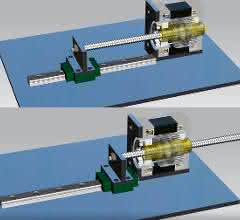
If the standard trapezoidal screw is not sufficient for the application, a ball screw can increase performance even further: It can be used to achieve even more precise positioning, minimized backlash, lower friction, a particularly long service life and high loads. In addition, the wide range of quality classes, pitches, designs and lengths means that most customer requirements can be met.
Both technologies are available with winding connections for unipolar or bipolar control, whereby the bipolar controlled version is now common. The linear actuators are offered either with a hollow shaft nut and spindle (with or without internal anti-rotation lock) or with an external spindle and nut. This results in four designs:
Both versions are available in "External", "Non-Captive" and "Captive C" or "Captive K" versions.
In the External version, the linear movement is achieved by securing the nut against rotation on the spindle, which acts as a motor shaft. This is a popular application. The nut is secured in the slide to be moved and moved linearly by the rotary movement of the spindle. The slide must be guided by the customer. In order to achieve a long service life and reduce frictional forces, it is important to precisely adapt the guide to the axis of rotation. The user must take care of the anti-rotation protection himself, for example by attaching a guide rail. For longer spindles, the free end of the spindle may need to be supported.
In the non-captive version, the nut is inserted in the hollow shaft of the motor. Its rotation causes a linear movement of the spindle. If the spindle is fixed here, the motor moves back and forth. If the motor is fixed, the mass sits on the spindle at the end, secured against rotation.
The Captive C version (closed system) is suitable for harsh environmental conditions. Here, the linear movement is generated by the push rod, which is already internally secured against rotation. The push rod has an internal thread and an anti-rotation lock and is guided in a specially shaped housing. When the rotor (spindle) turns, a linear movement is created via the screw drive and the push rod moves in and out. As the anti-rotation device is already integrated, this variant requires the least design effort from the customer. The load is fixed at the end of the push rod.
The Captive K version differs from the Captive C version in terms of the drive. The push rod is grooved at the front and is therefore secured against twisting. This version forms the drive together with the threaded spindle. When the rotor turns, the push rod retracts or extends. It should be noted here that the spindle on the rear can extend depending on the stroke. The latest version is a very good alternative to the Captive C version in many applications due to its smaller design.
Great application potential
"The possible applications for these linear actuators are so diverse that I can only name a few examples here," says Olaf Kämmerling. "They are used in the adjustment of filling machines for different product widths, for the adjustment of valves to control the flow rate of filling goods, in the sealing technology of injection molds, for positioning products in three planes such as on X-Y-Z tables, as a drive for piston pumps, dosing units and grippers as well as in manipulators, belt stoppers, dosing and positioning units - in other words, wherever linear positioning takes place."
In general, the applications do not differ based on the type of actuator used. Rather, their selection depends in part on the customer's philosophy and the conditions in the company, as well as factors such as price and available installation space.
Networked into the future
If the linear actuator is used for positioning tasks, for example, users increasingly want to integrate it into their network. "We can equip our actuators with an integrated controller for such applications. Network capability is rarely required for PM linear actuators. In contrast, this requirement is more likely to be on the wish list for hybrid linear actuators," says the Managing Director.
The MDrive and Lexium MDrive drives with RS485/Modbus, CANopen, Ethernet and Profinet interfaces are available for the factory of the future or Industry 4.0 applications. Or they can be completed with an RS485 or a sequence program I/O controller via the KannMotion controller.


You might also be interested in
Helu makes its first trade fair appearance under a new brand name
Helu Kabel will be presenting itself as Helu for the first time at Hannover Messe 2026, showcasing system solutions, Heluchain cables and new industrial luminaires.
 read more...
Strategic realignment with brand relaunch
In future, Helukabel will trade as Helu
The Helukabel Group is parting with part of its name: in future, the company will only operate under the Helu brand. With this step, the specialist for electrical connection technology is underlining its strategic development from a classic cable...
read more...Modular plant construction for corrugated board
Insight into the production of corrugators at BHS Corrugated: Automated, modular and equipped with Helukabel components.
read more...Best quality for the steel
Conditions in the steel industry are harsh and inhospitable. The machines used must be able to withstand the demanding environmental conditions in order to deliver the best quality at all times.
read more...If the standard cable is not sufficient
Lapp offers cables for countless applications - but not for all of them. From time to time, the developers have to modify a standard cable or develop a special cable.
read more...Slight decline in sales, strong investments
The Lapp Group has not been spared from the weakening global economy. However, the company only recorded a slight loss in the past 2024 financial year.
read more...Electrical connection technology
Cables and wires for industrial automation
Heukabel offers system solutions for cable routing from a single source. The subsidiary EKD Systems specializes in tailor-made cable drag chains made of steel, stainless steel and plastic, which are used in moving machines and systems as well as in...
read more...Lapp relies on Ultramid from BASF
Mobile charging of electric vehicles
The automotive industry is currently undergoing the biggest transformation in its history. The boom in battery electric vehicles in particular is presenting the industry with major challenges. Lapp, as a supplier of cables and connection...
read more...Cable handling application
At this year's Motek, ArtiMinds Robotics is showcasing a robot-based automation solution for the sensor-assisted assembly of flexible cables in connector housings.
read more...