
Business figures 1st half-year 2020
Schaeffler reports signs of recovery
Although revenue in the first half of 2020 was 21.8 percent below the same period of the previous year due to the Covid-19 pandemic, Schaeffler is satisfied with the order intake.
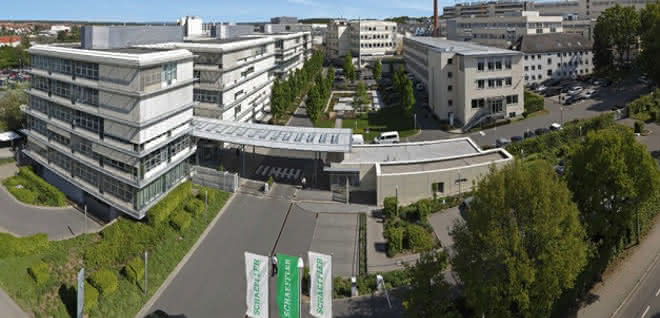
Schaeffler 's revenue (adjusted for currency effects) fell by 21.8 percent in the first half of the year due to the coronavirus pandemic. However, the Herzogenaurach-based company is cautiously optimistic: there were clear signs of recovery over the course of the second quarter.
The interim report of the industrial and automotive supplier shows Group sales of EUR 5.574 billion for the first six months of the year (previous year: EUR 7.226 billion). Adjusted for currency effects, sales fell by 21.8% in this period, in particular as a result of the decline in demand in connection with the Covid-19 pandemic. This was mainly due to the downward trend in revenue in all three divisions, with the Automotive OEM division recording by far the sharpest currency-adjusted decline of 26.8% in the first half of the year.
Structural and efficiency measures with job cuts
The Schaeffler Group generated EBIT before special items of EUR 65 million in the first six months (prior year: EUR 556 million). This corresponds to an EBIT margin before special items of 1.2 percent (prior year: 7.7 percent). According to the company, the deterioration compared to the previous year is due in particular to the decline in the gross margin as a result of the volume-related fall in sales.
EBIT in the reporting period was negatively impacted by one-off effects amounting to € 288 million (previous year: € 73 million). This included an impairment of goodwill allocated to the Automotive OEM division of EUR 249 million in the first quarter. The special effects also include expenses of EUR 39 million for the expansion of the RACE (Regroup Automotive for higher Margin and Capital Efficiency) and FIT programs, which are primarily related to job cuts.
The RACE (Automotive OEM), GRIP (Automotive Aftermarket) and FIT (Industry) programs initiated in the three divisions in spring 2019 are having the intended effect. The structural and efficiency measures initiated in this context had a positive impact on the cost of sales. In addition, measures were introduced and continued in the reporting period to mitigate the financial effects triggered by the coronavirus pandemic. These include temporary measures such as the introduction and expansion of short-time working, the reduction of vacation days and time accounts, hiring freezes and closing days at our plants. In the first quarter, the program was already expanded from 1,300 to 1,900 jobs to be cut.
With these special effects, EBIT amounted to minus 223 million euros (previous year: plus 483 million euros).
The Schaeffler Group's freely available funds in the form of cash and credit lines amount to approximately EUR 2.4 billion, which corresponds to approximately 19 percent of revenue for the last twelve months.
Regions differ
The four regions were affected differently by the pandemic. The Greater China region recorded revenue growth of 3.0% on a currency-adjusted basis in the reporting period due to the recovery that began in the region in the second quarter. The other three regions recorded significant declines in turnover in the first six months. Over the course of June, all divisions and regions saw a noticeable recovery in business performance.
Industrial division: incoming orders stabilize
The Industrial division achieved sales of 1.562 billion euros in the first half of the year (previous year: 1.804 billion euros). Adjusted for currency effects, the decline in sales was 12.8%. During the first six months of 2020, the Europe, Americas and Asia/Pacific regions recorded significantly negative development due to the crisis. Only Greater China recorded double-digit growth, with the wind sector cluster growing in particular. The Power Transmission sector cluster also contributed to growth. Order intake in the Industrial division stabilized towards the middle of the year. In the second quarter, important customer orders were booked for new products, including in the growing robotics sector and for linear technology products. Furthermore, the OPTIME condition monitoring system, which was developed specifically for easy retrofitting in existing industrial plants, was brought to market maturity. The market launch took place in July.
Sales growth in the Greater China region amounted to 17.6% on a currency-adjusted basis, while sales in the Asia/Pacific region declined by 23.4%, Europe by 20.6% and the Americas by 16.8%.
The Industrial division generated EBIT before special items of EUR 141 million in the first six months (previous year: EUR 194 million), which corresponds to an EBIT margin before special items of 9.0% (previous year: 10.8%).
Free cash flow before cash inflows and outflows for M&A activities above previous year
The Group result attributable to shareholders before special items fell significantly in the first six months of 2020 compared to the same period of the previous year to minus 76 million euros (previous year: 324 million euros). Consolidated net income amounted to minus 353 million euros (previous year: 273 million euros). Earnings per preference share therefore amounted to minus 0.52 euros (previous year: 0.42 euros).
Free cash flow before cash inflows and outflows for M&A activities amounted to EUR -148 million in the first half of the year and was therefore higher than in the same period of the previous year (EUR -229 million). At EUR 300 million, capital expenditure (capex) on property, plant and equipment and intangible assets in the first six months was significantly below the previous year's level (EUR 594 million), which corresponds to an investment ratio in relation to sales of 5.4% (previous year: 8.2%).
Klaus Rosenfeld, CEO of Schaeffler AG, said: "By managing free cash flow with foresight, we were able to achieve a better figure in the first half of the year than in the prior year. The strict cost and capital discipline of recent months has paid off. We will continue to maintain this in the second half of the year."
Net financial debt increased to EUR 3,002 million as at June 30, 2020 (December 31, 2019: EUR 2,526 million). The gearing ratio, i.e. the ratio of net financial debt to equity, increased significantly to around 160% (December 31, 2019: 86.6%). The gearing ratio before special items was 1.8x at the end of June 2020 (December 31, 2019: 1.2x).
As at June 30, 2020, the Group employed 84,223 people (December 31, 2019: 87,748), which corresponds to a decrease of 4% or 3,525 jobs in the first half of the year.


You might also be interested in
Electromobility and the supplier industry
Bosch wins major order from Mercedes-Benz for electric motors
Bosch receives a major order from Mercedes-Benz to supply electric motors for new electric drives until the 2030s. The supplier is thus further expanding its position in the growth market of electromobility.
 read more...
Production of high-voltage batteries
Electrically mobile - sustainable on the road
High-voltage batteries for electric cars are produced at the BMW plant in Leipzig. SEW-Eurodrive supplies proven and new drive solutions from the Movi-C modular system for all process steps - from cell preparation to end-of-line testing.
read more...Thyssenkrupp and Novelis cooperate
Platform for the circular economy
With a platform for the circular economy in the automotive industry, the two companies Thyssenkrupp Materials Services and Novelis want to set new standards for the recycling of used materials. The open platform will enable access to larger...
read more...85 years of precision technology from the...
Anniversary at Kammerer Gewindetechnik
Kammerer Gewindetechnik, manufacturer of screw drives in Hornberg in the Black Forest, is celebrating its 85th anniversary this year. The family business was founded in 1938 and is now managed by the third generation with 160 employees.
read more...Hydraulic brake cylinders from ACE: Easier handling even in critical environments
For active air sampling in highly sensitive cleanroom areas, special samplers are used for maximum protection of people and materials. The British company Pinpoint Scientific, which specializes in laboratory equipment, uses hydraulic brake cylinders...
read more...Expansion of the business units
Ulrich Engenhardt new CBO at Rittal
New on the Rittal Management Board: Ulrich Engenhardt has been responsible for the business units at the enclosure, IT and energy system specialist since June 1, 2023.
read more...Lifting oven grates
Bharat Forge CDP is a supplier of forged chassis and engine components as well as non-automotive systems. Since 2020, the company has been working with Kito-ER2 electric chain hoists to lift furnace grates in the production hall.
read more...Digital twins are the key to sustainability
Altair has published the results of an independent survey that shows a high level of acceptance of digital twin applications in the automotive industry. Furthermore, the use of these technologies is expected to increase as a means of achieving...
read more...Balluff remains consistently on course for growth
Balluff achieves a record result for the second time in a row. Total sales in the 2022 financial year amounted to 567 million euros. The sensor and automation specialist sees further growth opportunities for products in the field of image processing.
read more...