
Altair survey
Digital twins are the key to sustainability
Altair, a specialist in computational science and artificial intelligence, has published the results of an independent survey showing a high level of acceptance of digital twin applications in the automotive industry. Furthermore, the use of these technologies is expected to increase as a means of achieving sustainability goals.
The global survey of more than 2,000 professionals from different industries and 10 countries examined the adoption of digital twin technology and assessed how companies are using it, the benefits it brings to their business and the impact it has on sustainability initiatives.
"As consumer demand, government expectations and global emissions targets increase, so do the demands on automakers to keep their electric vehicle production on track," said Dr. Royston Jones, Senior Vice President of Automotive at Altair. "The survey results show how important the use of digital twins is to achieving these targets. Although many companies have already integrated these technologies into their processes, there is still a lot of education needed about the benefits that will lead to rapid adoption of the technologies across the industry and beyond."
According to the survey, the automotive industry ranks second only to heavy engineering among the eleven sectors surveyed in terms of the prevalence of digital twins. Although 76% of respondents from the automotive industry stated that their company already uses digital twin technologies, users in the automotive industry are apparently still at an early stage of adoption and would like to learn more about the benefits and possible applications. Only 35% of respondents believe that they are "very familiar with digital twin solutions" - the second lowest percentage of all industries surveyed.
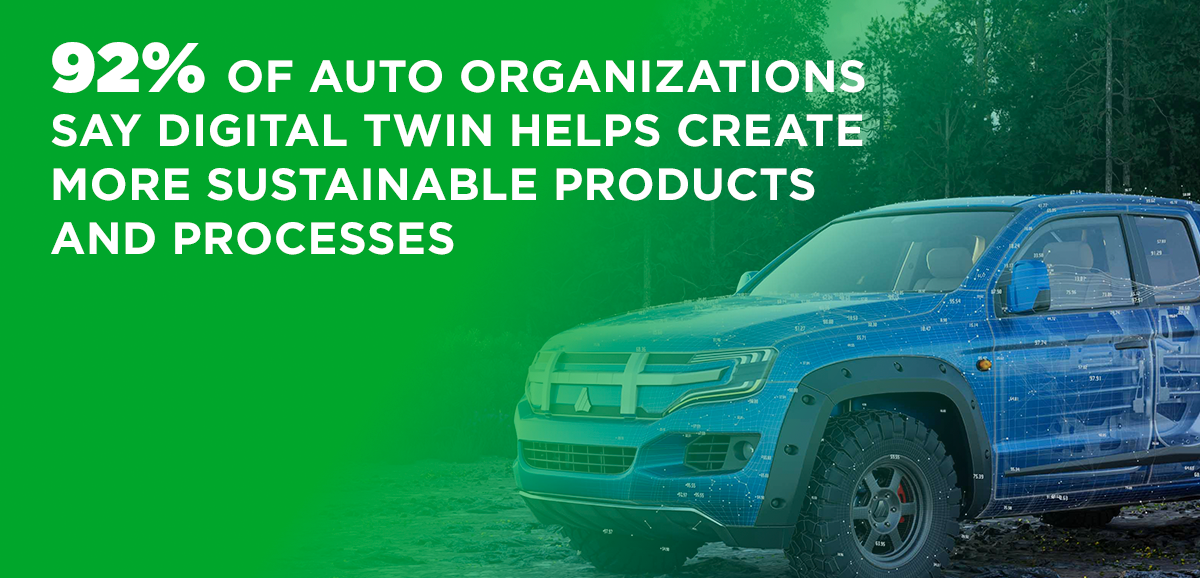
Crucially, almost all respondents from the automotive sector (92%) who said they used digital twins said they had helped them to develop more sustainable products and processes. The automotive industry was the sector most likely (63%) to use digital twins to achieve sustainability goals. Solutions using digital twin technology reduce material waste by allowing engineers to run simulations during the design process and test features before they are prototyped, reducing the number of physical prototypes needed.
Conversion to e-mobility
The transition to electric vehicles, which will be an important aspect in the fight against climate change and the reduction of carbon dioxide emissions, is driving rapid change in the automotive industry. Consumer interest and demand for EVs is growing, and the U.S. government is enacting stricter regulations to incentivize automakers to move away from traditional internal combustion engine vehicles. Digital twin technology can help the automotive industry bring more EVs to market faster and at affordable prices.
Further results of the survey
Cost reduction and better products: Almost all respondents (97%) stated that solutions using digital twin technology support the development of new products.
- Importantly, 70% of those who use digital twins stated that it has significantly reduced maintenance and warranty costs.
- The responses from the automotive industry most clearly predict that solutions using digital twin technology will improve the quality of products manufactured in the future (50%).
- 38% of respondents from the automotive industry believe that digital twin technology will make the creation of physical prototypes obsolete within the next four years or sooner.
Sustainable impact: An impressive 92% of automotive respondents expressed that digital twin technology has helped their business develop more sustainable products and processes.
- 63% use digital twins to achieve their sustainability goals and find that it makes their products and services easier to refurbish and/or reuse (51%).
- 78% of respondents stated that the technology helps their company to achieve energy savings and/or enable the efficient use of resources.
Desire for more education and acceptance: Although the data shows that digital twin technology is widely used in the automotive industry, there is potential for growth and a desire for more education.
- Of those respondents whose organizations are not currently using digital twin solutions, 22% expect to do so in the next six months or sooner, and 33% expect to do so in a year at the earliest.
- 92% of non-executive employees believe their managers would be more willing to invest in digital twin technology if they better understood its benefits.


You might also be interested in
Predictive maintenance in retrofit
Predictive maintenance pays off. This is because early detection of impending failures means that systems can be serviced in a targeted manner before production downtime occurs. But how complex is it to integrate such a maintenance concept into an...
 read more...
Maintenance instead of replacement
The circular economy starts with the machinery
Sustainability in industry starts with machines, says our guest author from Deguma: How maintenance, modernization and the 5R strategy save resources, energy and CO₂.
read more...3D printing for unplanned requirements
The material fails and the machine suddenly stops? Then you need to take the right measures to be able to resume production quickly. Material failure in the form of faulty components or material wear in the frame are a risk for any production.
read more...High demands in terms of safety, application and robustness
Demanding work in the electrical trade and energy supply as well as smooth processes in production require innovative and customized measurement technology that scores points for safety, ease of use and resilience.
read more...Car meets e-bike: riding with lubrication-free polymer bearings
Studies show that the proportion of pedestrian and bicycle traffic is increasing in urban areas. With the JetBike, JetBike GmbH from Braunschweig presents a mixture of e-bike and car and relies on lubrication-free polymer bearings from Igus.
read more...Hydraulic hub for more efficient servicing
Bosch Rexroth presents a digital toolbox for service and maintenance. With a comprehensive range of digital services, the Hydraulic Hub simplifies and accelerates the service and maintenance of hydraulic products and increases machine availability.
read more...Arnold Umformtechnik expands after-sales...
Faster help with VR glasses
Arnold Umformtechnik is expanding the after-sales service for its machines to include digital remote services. The focus is on data security, simple operation and clear processes.
read more...147,000 euros per hour: high costs for German companies due to unplanned downtime
According to the "Value of Reliability" study, 67% of industrial companies in Germany experience unplanned downtime at least once a month. This costs the German economy 147,000 euros per hour. Nevertheless, reactive maintenance concepts are not...
read more...Maintenance starts with a maintenance planner
Legal requirements stipulate that machines and systems must be serviced regularly. The maintenance work serves to ensure occupational safety and economic efficiency.
read more...