
Welding robots
Welding robot with extended workspace
A welding technology company uses flexible high-tech robots to weld series products. This has significantly increased quality and production capacity.
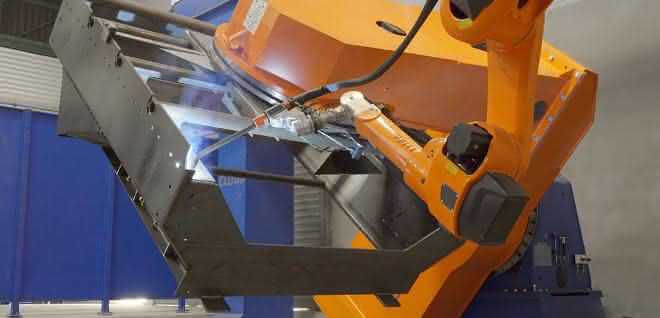
As a contract manufacturer for international companies in various sectors, Bieber Industrie uses welding technology from Cloos. In addition to manual welding equipment, Bieber uses three robot systems from the specialists in Haiger. Bieber commissioned the third robot system for welding grate troughs for waste incineration systems just in time for the company's 100th anniversary in 2019. Both Bieber and Cloos were founded in 1919 and can therefore each look back on more than 100 years of company history.
In the early years, Bieber initially manufactured equipment for the agricultural sector and quickly developed into an industrial subcontractor for the production of individual parts for large series after the Second World War. From the mid-1990s, the company once again invested heavily in machinery in order to expand its product range. Today, more than 100 employees manufacture various products for sectors such as environmental technology, the energy industry, the rail industry, metal and mechanical engineering, the food industry and agriculture. "Thanks to our strong diversification, we are independent of individual markets," says Managing Director Raymond Bieber, who is now the fourth generation to run the family business together with his great cousin Marc Bieber.
Welding as a core competence
Whether laser cutting, edging, bending, electrical or mechanical assembly - Bieber offers the entire range of sheet metal processing. At the heart of this is the welding area. Bieber has been using welding technology from Cloos for more than 20 years. A total of 40 employees work in welding production. In the manual welding area, Bieber uses more than 20 welding power sources from Cloos. The first robot system for welding small parts was added in 2015. Another robot system followed in 2017 for welding medium-sized components.
The latest system from 2019 now welds the complete grate trough for waste incineration systems. Here, the Qirox QRC-350 is mounted overhead on a vertical track with vertical and horizontal lift. This considerably extends the robot's working area, allowing it to move flexibly in all directions. The workpiece positioner brings the components into an optimum position for welding. It has a horizontal swivel axis on which an L-shaped arm is mounted. A vertical rotary axis with a faceplate is integrated into the arm and is used to hold the workpiece.
The robot has a torch changing system. This enables the flexible use of different welding processes - depending on the application. The system is also equipped with an arc sensor to compensate for any component tolerances. This sensor not only uses the arc for welding, but also for measuring the workpiece joint position. If the measurement results are unequal on both sides, the position of the joint deviates from the programmed path. The computer-based robot controller then corrects the position of the welding head so that the seam is positioned exactly in the middle of the joint. As measuring and welding take place simultaneously with the arc sensor, there is hardly any loss of time.
The intelligent Duo-Drive wire drive system transports the welding wire safely and reliably without restricting the robot's freedom of movement. The slim and compact design of the wire drive guarantees good accessibility even in confined areas.
Increased production capacities
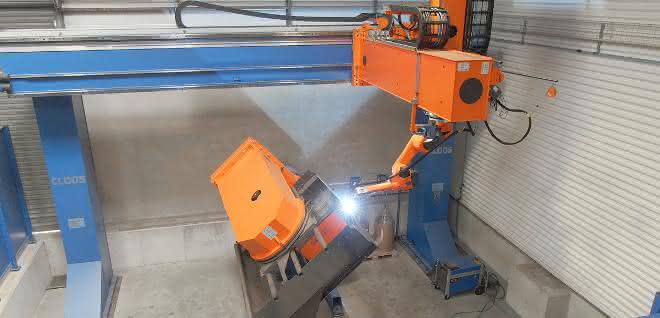
So far, the new robot has mainly welded grate trays for waste incineration systems in various sizes and dimensions of up to 3 x 3.50 m. Due to the extensive equipment of the robot system, a large number of different products can be manufactured here.
By speeding up the welding process, Bieber was able to significantly increase its production capacity. The company used to produce 15 grate troughs per month, now it produces around 45. The welding robot achieves precisely reproducible results, which has further improved quality. Last but not least, the company can now operate more independently of human resources. Bieber is also affected by the shortage of skilled workers and faces the challenge of finding suitable manual welders. The investment in automated welding technology was therefore absolutely essential in order to ensure long-term competitiveness. The robots mainly weld series products, while individual parts or special parts are still welded manually.
Aiming for maximum flexibility
"The schedule for the delivery and commissioning of the robot systems was well adhered to," says Bieber happily. "We are very satisfied with the support provided by both the Cloos employees in Haiger and the Cloos factory representative Philippe Schweißtechnik."
With the three robot systems, the modernization of welding production at Bieber is complete for the time being. No further robots are planned for the time being. However, the positioners on the robot system from 2015 are to be adapted so that an even greater variety of components can be welded on the system. "We develop the products hand in hand with our customers," says Bieber. "Our aim is to become even more flexible so that we can expand our range of products even further."
Stefanie Nüchtern-Baumhoff, Head of Corporate Communications & Marketing Carl Cloos / am


You might also be interested in
CU-Flex copper processing center
Process copper in three stations
Boschert also presented the revised CU-Flex copper processing center with its three stations for punching, bending and shearing in Hanover. This allows users to completely manufacture copper parts in just one work process.
 read more...
Unlocking hidden CAD data potential
With the new version of the Classmate software suite, Simus has increased the user-friendliness and effectiveness of the modules. From structuring and cleansing databases to synchronization with SAP, the tools provide sustainable benefits in design,...
read more...Resource-saving bending as a competitive factor
Resource-saving, user-friendly and highly efficient - Schwarze-Robitec, the tube bending machine manufacturer, combines these advantages in an all-electric multi-radius tube bending machine with a newly developed cutting system.
read more...Sheet metal knowledge at the touch of a button
Optimate, a start-up spun off from Trumpf, wants to give sheet metal processing more process reliability in production. The key to this is a cloud-based web app solution for the analysis and optimization of sheet metal components.
read more...Speaking the same language
Tables have a long tradition in work planning. In the search for empirical values, work planners spend valuable time on values that are inaccurate and not very reliable in production practice.
read more...Precise and efficient bending technology
MicroStep Europe offers press brakes that are characterized in particular by numerous sensor-controlled assistance systems. These reduce the demands on the operator's specialist knowledge and also ensure the highest quality bending results in a...
read more...Fully automatic folding
The well-known Austrian window manufacturer G.S. Georg Stemeseder now also offers sun protection products. The Schröder Group has enabled an unprecedented level of automation for the new production.
read more...Prepared for increasing demand
In the first half of 2021, Stauff, a manufacturer of components for hydraulic piping systems, commissioned a new Riello rotary transfer machine.
read more...Networked pipe technology
Transfluid is coming to Blechexpo with a wide range of innovations. In addition to new system technology, the focus will be on networking.
read more...