
High-performance plastics
Special screw for secure connection
In the automotive industry, aluminum components are increasingly being replaced by high-performance plastics. In addition, the complexity of the components in which the material is used is constantly increasing. Against this backdrop, companies can use fasteners with an asymmetrical thread profile to ensure a secure connection.
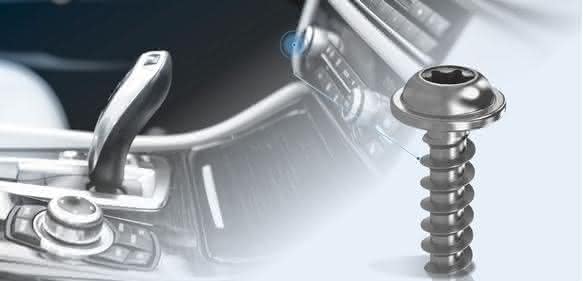
A classic metric connection can be calculated and designed realistically using analytical methods. However, the material used plays an important role in direct plastic fittings. Although the basic composition of the plastic types is always the same, the additives that are introduced, for example to adjust the strength or special properties, result in an individual component. This has an impact on the screw connection and is therefore a challenge for developers and manufacturers.
The first processing step in a conventional plastic screw fitting is inserting the insert into the mold. The plastic component is then injected, cooled and demolded. Before the final assembly process can begin, a screw is also required. However, plastic direct fasteners are increasingly being used wherever lightweight construction, high forces and cost optimization come together: in PCB fasteners where installation space is severely limited or the use of inserts is not possible, in highly stressed thin-walled components such as exterior mirrors, but also where production costs are of great importance - in coffee machines, vacuum cleaners or oil filters.
In contrast to conventional plastic screw fittings, the processing time for direct plastic screw fittings with the Remform screw from Arnold Umformtechnik is significantly shorter. "The component can be injected directly with optimally designed core holes and then assembled using a plastic screw. This eliminates cost and process time drivers such as handling different small parts as well as higher tool costs and process times for the insertion process," explains Martin Stasch, product engineer at Arnold.
Secure connection thanks to special thread geometry
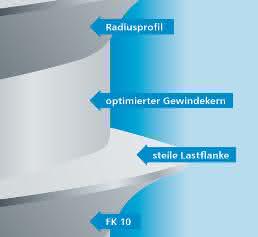
Thanks to its asymmetrical thread profile, the Remform screw ensures a secure connection of the plastic direct screw connection. "Compared to a conventional plastic screw, the Remform has an optimized thread core, which significantly increases both the fatigue strength and the breaking torque of the screw. This leads to a more stable connection between the joining partners and enables a higher assembly torque without the risk of screw breakage, even with high-strength plastics," says Stasch.
The radius profile of the thread flanks is an improvement on the usual 30° flank. Due to the rapidly occurring compressive stresses during thread forming and the comparatively high rotational speeds, heat is transferred locally into the plastic. Due to the temperature-dependent visco-elastic properties of the plastic, the flow behavior and direction can be specifically influenced. With the higher material volume, the radius profile displaces the plastic towards the load-bearing flank without generating strong stress peaks. The steep load flank has the task of generating the necessary preload force while ensuring a high level of installation safety. The preload force applied must therefore be absorbed evenly by the plastic without risking dome breakage due to excessive radial stresses. The comparatively flat inclination of the load-bearing flank and the increased proportion of plastic on the contact surface enable a steeper orientation of the force vector in the axial direction. This reduces the risk of dome breakage by minimizing the radial stress while increasing the transmittable force.
In order to meet all these requirements for plastic direct fittings, Arnold uses a material of strength class 10 for the Remform.
Solutions for individual applications
The trend towards replacing metals with increasingly high-performance and high-strength plastics continues. Optimally designed direct fastening processes adapted for these high-performance plastics take this into account. They can shorten assembly times and minimize assembly risks. The screw design and the correct layout of the plastic component play a particularly important role here. For Martin Stasch, one thing is certain: "Plastic direct screw fastening can be used in almost any plastic application through targeted design." It is important to reduce the number of small parts to a minimum, especially in the case of complex assemblies, either during development or in the form of optimization loops.
"We support the customer right from the start of the design process and create a targeted analysis of the components and requirements. This allows us to reduce complexity without influencing the component properties while maintaining and possibly even improving the connection properties. The aim is always to develop a solution that is individually tailored to the customer's application," explains the product engineer.
The geometric properties of the plastic screw result not only in a high level of assembly reliability and assembly preload force, but also the possibility of creating process-reliable repeat screw connections. In contrast to conventional plastic screw connections using a sleeve, screw and nut, the complexity of the components and the number of small parts to be managed can be reduced thanks to the one-sided accessibility of plastic direct screw connections.
With the help of the Arnold Fast Designer Plastics forecasting tool, the assembly process and the assembly preload forces can be predicted during the design process and the core hole and screw can be adapted to the corresponding requirements. Cost-intensive trials can thus be reduced. am


You might also be interested in
Safe-Torque Speed in three sets
With this torque screwdriving tool, users can set the desired torque value and screw in the screw precisely.
 read more...
Screws, swivels, rings and brackets
Ganter offers a wide range of different load attachment points. Classic and simple attachment points are DIN 580 eyebolts, which are screwed into a thread; DIN 582 ring nuts made of steel or stainless steel are suitable for loads without a thread.
read more...Nomination Products of the Year 2024
Arnold Umformtechnik: Conform screw
Under the motto "Every screw can be a climate protector", the Conform screw from Arnold Umformtechnik has been nominated in the metalworking category in the competition for Product of the Year 2024. Its use can save costs andCO2.
read more...Implement milling tasks economically
Milling covers a wide range of applications - from the machining of large free-form surfaces in the aviation industry and in the manufacture of wind turbines to the milling of cavities and highly automated mass production.
read more...Heat recovery for compressed air generation
Tube bundle heat exchangers utilize waste heat
Aerzen implements efficient heat recovery systems. By recovering the heat generated in the compression process, operators can save energy and increase their competitiveness. Energy-saving measures are particularly useful in compressed air generation...
read more...Clean, safe and modular
With the intelligent Aquamat i.CF, Kaeser Kompressoren is redefining condensate treatment. The oil-water separator is available for delivery volumes of up to 90 cubic meters per minute and is equipped with the internal Aquamat Control for the first...
read more...Screw blower series extended
Delta Hybrid is an innovative and efficient solution in compressor technology. Aerzen has now taken its successful screw blowers to the next technological level.
read more...Efficient and sustainable
Rotary screw compressors are the reliable backbone of industrial compressed air generation. The innovative CSD/CSDX series from Kaeser Kompressoren with its numerous features produces them efficiently and saves energy costs. This also reduces theCO2...
read more...Intelligent compressed air management
At the Hannover Messe, Boge showed how compressed air systems can be analyzed and optimized with Boge connect. The service tool has been expanded to include additional connection options and offers even more versatility.
read more...