

Fasteners in sandwich materials
MultiMaterial-Welding - fast and resilient
Products in sandwich construction are in vogue throughout the industry. They offer high strength combined with low weight. Various material combinations also allow flexible application options. MultiMaterial Welding technology is a new process that enables the reliable joining of load-bearing connecting elements in foamed and honeycomb core materials.
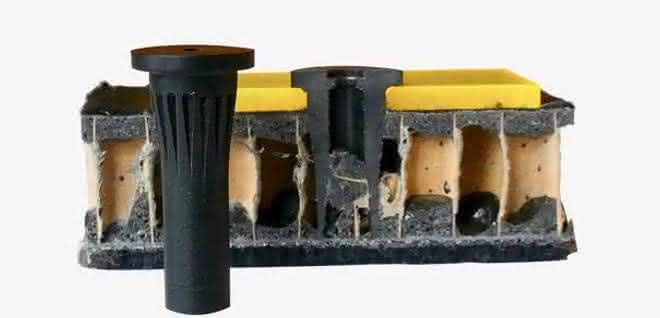
Lightweight or sandwich materials pose challenges for designers and developers: The solutions used must offer maximum safety and efficiency and at the same time be designed in such a way that they take into account the special properties of the substrate material and the requirements of the respective applications. Traditionally, riveting, screwing or gluing methods are used for the installation of fasteners. These are mainly due to the large number of possible material combinations: An MDF board (medium density fiberboard) coated with melamine resin requires a different approach than an aluminum/plastic core combination or a workpiece with a plastic surface and foam core or honeycomb structure.
Regardless of the joining method chosen, preparatory work such as drilling holes or applying adhesive substances is required. In addition, curing or cooling times often have to be taken into account afterwards. The additional work involved stands in the way of the requirement for the most efficient automation processes possible. KVT-Fastening 's MultiMaterial-Welding technology (MM-W) takes a completely different approach.
New fastening technology
With the patented MM-W technology, a new fastening technique is now available. Using ultrasound and thermoplastic fastening elements, permanent force-fit and form-fit connections are created in a matter of seconds. The method has its origins in the WoodWelding and BoneWelding processes, which have been used in a similar form in the furniture industry and medicine for many years. Conventional joining techniques are based on the principle of solid materials that are to be joined together. In lightweight construction, on the other hand, both extremely strong metals and combinations of fiber composites are joined together. Conventional joining systems with partially adapted properties are used for the metallic components. However, fiber composites, sandwich panels and lightweight materials, for example in the form of foamed materials through to those with a honeycomb structure, are often porous materials.
The existing cavities in these materials - and therefore the lack of solid mass in the material - often make it difficult or impossible to use conventional fastening systems. This is because the relatively small contact surfaces between the connector and the component or part cannot transfer large, load-bearing loads. If a pilot hole is required into which conventional fasteners such as rivets or screws are to be inserted, this not only involves an additional process step. There is also a risk of material weakening. If the components are glued, the process reliability is limited due to the surface properties, which are not always optimal. This severely limits the wishes of process engineers for faster and simpler production processes and of designers and developers for new design options in the field of lightweight construction technology.
What is behind MM-W?
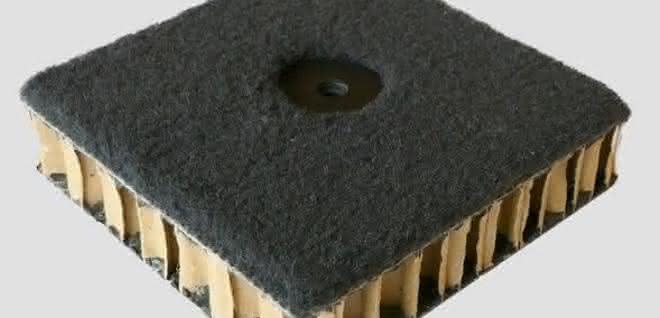
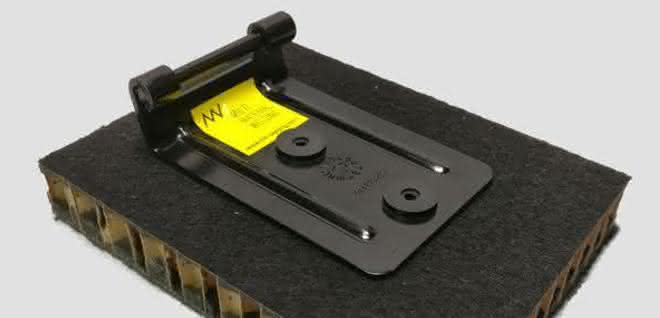
With the MM-W technology, which is patented by MultiMaterial-Welding AG and sublicensed by KVT-Fastening parent Bossard, the LiteWWeight variant, for example, uses thermoplastic fasteners in a pin, sleeve or freely selectable form instead of conventional fasteners (see Figures 1, 2 and 3). The functional principle: The thermoplastic fastener is driven through the surface layer in phase 1 by a combination of ultrasonic movement and pressure. Due to the friction between the fastener surface and the component, the surface of the fastener itself becomes the joining material. Thanks to its material hardness, however, it retains its shape and function. The MM-W process uses the combination of ultrasonic energy, material hardness and the design of the fastener to drive it into the component on the one hand and to use the melted plastic as a bonding material on the other. The porous material of the component is ideally filled via the capillaries of the melt, which results in a larger-volume and larger-surface holding anchorage.
MM-W technology has various advantages. One of these is the significantly shorter process time compared to alternative joining techniques. This leads to more efficient inline processing: the entire joining process takes less than a second. No curing or cooling times need to be taken into account afterwards. The joint can be loaded immediately after the joint is released. In most cases, there is also no need to pre-drill a hole in the material. Another advantage: the technology offers a high degree of flexibility, as the fasteners can be used without pre-positioning to compensate for tolerances. In addition, the MM-W method guarantees stronger bonds than many other fastening methods. The background to this is that by designing a surface shape and size that meets the requirements in combination with the selection of the appropriate thermoplastic fastener, loads are applied to a large area of the component. This not only creates a fastening point, but also integrates the fastener into the component both functionally and visually.
These new freedoms in the design of applications are also not tied to specific geometry specifications, such as radial symmetry. In addition, thin substrates can also be provided with connection points without visually impairing the "reverse side". Processing is also cleaner compared to conventional joining techniques, as no additional materials or pre-treatment of the surfaces are required and no waste is produced. Last but not least, the ability to statistically control the process guarantees the consistent quality of each individual connection point and makes the process permanently reproducible and reliable.
Areas of application for MM-W
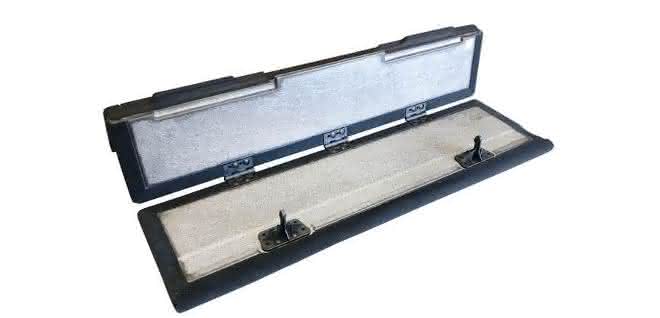
The main focus of the constantly evolving MM-W technology is currently on joining foamed materials, sandwich materials or honeycomb panels, such as those used in the automotive and transportation industries (see application example in Fig. 4). Joints between sheet metal and compact plastics are also possible. In this case, a deep-drawn "pore" is driven into the compact thermoplastic in the sheet metal. As a result, a metallic fastener, for example a nut or a bolt, can be equipped with a specific anchoring geometry, which is then applied to the back of a component with a Class A surface using the MM-W process, thus creating an invisible joint. Further developments are in the test phase and will be applied in the near future as requirements increase.
All in all, MM-W technology combines the advantages of conventional joining and bonding technology. It combines high strength with fast and controllable processes, increases product quality and process efficiency and therefore offers a completely new alternative for joining lightweight materials.
Florian Beer, Managing Director at KVT-Fastening Germany / ag


You might also be interested in
Cutting solutions in 2D and 3D
Microstep showed 2D and 3D cutting solutions in action on sheet metal, tubes, profiles and container bases, including bevel cutting with plasma or waterjet and dynamic fiber laser cutting, as well as drilling, milling and marking demonstrations.
 read more...
Precision machining of bores
Paul Horn is presenting an innovative extension for the Supermini system in the field of ultra-fine machining at EMO 2023. The system has been supplemented by a variant with an ultra-fine ground cutting surface.
read more...Deep drill holes optimized with PCD
When the Schlote Group built a new plant in Harzgerode in 2017, production was geared towards series production of a single component right from the start.
read more...Production goes digital
EMO, the world's leading trade fair for production technology, invites the industry to Hanover from September 18 to 23.
read more...Vibration-free groove turning process
Adjustable damped boring bar
Paul Horn is exhibiting innovations and product enhancements at the EMO in Hanover. Among other things, the company is exhibiting a boring bar that can be adjusted to the vibration amplitudes that occur.
read more...Efficiency with digital twins
Digitalization and automation are the way to increase efficiency and flexibility in machining. The Tebis team will be presenting suitable solutions for mechanical engineering at EMO.
read more...Many highlights in Leipzig
Ceratizit will be presenting the highlights from its portfolio at Intec. In addition to the latest tools for milling, turning and drilling, automation solutions will also be a top topic at the tool manufacturer's stand.
read more...How smart robot simulation works
More intelligent, more efficient, easier to operate - robots are developing rapidly. Among other things, great care is required when setting them up and operating them in order to avoid cost-intensive downtimes. Robot simulation tools are...
read more...Milling, turning and grinding center
Milling, turning, grinding and gear cutting on one and the same machine - in a single clamping operation: Soraluce's multitasking machines are the answer to technically complex workpieces with tight tolerances that require various machining...
read more...