
Welding of bipolar plates
More productive welding for hydrogen fuel cells
Scanlab, together with sister companies Blackbird Robotersysteme and Holo/Or, is developing a new system setup that could double productivity in the welding of bipolar plates for hydrogen fuel cells.
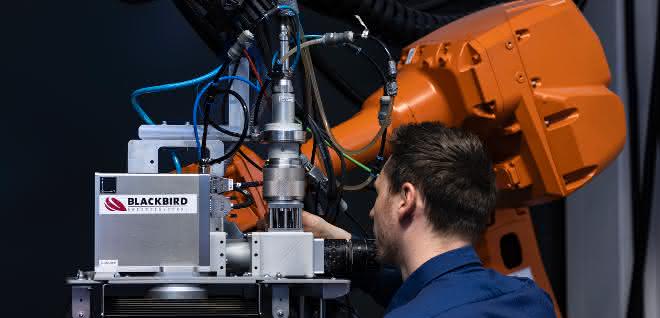
Fuel cell technology was long regarded as a niche market. In the meantime, demand has increased noticeably, but for efficient mass production, the throughput for welding metallic bipolar plates, which form the stack of a fuel cell, must be increased. High welding speeds require fast scanning systems and high-power lasers, both of which are available today. However, the welding process itself is decisive for the achievable speed. Defects in weld seams, such as "humping effects" and penetration notches, often occur as soon as a certain speed is exceeded.
Blackbird Robotersysteme has integrated the Intelliscan 2D scan head of the Flexishaper in a test setup. Flexishaper, a beam shaper that can be adjusted across the entire power range, is the latest development from Scanlab and Holo/Or. A process simulation was used to determine the necessary beam shaping. The design of the beam shaper used is the result of a combined optical design that combines diffractive optical elements (DOE) with a scanning system. The application tests allowed the speed limit for flawless welding to be shifted from 45 m/min to up to 70 m/min.
High demands on the process
Welding thin sheets for bipolar plates places similar demands on the machining process as laser powder bed fusion (LPBF). Both processes require a scanner image field of up to 500 x 500 mm² and a typical process speed of around 1 m/s and below. In the metal 3D printing process, the processing speed is not limited by the scanning system or the laser power, but the process itself sets the limits for the throughput. The pleasing laser welding results are therefore the first step on the way to optimizing LPBF processes.
The next steps are to test the concept of laser welding on a larger scale and to pursue various applications in parallel. Scanlabs Fibersys is specifically designed to meet the requirements of both LPBF and welding processes. For this reason, the integration of DOEs precisely into this scanning system, specially designed for use in multi-head machines, has been included in the development roadmap.


You might also be interested in
New Resin Opens Up 3D Printing for the Optics Industry
With BMF Clear, Boston Micro Fabrication has introduced an optically transparent photopolymer resin for micro-precision 3D printing that achieves a light transmittance of over 90 percent at layer heights of 10 micrometers or more and is suitable for...
 read more...
3D Printing in the Defense Sector
Formnext Launches 2026 Defense Summit
Formnext is expanding its program to include the security and defense sector and will host the first Formnext Defense Summit in 2026. The event will focus on the potential of additive manufacturing for resilient supply chains, industrial...
read more...UltiMaker Doubles Speed in Industrial 3D Printing
With the Factor 4 Plus, UltiMaker is introducing a new version of its industrial desktop 3D printing platform, which operates at up to twice the print speed of the standard model. The platform is designed for use in manufacturing and defense...
read more...Stratasys takes over MarkForged
Stratasys is acquiring MarkForged from Nano Dimension for USD 42.5 million, thereby expanding its portfolio in the field of fiber-reinforced composites. The acquisition also strengthens the company's software and materials expertise in industrial 3D...
read more...Timo Göbel, Head of BMW Additive Manufacturing
"Clearly on course for broad industrialization"
The BMW Group's Additive Manufacturing Campus (AMC) is setting the course for the next stage of industrialization. Under the leadership of Timo Göbel, additive manufacturing is being further integrated into all stages of the vehicle life cycle. In...
read more...Real-time control to make recycling materials economical
The Fraunhofer IAPT is researching AI-based closed-loop processes for industrial 3D printing with recycled plastics. The aim is to achieve less waste, greater process stability and profitable printer farms.
read more...Forum Solutions 4AMIndustry shows ways into industrial application
Additive manufacturing has developed dynamically in recent years and has long outgrown its status as a purely innovative technology in many industries. Nevertheless, companies still face the challenge of integrating AM into their production...
read more...Alliance aims to drive forward industrial 3D printing
Machine components, electrostatically shielded transport containers, large components for the automotive, rail and aviation industries or specific medical products straight from the printer - the potential applications of additive manufacturing are...
read more...Photonic microchips with 3D connector
How a 3D system makes photonic chips industrially viable
A research team from Heidelberg is developing a 3D-printed "connector" for photonic microchips. The solution promises a low-loss, standardized coupling of glass fibre and chip - and could fundamentally simplify the production of photonic integrated...
read more...