
Servo amplifier
Torque changeover during operation
Sieb & Meyer has developed a special function for the use of the SD3 in servo screw jacks: The servo amplifier now makes it possible to switch between torque and speed operation "on the fly".
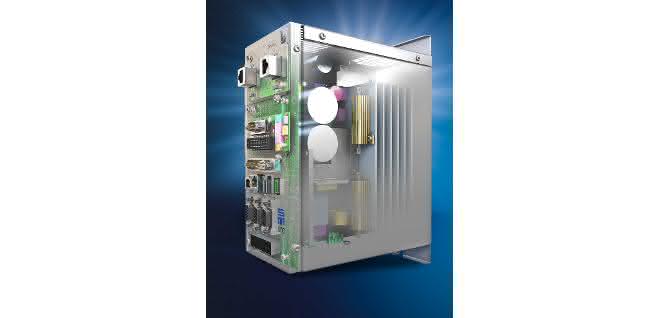
This control technology challenge exists primarily in lifting systems for material handling, such as those used in the automotive industry.
"The SD3 has been used in hoists from a renowned manufacturer for several years and has proven itself very well there," explains Ralph Sawallisch, Key Account Manager Drive Electronics at Sieb & Meyer . "With the new function, we are responding specifically to a requirement that has arisen in a special application." Specifically, this involves a scenario in production in which a trolley rolls horizontally on a rail system. It transports a suspended load of variable weight - for example, a gearbox that is to be mounted on an engine block. The system automatically recognizes when the two components meet, i.e. when the load encounters resistance. The trolley must now come to a standstill as gently as possible, but at the same time exert slight pressure so that the worker can screw the gearbox onto the engine block. Once this is done, the load is released from the system and the resistance is suddenly no longer present. The car now has a significantly lower mass, but should still accelerate back to the set speed as smoothly as possible. "The requirement is that the entire process runs automatically," says Ralph Sawallisch. "The new function makes this possible by allowing the transitions to be implemented cleanly in terms of control technology."
All-in-one solution
The further development opens up new possibilities in an application in which the SD3 already proves its multifunctionality: As an all-in-one solution, it fulfills the functions of a PLC, a servo amplifier and a digital and analog I/O interface. This is the only way to continuously monitor and control the lifting loads and the up and down movements of the lifting systems. This is made possible by the open-source nature of SD3, which allows exceptional freedom for the system manufacturer to create specially tailored functions. The Linux-based environment offers potential that cannot be realized on many other platforms. From a hardware perspective, option modules enable further customizations and upgrades.


You might also be interested in
ebm-papst is growing again thanks to AI and data centers
ebm-papst returned to a growth trajectory in fiscal year 2025/26. Air Technology, data center applications, and artificial intelligence are driving revenue and investment.
 read more...
SPE on the Verge of a Market Breakthrough
Single Pair Ethernet (SPE) has moved beyond the conceptual phase and is increasingly being implemented in industrial settings. The focus here is not only on higher data rates and simplified cabling, but above all on the issue of system integration...
read more...More than 900 exhibitors already registered
Around six months before the start of the trade fair, more than 900 companies have registered for SPS 2026 in Nuremberg. The trade fair focuses on industrial AI, cyber security and digital transformation.
read more...Virtual PLCs in practice: How vPLCs make production systems more flexible and scalable
The increasing networking of IT and OT is fundamentally changing industrial automation. The IT/OT Integration Summit shows how modern technologies can make production environments more efficient, flexible and future-proof. The event will focus on...
read more...Sales growth in a turbulent market environment
Thanks to innovations and a focus on strategic industrial markets, Sick was able to moderately increase its sales in the 2025 financial year. In a turbulent market environment, the company was able to maintain its position and gain market share with...
read more...Siemens presents new AI agent
Siemens is launching 'Eigen Engineering Agent', an AI for automation technology. The solution is integrated into the TIA Portal, has been tested with over 100 companies and is designed to significantly accelerate engineering processes.
read more...Schaeffler keeps sales almost stable
Schaeffler generated revenue of EUR 23.5 billion in 2025 and increased EBIT before special items to EUR 936 million. At 266 million euros, free cash flow was significantly above the prior year and forecast. Net income remained negative due to high...
read more...Advancing artificial intelligence together
Helukabel is stepping up its activities in the field of artificial intelligence and is now a member of the IPAI. The innovation and collaboration platform for companies, research facilities, institutions and administration has set itself the goal of...
read more...New impetus for ifm sales
Two new positions were filled at ifm at the start of 2026: Markus Wolf becomes Managing Director Sales Germany, Sven Quant takes over the position of Central Managing Director in the Process Sensors division within the ifm Group.
read more...