
Linear guide monitoring
Linear axes under control
A new type of clamping frame changing system for car production moves vehicle parts using linear axes. A malfunction in this system brings production to a complete standstill. A monitoring system with specially developed sensors ensures that the linear axes are always optimally lubricated, thus preventing breakdowns. By Jürgen Klein
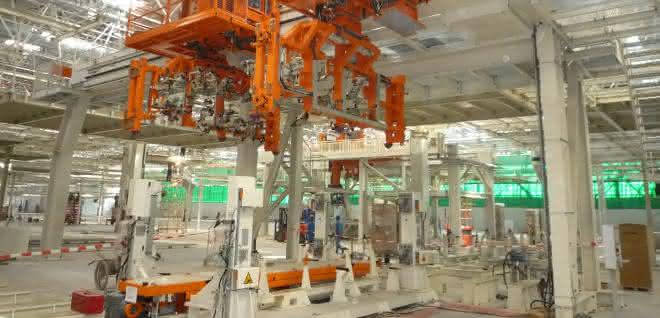
Senior boss Hans Hager from Möttingen points to his special machines. With the huge portal handling systems, the special machine manufacturer has made the assembly line production of car bodies more flexible. The linear axes of the machines are now being retrofitted and equipped with a monitoring solution from Schaeffler. "No more flying blind," says Hager.
In 2012, the Mötting-based family business became known far beyond the Bavarian-Swabian border as a winner of the "Central Innovation Program for SMEs". The project, funded by the German Federal Ministry of Economics and Technology, involved the development of a clamping frame changing system for precise fixing devices for car body parts. The conventional changing systems used to date severely restricted the number of body shapes that could be produced on an assembly line and took up too much space.
Bodyframing in car body production
How does the production of passenger compartments actually work today? It is important to know that a rigid body is only created by welding the floor assembly to the side panels and the roof. The individual sheet metal parts are relatively flexible and must therefore be precisely positioned and fixed before welding. For this purpose, the two side panels are initially placed loosely on the floor assembly and fed to the welding station - also known as precision steel construction, PSB. Large clamping frames weighing over two tons then approach the side parts from both sides. Once the clamping frames have been locked into position, the side panels are clamped precisely onto the clamping frames. The robots then weld the floor assembly to the side panels. The clamping elements are then released and the clamping frames are moved apart into their initial position to release the body for transportation.
The catch is that a special pair of clamping frames is required for each body shape. The tenter frames therefore have to be replaced every time the body is changed. They are kept in a magazine called a stenter frame storage system. The challenge now is to be able to replace the stenter frames automatically within a few seconds. In the past, this was done at ground level using slide systems. Hans Hager, developer of the KFG3 Framer, on the task: "We very quickly realized that the ground-level feeding of the change frames in the very cramped precision steel construction was the Achilles' heel of the production system. However, thanks to our many years of experience with large gantry handling systems for flat glass, we were able to implement a vertical transport solution for the clamping change frames."
The dimensions of the gantries are enormous: they enclose the entire production line and even have to provide space for two supply lines. This adds up to 20 m or more for the Y-axis alone, while the Z-axes offer a travel distance of around 2.6 m. For each body, the Y-axis has to move the clamping frames apart by around 0.7 m and back together again. Each time the bodywork is changed, the appropriate stenter frames are retrieved from the storage area, moved over the PSB and the stenter frames are replaced with the aid of the Z-axes. This innovative solution from Hager can now be found in automotive industry plants all over the world. Maintenance, general overhaul and assembly of the portal handling systems are also carried out by Hager's 150 or so employees.
Avoid standstill
To ensure high availability of the production line, system-critical parts are replaced at fixed intervals in the automotive industry. This also applies to the profile rail guides in the linear axes of the "Framer" - as Hager calls its gantry handling systems. If they were to fail, the entire production line would come to a standstill. This led to interest in a retrofittable monitoring solution for the linear axes. Michael Martinkovich from the Schaeffler engineering office in Munich suggested Schaeffler DuraSense as a monitoring solution for the linear axes. The system consists of carriages with a sensor system specially developed for this task and a pre-processing unit for up to seven sensors.
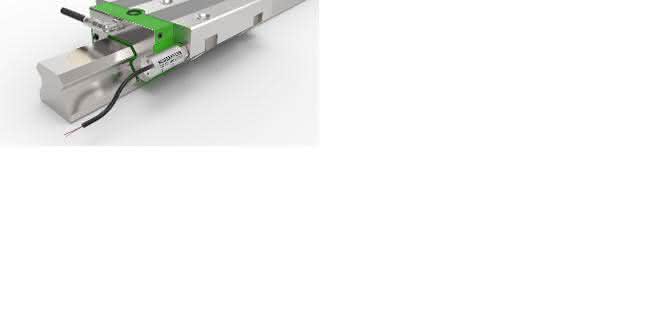
The pre-processing unit is at the heart of DuraSense, as it contains Schaeffler's rolling bearing expertise, evaluates the sensor signals and generates a meaningful characteristic value, the lubrication coefficient. DuraSense utilizes the effect that the vibration energy emitted by the carriage is influenced as the lubricant ages or the amount of lubricant decreases. The lubrication parameter determined during the measurement runs describes the current lubrication condition of the carriage, and DuraSense sends a signal to the machine control system if a lubrication limit value generated in the new, i.e. target condition, is exceeded. The system recognizes proper lubrication as well as a lack of relubrication.
The primary goal is a pure monitoring solution. This means that all approved maintenance procedures and lubrication systems can continue to be operated without any changes. Michael Hager and his colleague Stefan Schneider on the benefits of monitoring the condition of the profile rail guides: "On the one hand, we or the car manufacturer can evaluate and optimize the parameter settings of the installed lubrication system in terms of effectiveness and duration for the first time."
Schneider continues: "Across all plants, it will also be possible to make more precise statements about the service life and extend the intervals between general overhauls of our systems. There is enormous potential for cost savings behind this, which can be realized through the monitoring system alone. In addition, we can use a single system to detect all sources of error that lead to inadequate or even missing lubrication on the carriages, such as empty cartridges, clogged or leaking lines and defective lubrication units. That's a lot of advantages."
Michael Hager concludes: "Once you have looked into the possibilities of a monitoring solution, you suddenly realize that the machines were previously operated on the basis of calculation, a lot of experience and sophisticated maintenance plans, but ultimately still flying blind. With the monitoring system from Schaeffler, we have found a solution that is easy to integrate and we will gain more know-how about the wear behavior of our systems with every system we install."
Jürgen Klein, Head of Marketing and Communication Industrial Automation, Linear Motion Technology at Schaeffler / am


You might also be interested in
Further simplify assembly processes
In addition to the proven racks with a length of one meter, Wittenstein alpha now offers optional two-meter racks for linear systems. They are particularly suitable for use in short axes, for example, in order to simplify assembly even further.
 read more...
Hiwin manufactures its own shaft gearboxes
Have you ever waited several months for an urgently needed corrugated gearbox? Hiwin has too. That's why the Offenburg-based drive specialist has decided to produce its own space and weight-saving reduction talent.
read more...Human-robot interaction at the trade fair
Sumitomo Drive Technologies is presenting its drive solutions for automation and robotics at Automatica 2023 together with the Lafert Group. The company will be showcasing two different applications of the Tuaka drive system for robot applications...
read more...Partial automation with robots
At Automatica, Promess will be showcasing its modular individual workstations and how these can be partially automated with robot support. The servo press manufacturer will also be providing information about the latest features of its Revolution X...
read more...A new benchmark for collaborative robots
At this year's Automatica, Denso Robotics will be showcasing its innovations in the field of robotics. The collaborative Cobotta Pro product family will be the focus of the presentations. Visitors to the trade fair can see all variants in various...
read more...Clamping system for a new milling machine
Investments in machinery often lead to further purchases - as is the case at Joma-Maschinenbau, whose modern production facility has recently been supplemented by a 5-axis milling machine.
read more...Schunk wants to simplify processes in automated production
The declared aim of automation specialist Schunk is to make its customers' processes comprehensible, simple and efficient. Data transparency plays an important role in this. It enables reliable processes and provides the basis for resource-saving...
read more...Festo and Hahn Automation develop battery tester for greater safety
The success and reputation of electric vehicle manufacturers depend on the safe and flawless functioning of batteries. Hahn Automation has therefore developed a battery tester that performs a fully automated 100% test of mobile energy storage...
read more...SPN Schwaben Präzision presents gearbox solutions for automation and industrial robotics
Short cycle times, robust technology, wear-free surfaces and compact designs have always been relevant for automation and robotics solutions. This year's Automatica trend topics include "Sustainable production" and "Digitalization and AI". SPN aims...
read more...