
DC power lines
DC voltage for the future
Industry is exploring the potential of a DC power supply. It offers enormous energy-saving potential. Lapp addressed this issue at an early stage and is now offering its first DC cables. An important question that the company would like to answer in research projects: Are AC cables also suitable for DC?
Alongside digitalization and artificial intelligence, energy supply with direct current (DC) was one of the key topics at the Hannover Messe 2019. The ZVEI had set up a pavilion specifically for this purpose, and Lapp presented its first products in its futureLab. The specialist for integrated cable and connection systems is a pioneer in this field. As an associated partner in the DC Industry research project, the company is working on the question of how DC voltage networks with central conversion can be established as an energy-saving alternative, particularly for drives in production, and how renewable energies can be better integrated. In this ambitious project, Lapp is looking into the suitability of certain cable types and the development of cables that are suitable for DC networking.
First products presented
Such cables are already available in Lapp's portfolio. The first on the market specifically for direct current is the Ölflex DC 100. The color coding of its cores follows the DIN EN 60445 (VDE 0197):2018-02 standard for direct current cables, which was updated in February 2018: red, white and green-yellow. The insulation of the cores is made of special PVC, the sheath is made of PVC. Other cables include the Ölflex DC Servo 700 with special PVC insulation and the DC Chain 800 with TPE insulation for continuous movement in energy supply chains. Lapp has also developed the Ölflex DC 100 Hybrid, a cable for the DC industry consortium. The DC hybrid cable contains two cores for power transmission plus a protective conductor, a Cat.6A data cable with four shielded wire pairs, two cores for Safe Torque Off (emergency stop) and a 24 V control pair for the brake.
A DC energy supply can play an important role in a successful energy transition. This is because it is not just about generating as much renewable energy as possible, such as solar and wind energy. Significant and often overlooked potential for switching to a sustainable energy supply also lies in saving energy. Direct current is a key here, as there are no losses when converting between AC and DC. The automotive industry has recognized this. There are already pilot projects there to supply production cells and later entire factories with direct current only.
Relief for the power grid
A direct current supply is also a prerequisite so that drives can feed energy back more easily when braking. As with electric or hybrid cars, this energy would be stored in batteries until the drive accelerates again. Both drives and batteries consume direct current. This energy buffer can be used to supply power consumers with high power requirements, for example during welding. This would allow companies to cut peak loads and avoid having to draw large amounts of energy from the grid for short periods.
Not only industry, but also households would benefit. Many electrical consumers, from LED lights to electric cars, actually work with direct current, which previously had to be converted from alternating current from the socket. In addition, more and more systems that generate direct current, above all photovoltaics, are feeding into the increasingly decentralized electricity grid.
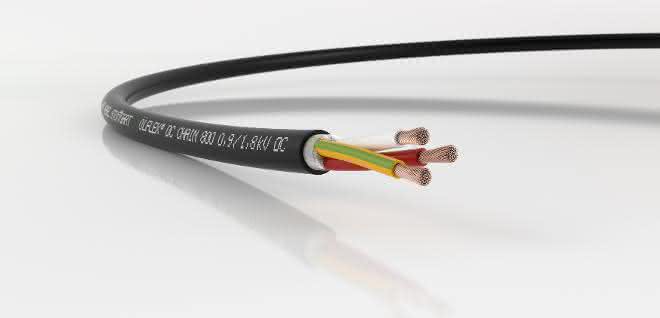
A question that has not yet been discussed: Are low-voltage AC cables also suitable for DC voltage? There have been no research results on this so far, presumably because most experts were of the opinion that this was possible without further ado. Long-term tests by Prof. Frank Berger's research group in the "Electrical Devices and Systems" department at Ilmenau University of Technology have now shown for the first time that this is a misconception. Over a period of 2,590 hours (around 108 days), Berger's team subjected individual conductors with different insulation materials to 1 kV DC voltage in a water bath at 80 °C in order to track the effects in fast motion. The test equipment and the cables were provided by Lapp. The research results show that a DC voltage field has a different effect on the ageing behavior of insulation materials than an AC voltage field. Many experts had previously denied this.
Further research needed
Further research is needed to come to reliable conclusions. On the one hand, Prof. Berger is planning aging tests that do not require a water bath, but would then have to take longer. Secondly, he wants to understand what happens chemically and physically in the plastic. Possible causes could be the degradation of the polymer or swelling in water, as well as the leaching of additives or the formation of "water trees" - an ageing phenomenon of the insulation in power cables that are exposed to moisture.
Until reliable data is available, there is no reason not to use cables with PVC insulation in DC voltage applications. However, users should ensure that these cables are laid firmly, i.e. without movement and without mechanical stress, for example due to excessively tight bending radii. In addition, the environment should always be dry. If these conditions are not met, for example in moving applications in energy chains, users can switch to other insulation materials, such as TPE, which has performed excellently in water bath tests.
Bernd Mueller, freelance journalist on behalf of Lapp / am


You might also be interested in
Helu makes its first trade fair appearance under a new brand name
Helu Kabel will be presenting itself as Helu for the first time at Hannover Messe 2026, showcasing system solutions, Heluchain cables and new industrial luminaires.
 read more...
Strategic realignment with brand relaunch
In future, Helukabel will trade as Helu
The Helukabel Group is parting with part of its name: in future, the company will only operate under the Helu brand. With this step, the specialist for electrical connection technology is underlining its strategic development from a classic cable...
read more...Modular plant construction for corrugated board
Insight into the production of corrugators at BHS Corrugated: Automated, modular and equipped with Helukabel components.
read more...Best quality for the steel
Conditions in the steel industry are harsh and inhospitable. The machines used must be able to withstand the demanding environmental conditions in order to deliver the best quality at all times.
read more...If the standard cable is not sufficient
Lapp offers cables for countless applications - but not for all of them. From time to time, the developers have to modify a standard cable or develop a special cable.
read more...Slight decline in sales, strong investments
The Lapp Group has not been spared from the weakening global economy. However, the company only recorded a slight loss in the past 2024 financial year.
read more...Electrical connection technology
Cables and wires for industrial automation
Heukabel offers system solutions for cable routing from a single source. The subsidiary EKD Systems specializes in tailor-made cable drag chains made of steel, stainless steel and plastic, which are used in moving machines and systems as well as in...
read more...Lapp relies on Ultramid from BASF
Mobile charging of electric vehicles
The automotive industry is currently undergoing the biggest transformation in its history. The boom in battery electric vehicles in particular is presenting the industry with major challenges. Lapp, as a supplier of cables and connection...
read more...Cable handling application
At this year's Motek, ArtiMinds Robotics is showcasing a robot-based automation solution for the sensor-assisted assembly of flexible cables in connector housings.
read more...