
Assembly system
The assembly is ready every 40 seconds
The automotive industry continues to invest in the production of diesel engines. Special machine manufacturer MartinMechanic has therefore completed a system that assembles and welds shielding parts for diesel vehicle exhaust systems.
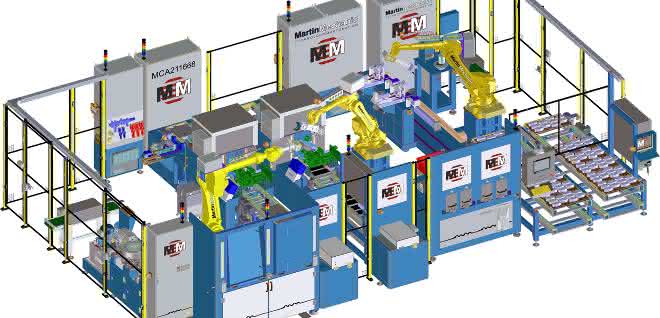
With the MCA211668, an assembly 200 millimetres long is produced every 40 seconds. These parts, which have a diameter of 100 millimetres, are used for direct insulation of the exhaust systems, which become very hot when the engine is switched on. The insulation ensures that valuable heat energy is not lost. The shielding parts also help to reduce emissions and act as silencers to protect against excessive noise. The customer's welding station, which welds the outer and inner stainless steel shells together, was integrated in the middle of the production line. Three Fanuc industrial robots are used for the entire process.
Production is sorted by type. A workpiece carrier, into which ten stainless steel outer sleeves are inserted by hand, travels via two accumulating conveyors to the first part of the work cell. At the staging area, a transponder is used to check whether the correct materials are being used. The same happens with the inner sleeves on the second conveyor belt.
The first Fanuc M-710iC/50 robot then removes the two sleeves with its double gripper and inserts them into the rotating optical measuring station. A laser measures the outer dimensions of the sleeves and transfers the part-specific measurement data to the system's control unit. When the workpiece carrier is empty, it automatically moves to the lower level, where the worker removes it again manually.
A second robot of the same design inserts temperature-resistant mats into the wrapping station. For this purpose, the worker places the stacked mats in four drawers. Once the drawers are full, they are closed. If the corresponding code matches the selected construction variant, production is released so that the robot can remove the first mat with its gripper and place it on the mat scale. If the weight of the mat is within the prescribed specification, it corresponds to the correct dimensions and it is also ensured that it is only one mat at a time - in this case 200 by 250 millimetres.
The first robot picks up the outer and inner sleeves in parallel to this process. One after the other, the first mat is placed around the inner sleeve in the wrapping station, the outer sleeve is placed over it again and then everything is wrapped in a second mat. Finally, a plastic film is stretched around the entire assembly so that it can no longer fall apart. The film is welded twice and the excess is cut off.
The robot transports the assembly to the customer's welding station, where the inner and outer sleeves are welded together. However, if the components do not meet the quality criteria of the optical measuring system, they are ejected via a conveyor belt. It is also possible to manually remove complete assemblies that are not to be further welded using an accumulation conveyor system.
Back to the welding station: the fully automatic loading door releases the component again. Now a third Fanuc robot of type R-2000iB/175L is used. It hydraulically presses the welded assemblies into the stainless steel shells provided by the worker. The assembly is positioned correctly in the pressing station. The ends of the shell are then bent so that the assembly no longer moves and its diameter can be properly calibrated. The industrial robot places the assembly in another station, where it is marked with a laser.
Before the finished assembly is transported to the stamping station, its data matrix code is read. The parts that are not in order are ejected via a discharge conveyor. Only the good assemblies now receive the manufacturer's embossing stamp and are placed in the grid boxes with intermediate trays provided for this purpose. Up to six levels with 12 assemblies each are stacked on top of each other on a pallet. The system door opens automatically and the worker can remove the pallets with the pallet truck.
It took the engineers at MartinMechanic 12 months to develop the two work cells and adapt them to the customer's own welding station as a complete system. The heart of the MCA211668 is the S7-1517F PLC controller from Siemens. Conveniently, the mobile, cable-connected KTP900 touch panel can be plugged in at three points in the extensive system. as


You might also be interested in
ebm-papst is growing again thanks to AI and data centers
ebm-papst returned to a growth trajectory in fiscal year 2025/26. Air Technology, data center applications, and artificial intelligence are driving revenue and investment.
 read more...
SPE on the Verge of a Market Breakthrough
Single Pair Ethernet (SPE) has moved beyond the conceptual phase and is increasingly being implemented in industrial settings. The focus here is not only on higher data rates and simplified cabling, but above all on the issue of system integration...
read more...More than 900 exhibitors already registered
Around six months before the start of the trade fair, more than 900 companies have registered for SPS 2026 in Nuremberg. The trade fair focuses on industrial AI, cyber security and digital transformation.
read more...Virtual PLCs in practice: How vPLCs make production systems more flexible and scalable
The increasing networking of IT and OT is fundamentally changing industrial automation. The IT/OT Integration Summit shows how modern technologies can make production environments more efficient, flexible and future-proof. The event will focus on...
read more...Sales growth in a turbulent market environment
Thanks to innovations and a focus on strategic industrial markets, Sick was able to moderately increase its sales in the 2025 financial year. In a turbulent market environment, the company was able to maintain its position and gain market share with...
read more...Siemens presents new AI agent
Siemens is launching 'Eigen Engineering Agent', an AI for automation technology. The solution is integrated into the TIA Portal, has been tested with over 100 companies and is designed to significantly accelerate engineering processes.
read more...Schaeffler keeps sales almost stable
Schaeffler generated revenue of EUR 23.5 billion in 2025 and increased EBIT before special items to EUR 936 million. At 266 million euros, free cash flow was significantly above the prior year and forecast. Net income remained negative due to high...
read more...Advancing artificial intelligence together
Helukabel is stepping up its activities in the field of artificial intelligence and is now a member of the IPAI. The innovation and collaboration platform for companies, research facilities, institutions and administration has set itself the goal of...
read more...New impetus for ifm sales
Two new positions were filled at ifm at the start of 2026: Markus Wolf becomes Managing Director Sales Germany, Sven Quant takes over the position of Central Managing Director in the Process Sensors division within the ifm Group.
read more...