
System planning with virtual reality
Allow me, your workplace
Schnaithmann uses planning software from Rüdenauer 3D Technology to design assembly systems. Virtual workplace and system planning is possible on the basis of CAD data, which supports the design process and involves the customer in the development process.
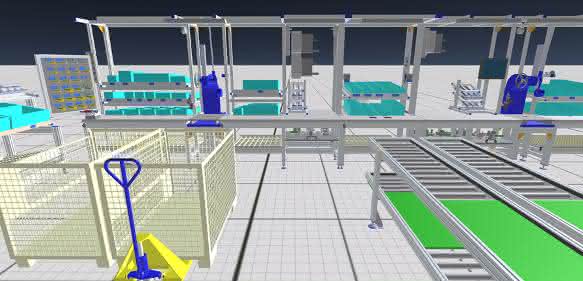
"Software determines the performance of a system, hardware will be sold by the kilogram in the foreseeable future," says Volker Sieber provocatively. The Head of Development at Schnaithmann Maschinenbau, a system supplier for automation technology, is convinced that, in view of ever shorter product life cycles, it is now possible to differentiate between competitors using software alone. "Ease of use and customer support in system planning and after-sales service will be decisive criteria when purchasing a system."
Experience the system in the construction phase
Schnaithmann uses virtual reality to meet the demand for support when planning an assembly or transfer system. As early as the design phase, the customer can experience their future system on a holodeck "as if it were real" and examine it virtually for ergonomic aspects or ease of maintenance. The use of virtual reality technology also promises advantages when training and instructing employees.
The software used by Schnaithmann for this purpose, called Cross Connected, was developed by Rüdenauer 3D Technology (R3DT). The spin-off from the Karlsruhe Institute of Technology (KIT) launched the software for industrial planning and development processes on the market in mid-2017. It has now been further developed by R3DT so that large volumes of data, such as those inevitably generated by assembly systems, can now be used virtually without a great deal of prior effort or the involvement of service providers.
Virtual workplace and system planning
On the basis of CAD data, virtual workplace and system planning is possible on site, which supports the entire design process and involves the customer in the development process. This includes, for example, workflow analyses (MTM analyses), ergonomics studies and gripping space or collision checks. The process is also suitable for accessibility studies for maintenance, tests for planned conversions or extensions and for training purposes.
"It's an easy-to-use tool that anyone can use without any prior knowledge," says Andreas Rüdenauer, founder and Co-Managing Director of the young software company. "You upload your 3D CAD data to a virtual platform yourself, directly at your desk or in the meeting room. This can be done quickly, anywhere and at any time. The current status of the 3D model can then be viewed intuitively alone or with colleagues or customers in the VR glasses. This greatly increases understanding of the current status of 3D CAD designs and the next development and modification steps in the planning process."
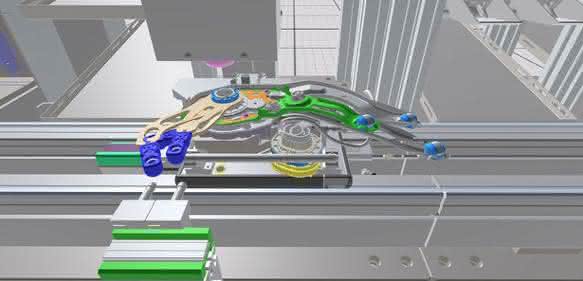
The R3DT tool can be operated intuitively by the user without training or instruction, either with their hands or via a hand menu. Products, machines or systems can thus be experienced directly in virtual space in their original size and understood in the literal sense. This ensures technical feasibility right from the start. Frequent trial and error can be detected earlier. Ergonomic tests during the development process ensure that the future system is optimally designed for the user. Ultimately, by dispensing with physical prototypes, costs can be reduced and the market launch and ramp-up time accelerated.
Fast prototype production
Schnaithmann sees the use of a virtual prototype as a basic requirement for agile project management. "In principle, the aim is to quickly have a prototype that can be used to learn, test and obtain feedback from the customer. The next prototype is then built based on this," explains Volker Sieber. "Rapid prototype production in the conventional sense is difficult or even impossible in mechanical engineering. However, if the existing CAD data is made tangible with the help of virtual reality, you have a digital prototype of the entire system in the early phase of product creation, which allows accessibility tests and uncovers design errors. This definitely avoids a number of iteration loops."
The starting signal for the collaboration was given in spring 2016, when a business mentor recommended the mechanical engineering company Schnaithmann to the young spin-off as an innovative sparring partner. So the Karlsruhe-based company came to Remstal to present its software. "That really was a stroke of luck," says Volker Sieber. "R3DT was looking for a beta tester for the software and we were investigating the potential that head-mounted displays could hold for us. We immediately started a project." Andreas Rüdenauer is also delighted with the collaboration: "Schnaithmann is much more than just a customer for us. As a start-up, we have learned a lot about the customer-specific requirements for the design of innovative systems through intensive dialog and implemented them directly in the software development."
Just a few months later, trade fair visitors were able to experience a virtual manual workstation from Schnaithmann at Motek 2016. By Motek 2017, R3DT had upgraded its software so that, depending on the geometry, it can now handle data volumes in the gigabyte range without any problems. "We now have real added value. Our customers are really impressed when we take them on a virtual tour of complete assembly systems," says Volker Sieber. as


You might also be interested in
Predictive maintenance in retrofit
Predictive maintenance pays off. This is because early detection of impending failures means that systems can be serviced in a targeted manner before production downtime occurs. But how complex is it to integrate such a maintenance concept into an...
 read more...
Maintenance instead of replacement
The circular economy starts with the machinery
Sustainability in industry starts with machines, says our guest author from Deguma: How maintenance, modernization and the 5R strategy save resources, energy and CO₂.
read more...3D printing for unplanned requirements
The material fails and the machine suddenly stops? Then you need to take the right measures to be able to resume production quickly. Material failure in the form of faulty components or material wear in the frame are a risk for any production.
read more...High demands in terms of safety, application and robustness
Demanding work in the electrical trade and energy supply as well as smooth processes in production require innovative and customized measurement technology that scores points for safety, ease of use and resilience.
read more...Car meets e-bike: riding with lubrication-free polymer bearings
Studies show that the proportion of pedestrian and bicycle traffic is increasing in urban areas. With the JetBike, JetBike GmbH from Braunschweig presents a mixture of e-bike and car and relies on lubrication-free polymer bearings from Igus.
read more...Hydraulic hub for more efficient servicing
Bosch Rexroth presents a digital toolbox for service and maintenance. With a comprehensive range of digital services, the Hydraulic Hub simplifies and accelerates the service and maintenance of hydraulic products and increases machine availability.
read more...Arnold Umformtechnik expands after-sales...
Faster help with VR glasses
Arnold Umformtechnik is expanding the after-sales service for its machines to include digital remote services. The focus is on data security, simple operation and clear processes.
read more...147,000 euros per hour: high costs for German companies due to unplanned downtime
According to the "Value of Reliability" study, 67% of industrial companies in Germany experience unplanned downtime at least once a month. This costs the German economy 147,000 euros per hour. Nevertheless, reactive maintenance concepts are not...
read more...Maintenance starts with a maintenance planner
Legal requirements stipulate that machines and systems must be serviced regularly. The maintenance work serves to ensure occupational safety and economic efficiency.
read more...