
Rotary table for machine tools
Precise positioning of aircraft parts
When it comes to positioning workpieces in machine tools, precision is required - whether they weigh tons or just a few grams. Turners, rotary tables or two-axis swivel devices are the heart of a machining center. Applications in aircraft construction show just how powerful these sub-assemblies are.

Premium Aerotec, an Airbus Group company, relies on machine tools from MCM with ATU 2000 Peiseler tables for the production of structural components for various aircraft programs. They are capable of moving transport loads weighing up to 50 tons with high precision in a matter of seconds.
Stability due to clamping cube
Even if the aircraft parts to be manufactured are significantly lighter, the tables of the sub-assembly manufacturer have to cope with a high weight. This is because the components are first mounted on a large steel clamping cube and a fixture attached to it in order to manufacture the landing gear mountings that are later attached to the wing spar. This ensures a high level of stability during the subsequent milling of the final contour. "The entire structure of the pallet with the clamping cube and the parts to be manufactured can weigh up to 28 tons and must be brought into the required machining position with an accuracy of five hundredths," explains Christian Mäusle, tool technologist in the bulk machining department at Premium Aerotec.
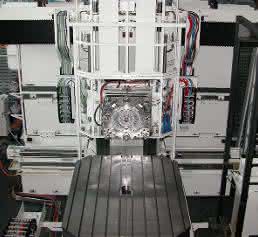
As his company has been manufacturing the suspensions for the main landing gear from titanium for several years, considerable forces are required during milling. "Not every manufacturer can design machine tools for such loads," emphasizes Mäusle. "The requirements were correspondingly complex," reports Roberto Rebecchi, Service Manager at MCM Germany. "We had to achieve a very high load capacity, maximum precision, high torque and a very advanced clamping system."
The long-standing partner Peiseler was already involved in the design of the machine. "For us, there was no alternative to their rotary table with these excellent properties," emphasizes Rebecchi. For machining the highly complex titanium components in the Airbus A350 and A380 programs, "the Peiseler rotary tables are ideally suited as an important component of the MCM machines," adds Natascha Gürtner, Project Manager Machine and Plant Investment at Premium Aerotec.
Production process optimized
For Dr. Benedict Korischem, Managing Director of Peiseler, such customer confirmations are proof that a technological edge leads to market advantages: "We have developed dividing units that run twice as fast and can process 30 to 40 percent more weight than those of our competitors." In particular, Peiseler has achieved unparalleled precision through consistent further development. To achieve this level, the Remscheid-based company has optimized its entire production process.
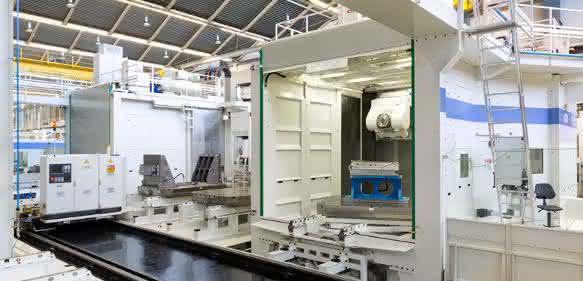
The IT landscape and the CAM system in particular play a decisive role in this. Peiseler works with the latest programs in design, machine planning and production control and carries out FEM calculations and simulations. Using the finite element method, the company checks the structure of the designs to ensure that the machines also function when individual parts stretch and change due to extreme loads and heat of movement. It is also about ideal conditions in production. For example, some of the CNC machinery is housed in air-conditioned rooms and employees carry out constant checks on individual parts at the machine. This is followed by a detailed measurement of the finished parts and test runs under one hundred percent capacity utilization.
Supplier audits and 8D reports are also part of the quality process. Furthermore, Peiseler only uses the highest quality steels and materials to ensure an optimal basis for the production of high-performance sub-assemblies with the highest precision. "These extensive measures enable a performance that is appreciated by our customers and secures our quality level in the long term," emphasizes Korischem. as


You might also be interested in
In-house exhibition Bielefeld 2026
How DMG Mori thinks about the factory of the future
DMG Mori will be showcasing turning and milling expertise, automation solutions and additive manufacturing along the Machining Transformation (MX) at the Bielefeld 2026 in-house exhibition.
 read more...
Up to 50 percent higher cutting speeds
The current market situation is putting pressure on companies that rely on carbide tools: Rising raw material costs, volatile supply chains and limited predictability are putting pressure on the industry. Fette Werkzeugtechnik, a member of the LMT...
read more...A robot for all occasions
Industrial robots take on many tasks. Even milling with accuracies in the sub-millimeter range is now possible.
read more...High metal removal rate for high maneuverability
Large module gears for ship drives place high demands on machining. Switching from skiving to 5-axis simultaneous milling with high-feed tools considerably shortens the roughing process. Process parameters and a well thought-out tool selection are...
read more...Schunk shows flexible systems for electronics production
Schunk Electronic Solutions will be exhibiting modular, flexible systems for electronics production at Productronica 2025 - from stand-alone depaneling systems to fully integrated inline solutions.
read more...Hydraulic 4-jaw chuck for automated workpiece clamping
HWR Spanntechnik presents a hydraulically actuated 4-jaw chuck for automated workpiece changing. The clamping device is designed to enable short set-up times, precise clamping and high productivity in automation.
read more...Corner, face and plunge milling
Paul Horn is expanding the DA milling system for corner, face and plunge milling. With the DA65 variant, the system offers a larger cutting insert compared to the existing DA62.
read more...World premieres at the EMO 2025
From September 22 to 26, 2025, Grob will be presenting several innovations at EMO Hannover. The focus of the trade fair appearance will be on the latest 4- and 5-axis universal machining centers and the associated automation solutions.
read more...Flexible and efficient processing
New high-performance CNC series
Fanuc's presentation at EMO will focus on the new FS500i-A CNC series. The new CNC generation offers high user-friendliness, process optimization as well as digital and network technologies.
read more...