
Five-axis milling machine
Milling in pinhead size
Pfisterer in Bernau am Chiemsee manufactures high-precision components for laboratory and medical devices. An Acura 65 from Hedelius has also been in use for this since 2017.
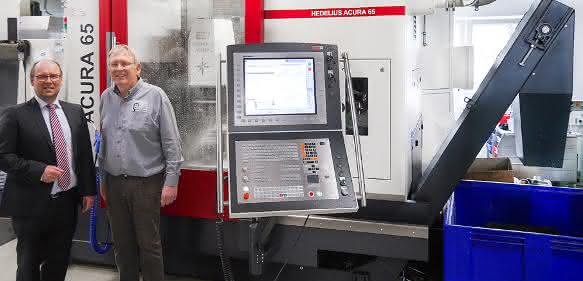
Pfisterer Feinwerktechnik was founded 18 years ago in Bernau am Chiemsee. The medium-sized company produces high-precision small and micro parts in two shifts for sectors such as medical and laboratory technology, as well as for the semiconductor industry and special machine construction. "Our customers are small, medium-sized and large companies from the region, for whom we manufacture products and whose locations worldwide. But we also have customers from Switzerland, Austria, China, Malaysia, England and the USA," explains company founder and Managing Director Georg Pfisterer. "The quality standards are often very high, many of our customers are certified and require test reports and protocols for documentation. We have to meet these requirements. That's why we have an employee who is exclusively responsible for quality assurance," continues Pfisterer.
From pinhead to shoebox
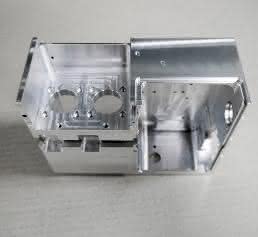
The company's quality standards are always high. This is also important, as the size of the components alone suggests that machining is not easy. Some of the work is very small and delicate. "On average, the milled parts are about the size of a matchbox, with the smallest parts being the size of a pinhead and the largest components the size of a shoebox," says Pfisterer, describing the workpieces. This is one of the challenges.
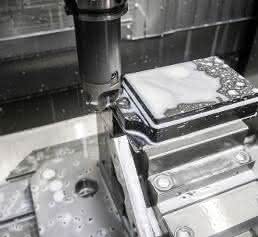
In addition, the workpieces must be machined with high precision. It is often a matter of hundredths. For example, milling fits with an accuracy of six micrometers is not uncommon. These machining operations are carried out on an Acura 65 from Hedelius in Meppen, among others. The five-axis milling machine with rotary swivel table from the North German manufacturer was put into operation in 2017. "If precision is required, we mill even the smallest parts on the Acura," says Georg Pfisterer. Aluminum and plastics are often machined, but stainless steel and titanium are also milled with the compact machine. As a lot of aluminum and plastic is machined, the five-axis machine was equipped with an HSK A63 spindle and 18,000 rpm. Another reason for the high speed is the very small tools that are frequently used.
The machining center is used to machine the contract manufacturer's entire range of parts. However, the milling machine is most frequently used for recurring parts and medium-sized series.
Adherence to deadlines is crucial
The Managing Director explains: "Our customers order batch sizes of between one and 500, sometimes weekly, monthly or quarterly recurring parts, sometimes just a single part. We have to be able to react to this. Adherence to deadlines and same-day delivery are crucial for us." The Acura 65 was therefore also equipped with a zero-point clamping system and a standby tool magazine with a taper cleaning station. In addition to the 65-position standard magazine, which can be operated from the front during machining, a further 180 tool positions are available. "With the standby magazine and the zero-point clamping system, we can significantly reduce set-up times for recurring parts. Vices are prepared and tools are immediately available," says Georg Pfisterer enthusiastically about the system.
With travels of 700 x 650 x 600 millimetres on a footprint of 2,725 x 2,850 millimetres, the Acura 65 offers large machining options in a very small space. This compactness was important for the precision engineers from Bernau, as space is at a premium in the production hall. Twelve CNC turning and milling machines are already in use, and a further turning/milling center will be delivered shortly.
Despite its compact design, the machine has a large sliding door and large viewing window. When the door is open, the machine operator can get very close to the machine table. In order to keep operation as simple as possible for the employees, a Heidenhain TNC 640 was chosen for the control system. "Our employees are familiar with Heidenhain, we also have the controls on other machines. We wanted to avoid a mix of different control systems," says Georg Pfisterer, explaining the decision. Pfisterer's employees often program components on the machine, while more complex parts are programmed using a CAD program. as


You might also be interested in
In-house exhibition Bielefeld 2026
How DMG Mori thinks about the factory of the future
DMG Mori will be showcasing turning and milling expertise, automation solutions and additive manufacturing along the Machining Transformation (MX) at the Bielefeld 2026 in-house exhibition.
 read more...
Up to 50 percent higher cutting speeds
The current market situation is putting pressure on companies that rely on carbide tools: Rising raw material costs, volatile supply chains and limited predictability are putting pressure on the industry. Fette Werkzeugtechnik, a member of the LMT...
read more...A robot for all occasions
Industrial robots take on many tasks. Even milling with accuracies in the sub-millimeter range is now possible.
read more...High metal removal rate for high maneuverability
Large module gears for ship drives place high demands on machining. Switching from skiving to 5-axis simultaneous milling with high-feed tools considerably shortens the roughing process. Process parameters and a well thought-out tool selection are...
read more...Schunk shows flexible systems for electronics production
Schunk Electronic Solutions will be exhibiting modular, flexible systems for electronics production at Productronica 2025 - from stand-alone depaneling systems to fully integrated inline solutions.
read more...Hydraulic 4-jaw chuck for automated workpiece clamping
HWR Spanntechnik presents a hydraulically actuated 4-jaw chuck for automated workpiece changing. The clamping device is designed to enable short set-up times, precise clamping and high productivity in automation.
read more...Corner, face and plunge milling
Paul Horn is expanding the DA milling system for corner, face and plunge milling. With the DA65 variant, the system offers a larger cutting insert compared to the existing DA62.
read more...World premieres at the EMO 2025
From September 22 to 26, 2025, Grob will be presenting several innovations at EMO Hannover. The focus of the trade fair appearance will be on the latest 4- and 5-axis universal machining centers and the associated automation solutions.
read more...Flexible and efficient processing
New high-performance CNC series
Fanuc's presentation at EMO will focus on the new FS500i-A CNC series. The new CNC generation offers high user-friendliness, process optimization as well as digital and network technologies.
read more...