
Modular transfer solution
In the flow through the assembly line
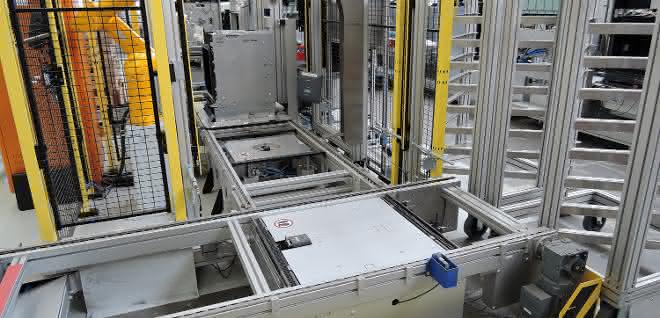
Schnaithmann has developed a transfer system for a new oven line for V-Zug, a Swiss manufacturer of household appliances. It ensures the smooth transportation of different appliance types through the individual assembly and testing stations and adapts to different production requirements.
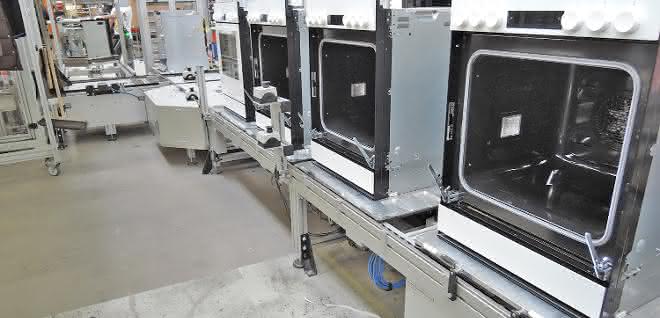
Schnaithmann manufactures transfer and assembly systems for automation, assembly, material flow and handling tasks in Remshalden near Stuttgart. The long-established Swiss company V-Zug is a manufacturer of high-quality household appliances. With the exception of a few models, the entire range of appliances is manufactured to order, which means that production varies greatly. Each household appliance is dispatched no later than two days after receipt of the order. In-house vertical integration is important for a goal like this. A new press shop with servo transfer presses is currently being built at the Zug site, on which all sheet metal parts for the household appliance range will be manufactured. "We are deliberately making this effort," explains Roman Janser, Head of Assembly in the Kitchen segment, "because we want to be as independent as possible from suppliers. We are also the only domestic household appliance manufacturer that develops and manufactures its products exclusively in Switzerland."
Every V-Zug household appliance has to pass up to 600 faultless test processes during production before it is released for dispatch. This and the high proportion of manual assembly work are time-consuming. For this reason, V-Zug attaches great importance to production and logistics concepts that guarantee the highest possible productivity without overburdening employees. Such concepts are developed in-house in the plant planning department.
"We needed a modular transfer system that could be flexibly adapted or expanded to meet our production requirements."
Project manager Paul Cathomas explains: "We work very closely with our development department and therefore know the technical specifications and features of each new device at a very early stage. We also know better than any external planner the sequence of the individual production and testing steps, their intricacies and the respective time requirements. We know the premises in which the system is to be installed. And we are constantly present, so we can quickly adapt our system planning in the event of design changes to the product or optimize assembly and logistics processes if necessary."
When planning all parts of the system on which a household appliance is to be manufactured, tested and packaged, Cathomas and his employees draw on extensive know-how, for example with regard to the targeted use of automation and robot technology for monotonous or difficult work steps, the ergonomic design of workstations, or intralogistics and Kanban control. The experience of employees from production and assembly is also incorporated into this planning process. In addition, the specifications of the required production and assembly equipment are defined and who is to supply it.
Building, installing and commissioning the system in accordance with V-Zug's detailed specifications is then generally the task of a system manufacturer as general contractor. High availability, reliability and durability are expected from the assembly and testing systems. Several generations of appliances are manufactured on each system over the course of its life, so that only product-specific adaptations are required for a product relaunch.
A good two years ago, V-Zug needed a new system as the old one had become technically obsolete. The development department was working on a new baking oven line based on a modular platform for several different appliance types. The engineers were working on production and logistics concepts in the plant planning department. The question arose as to the most suitable transfer system on which the new ovens should be assembled and tested, similar to workpiece carriers.
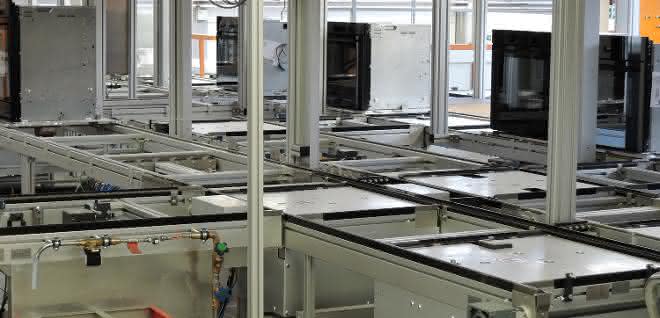
"In line with our platform concept, we needed a modular transfer system that could be flexibly adapted or expanded to our respective production requirements so that we could assemble all current and future oven types on it - even in batch size one," recalls Roman Janser. Janser, Cathomas and their colleagues went to Motek in Stuttgart to find out more and met Schnaithmann there. That same month, V-Zug sent Schnaithmann a specific request for a transfer system.
Sales engineers from the Remshalden-based machine manufacturer traveled to Switzerland to discuss the specifications of the desired system and scheduling with V-Zug. They agreed on an accumulating chain conveyor system that met the required technical specifications in terms of load capacity, height, indexing and control, as well as offering the desired modularity, scalability and reusability. The delivery order was signed and sealed in January 2018. As the new oven types were to be launched on the market as quickly as possible, a two-stage plan was defined: Stage one comprised the delivery, installation and commissioning of the transfer system in the testing area by June 2018; in stage two, the same was to happen in the assembly area by the end of the year.
One challenge was a special spatial feature at the Swiss plant: the testing area is located on a mezzanine floor above the assembly area. The ovens had to be raised to this level. Although there was a lift, it was not compatible with the desired transfer system. A new lift was therefore required. Schnaithmann had already installed similar lifts in the assembly area of a car manufacturer. "The way in which this task was solved shows Schnaithmann's extensive experience in special machine construction," emphasizes Cathomas. "In general, the collaboration was very close and good right from the planning phase." Wolfgang Schneider, Key Account Manager at Schnaithmann, agrees. All coordination took place via the short official channels. The same is true in his own company. Sales engineers and designers, who form a project team, sit at the same table. This means that everyone involved has the same level of knowledge about the progress of the respective project at all times. And there is only one contact person for each customer, the project manager.
"The major challenge for us was not so much the required technical specifications, but the tight schedule," explains Schneider. "We also manufacture standardized components in stock in order to keep delivery times short. These are normally between eight and twelve weeks, but with a system like this you need considerably more time. The weight and size of the ovens were no problem for our transfer systems, but we had to install and commission one part of the system within a two-week time window while production was still running, and the other part during the company vacations between Christmas and New Year."
The challenge was a special spatial feature: the test area is located on a mezzanine floor above the assembly area.
The implementation on site was then mainly the task of the team around Cathomas and Janser. The installation manager remembers around 40 moves before, during and after the installation of the transfer system. Parts of the assembly line, including the automatic stations, were dismantled and reassembled in a cleared area so that production could continue for a few days and to make room for the new transfer system. "Even the one or two interface problems that did arise during integration, despite the precise planning, were solved in an unspectacular manner," praises Cathomas.
This is important to mention, because with the new transfer system, V-Zug has also increased the level of automation within oven assembly. "There is absolutely no point," explains Janser, "in installing a future-oriented transfer system and leaving the production technology at a level that no longer meets current and future requirements." Multi-spindle automatic screwdriving machines now work where manual labor used to prevail. The thermal insulation is also no longer applied manually, but automatically. And there are other examples. The transfer system has been in operation for just over a year and Janser's verdict is positive: "We haven't had any problems so far. The availability of the system is very high. We are not yet using it to its full capacity in terms of cycle times. But that will come with the subsequent oven types." as


You might also be interested in
Plagiarius 2024 negative prize
On January 26, 2024, the Plagiarius campaign awarded its dreaded "Plagiarius" negative prize for the 48th time to manufacturers and retailers of particularly brazen counterfeits and fakes.
 read more...
Ivalua honors winners of the Generative AI...
AI-supported "add-ons" for buyers within 48 hours
Ivalua, provider of cloud-based spend management solutions, announced the winners and innovations of the first Generative AI Innovation Cup. The competition took place in December 2023. It was open to all Ivalua partners and employees - more than...
read more...Efaflex celebrates 50 years of high-speed...
The emphasis is on "fast"
Since day one, Efaflex has wanted to use new technologies as early as possible and drive progress in the industry. This year, the family business is celebrating its 50th anniversary under the motto "Fast Forward".
read more...Security of supply even during power outages
In the winter of 2022, Germany was worried about energy shortages. The drugstore retailer dm did not paint any horror scenarios, but nevertheless saw the possibility of controlled, temporary, regional power cuts (brownouts).
read more...Safety technology in mechanical engineering
Modules with new functions
Euchner's product highlights at EMO 2023 include the communication-capable solenoid interlocks.
read more...Transforming the paper industry towards climate neutrality
Together with partners from industry and research, Voith is developing a project for the optimization of energy and material flows in paper production. The aim of the research project is to develop a digital framework that enables effective process...
read more...Up to 95 percent less flue gas thanks to direct extraction
The requirements for occupational safety measures and safety technology are also constantly increasing in welding technology. The Technical Rules for Hazardous Substances (TRGS) stipulate that welding fumes and harmful substances must be extracted...
read more...Competitive advantages with large machines
Whether 3D-printed components for machines and systems, prototypes or aids for design: additive manufacturing is almost indispensable for modern companies in mechanical and plant engineering and automation if they want to play in the premier league.
read more...Transport technology from the modular system
Many transport tasks can be realized with the help of linear technology. Pre-configured solutions are available to simplify the interaction between the linear unit, motor, gearbox and controller. This minimizes the effort required for research and...
read more...