
Studies on the subject of wear and tear
Friction losses: the material is unforgiving
It is still largely unclear how exactly wear occurs. Scientists at KIT have now been able to prove that the effect occurs from the very first contact and always takes place at a very specific point in the material.
Friction occurs wherever objects adhere to each other, slide or roll over each other. Frictional forces cause wear and tear, and this costs immense sums of money. For example, around 30 percent of energy in the transportation sector is used to overcome friction. In Germany, friction and wear cost around 1.2 to 1.7 percent of gross domestic product, i.e. between 42.5 and 55.5 billion euros in 2017.
However, while the consequences are easy to understand when rubbing your hands - they get warm - materials react in a much more complicated way. "Many things change at the same time. But exactly how this change begins, where wear particles actually form and what effect the frictional energy has is still largely unknown, as we have hardly been able to look directly beneath the surface of the friction partners," says Professor Peter Gumbsch, Chair of Mechanics of Materials at the Karlsruhe Institute of Technology (KIT) and Director of the Fraunhofer Institute for Mechanics of Materials. "With our new microscopic methods, we can do this today. You can then see a sharp interface in the material, and the wear particles are detached at this interface. The question is, where does this weakening in the material come from?"
Foundation stone for the future weak point
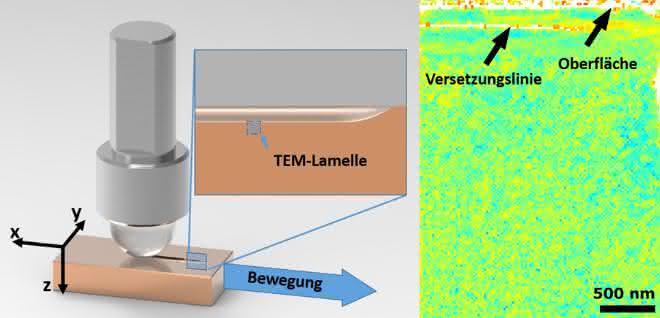
In fact, the scientists always found a sharp line at a material depth of 150 to 200 nanometers during their experiments. It forms after the first contact and cannot be reversed. This already lays the foundation for the future weak point in the material. The scientists experimented with different materials, such as copper, various brass alloys, nickel, iron or tungsten, always with the same result. "These results are completely new. We never expected anything like this," says Gumbsch.
The findings help to fundamentally understand the processes that take place during friction at a molecular level. "If we understand the effects that occur, we can intervene in a targeted manner. My aim is to develop guidelines that can be used to produce alloys or materials with better friction properties in the future," says Gumbsch.
The material makes a wave
The defect that has occurred in the material is a so-called dislocation. These are responsible for plastic, i.e. irreversible, deformations. The effect occurs when atoms shift against each other. To a certain extent, this creates an atomic wave in the material similar to the movement of a snake. "We have found that these dislocations are self-organized during the friction process to form the observed line-like structure. This effect occurred in the same way in every experiment," explains Dr. Christian Greiner from the Institute for Applied Materials - Computational Materials Science (IAM-CMS) at KIT.
The scientists compared the observed effect with the mechanical stress distribution in the material, which can be calculated analytically. The calculations confirmed that certain dislocation types self-organize in a stress field with a material depth of between 100 and 200 nanometres.
In addition to the aforementioned effect, the scientists used copper samples to investigate how friction affects the oxidation of surfaces. After a few friction cycles, copper oxide spots formed on the surface, which over time grew into semi-circular nanocrystalline copper oxide clusters. The approximately three to five nanometer copper-2-oxide nanocrystals were surrounded by an amorphous structure and grew more and more into the material until they overlapped and formed a closed oxide layer.
According to Greiner, this phenomenon has been known for a long time, but the cause of the effect has not yet been researched. "It is very important to understand how oxidation caused by friction takes place. Copper is a very common material in materials science studies. But it also plays an important role as a base material for moving parts," says Greiner. Many bearings are made of copper alloys such as bronze or brass. The results of the research are therefore of great interest to the copper processing industry.
Hard ball meets soft copper
The experimental approach for both tests is very simple: a sapphire ball is pulled very gently, slowly and in a controlled manner in a straight line over a plate made of high-purity copper. The sapphire ball was chosen because it guarantees a consistent, reproducible contact point and the friction effect on the ball itself is negligible due to the hardness of sapphire. After each pass, the researchers measured the resulting deformations and the resulting structural changes inside the metals. In a unique approach, they combined friction experiments with non-destructive testing methods, data science algorithms and high-resolution electron microscopy. as


You might also be interested in
Research at the Intersection of Fiber...
New Fiber-Optic Technology Reduces Energy Consumption in Photonic Computers
Frozen at -196 °C: A new liquid-core fiber combines light and sound with high efficiency, opening up new avenues for quantum computing and photonics.
 read more...
A quantum computer that performs calculations using oscillations
When it comes to storing information, quantum computers have so far run up against technical limitations. Instead of electromagnetic storage, researchers are now using mechanical vibrations. Their vibrating memory can store significantly more...
read more...Hydrogen Pipelines Put to the Test
New real-world lab tests safety and resilience
The Federal Institute for Materials Research and Testing (BAM) is opening a real-world laboratory to study pipelines and components for the safe operation of future hydrogen networks.
read more...Research Platform for the Energy Supply of the Future
For the first time, the Karlsruhe Institute of Technology (KIT) is bringing together key hydrogen technologies in a single research environment. The facility is intended to demonstrate how the production, storage, transport, and use of hydrogen can...
read more...When the quantum computer arrives
The Research Race to Ensure the Security of Critical Infrastructure
How can we protect our critical infrastructure from attacks by quantum computers in the future? As part of the QUEST project, Darmstadt University of Applied Sciences is researching new methods—post-quantum cryptography—designed to withstand even...
read more...VDE study on electrical engineering
More retirements than graduations
According to a VDE analysis, more than 30,000 electrical engineers will retire by 2029 without enough graduates to replace them. This is due to falling student numbers and high drop-out rates.
read more...Giving lightweight construction a profile
Pultrusion: A process that forms fibers under tension
Pultrusion is developing from a niche process into a key process for lightweight construction and sustainable fiber composite structures. The Fraunhofer IWU shows applications from energy to mobility.
read more...Green hydrogen directly from the sun and water
A start-up project at the Karlsruhe Institute of Technology (KIT) aims to fundamentally simplify the production of green hydrogen: Mass-produced photoreactor panels are to be used to produce hydrogen directly from sunlight and water - without...
read more...Fraunhofer shows industrial future between AI, data and new materials
At Hannover Messe 2026, the Fraunhofer-Gesellschaft will be presenting solutions for a resilient industry: from AI and data rooms to hydrogen technologies and material and recycling innovations.
read more...