
Further developments from Rittal
Automated processing of rails and channels
A lot of manual work is still common in switchgear construction, for example when cutting and processing busbars, trunking and cable ducts. Rittal offers advanced machines and tools to enable this work to be carried out automatically or semi-automatically.
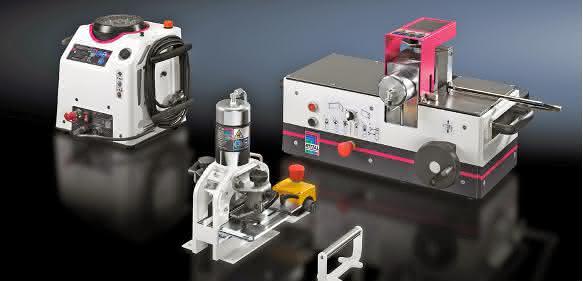
Cutting mounting rails and cable trunking to the correct length is a job that is still carried out by hand in many workshops. The required rail length is measured on the mounting plate, then the mounting rail is cut to the correct length. Labeling the rail so that it can be assigned to an enclosure and a position in the enclosure is done - if at all - with a felt-tip pen. According to the company, the Secarex AC 15 cutting center from Rittal makes this work easier, faster and more efficient. An automatic length stop ensures precisely fitting rails.
The cutting center is operated via an industrial PC with keyboard and trackball. Cutting rails to length is efficient if the dimensions are taken directly from the layout planning, which can be carried out in Eplan Pro Panel, for example. If several rails are required, the cutting center calculates the optimum number of pieces to minimize waste. The integrated label printer also labels the finished rails so that they can be easily assigned during subsequent assembly. The cutting center can be used to cut DIN mounting rails, C-rails and cable ducts to length in all standard sizes.
Cutting, bending and punching copper rails
Copper busbars, which are used in switchgear for power distribution or as busbars, must also be processed in the electrical workshop. In addition to cutting to length, further work steps such as bending or punching holes are often necessary. This work can be carried out with the CW 120 punching and bending machine (Copper Workstation). This is available in two versions: Stationary tabletop units for cutting, bending and punching busbars with an external hydraulic supply. The mobile version, which is designed with castors for flexible use in the workshop, with an integrated hydraulic pump. Only a simple 230-volt mains connection is required for the power supply.
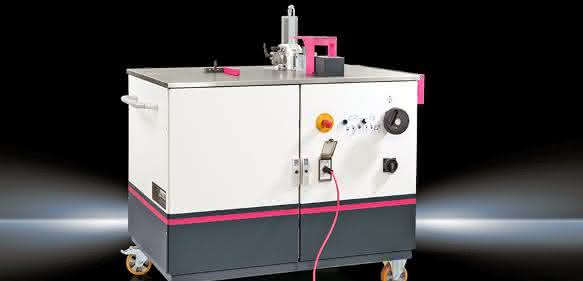
Both versions can process rails with a width of up to 120 millimetres and a thickness of up to twelve millimetres. Round holes can be punched in sizes from 6.6 to 21.5 millimetres. For slotted holes, maximum widths of up to 21 millimetres and lengths of up to 18 millimetres are possible. Punches and dies for round and slotted holes are available in various sizes as accessories.
Rittal sees the machines for processing mounting rails, cable ducts and busbars as a supplement for semi-automated production in switchgear construction. They simplify many tasks that previously had to be carried out manually, thereby increasing efficiency. As a result, costs are reduced and quality is improved. as


You might also be interested in
Helu makes its first trade fair appearance under a new brand name
Helu Kabel will be presenting itself as Helu for the first time at Hannover Messe 2026, showcasing system solutions, Heluchain cables and new industrial luminaires.
 read more...
Strategic realignment with brand relaunch
In future, Helukabel will trade as Helu
The Helukabel Group is parting with part of its name: in future, the company will only operate under the Helu brand. With this step, the specialist for electrical connection technology is underlining its strategic development from a classic cable...
read more...Modular plant construction for corrugated board
Insight into the production of corrugators at BHS Corrugated: Automated, modular and equipped with Helukabel components.
read more...Best quality for the steel
Conditions in the steel industry are harsh and inhospitable. The machines used must be able to withstand the demanding environmental conditions in order to deliver the best quality at all times.
read more...If the standard cable is not sufficient
Lapp offers cables for countless applications - but not for all of them. From time to time, the developers have to modify a standard cable or develop a special cable.
read more...Slight decline in sales, strong investments
The Lapp Group has not been spared from the weakening global economy. However, the company only recorded a slight loss in the past 2024 financial year.
read more...Electrical connection technology
Cables and wires for industrial automation
Heukabel offers system solutions for cable routing from a single source. The subsidiary EKD Systems specializes in tailor-made cable drag chains made of steel, stainless steel and plastic, which are used in moving machines and systems as well as in...
read more...Lapp relies on Ultramid from BASF
Mobile charging of electric vehicles
The automotive industry is currently undergoing the biggest transformation in its history. The boom in battery electric vehicles in particular is presenting the industry with major challenges. Lapp, as a supplier of cables and connection...
read more...Cable handling application
At this year's Motek, ArtiMinds Robotics is showcasing a robot-based automation solution for the sensor-assisted assembly of flexible cables in connector housings.
read more...