
Brush deburring in production line
From coil to burr-free part
Fritz Schiess wants to improve Overall Equipment Effectivenes (OEE) in the production of parts for seat adjustment in cars. To this end, the company is switching from workshop production to flow production. At the heart of the measures is a new continuous deburring system from Surfinsys.
Every minute, 90 parts fall from the fineblanking press onto the conveyor belt with the triple-feed follow-on tool. Each of the steel parts, which are 70 millimetres round in diameter and six millimetres thick, has a precise smooth cut, as is usual in fineblanking. Nevertheless, there are still burrs that need to be removed. This means that they cannot yet be passed on to the customer, who then produces the final contour in a high-pressure forming process. Later, they will be important parts of the seat adjuster, as found in every car.
Burrs also occur despite smooth cutting
First the burrs have to be removed, then the parts have to be washed, dried and demagnetized before they are packed in boxes ready for shipping. They also have to be checked. A scale decides whether they are OK or not. The round part should weigh 150 grams; quality management tolerates a deviation of one percent. All processes run quickly and reliably in a connected production line. No process may be slower than the one with the greatest added value - i.e. fineblanking. The line must be synchronized with all processes.
In the past, the parts were moved around more than they were processed. After each process, they were loaded into boxes, driven away, temporarily stored, retrieved, driven to the next process, and so on. Line production eliminates unproductive times. The core process of the subsequent processes is deburring. Here, Schiess has opted for the latest DAP machine generation from the Swiss company Surfinsys. It removes burrs that occur during punching, sintering or fine blanking.
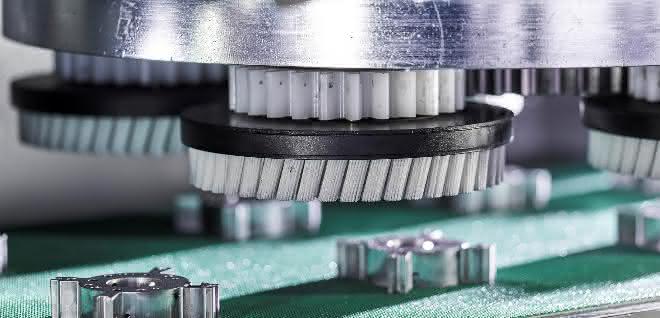
The six millimeter thick raw material is fed from the coil via a straightening machine into the fineblanking press and thus into the line. A Surfinsys DA300P is integrated directly after the fineblanking process. It works with two units, each with five integrated abrasive brushes with a diameter of 150 millimeters. The planetary brushes are driven directly via the central unit using gear wheels. This means that no additional gearbox is required. The brushes are simply mounted on short shafts and can be changed in seconds thanks to the quick-change mechanism. This allows primary and secondary burrs to be removed with high power density.
Remove primary and secondary burrs
The orbital movement of the central unit and the additional planetary rotation of the five brushes produce optimum sanding results on belts up to 340 millimetres wide. The double rotary movement removes the burrs that occur during the pre-process. The process has an advantage over the widely used vibratory grinding process because the deburring process is more defined. It ensures even rounding of round or pointed contours, pockets and chucks as well as the smallest bores. While the removal rate of mass finishing stones is reduced by around ten percent in a very short time and then decreases continuously by a further 20 percent over the next one hundred hours, with brush deburring it increases slightly but continuously over the course of the tool life. In addition, the deburring tools work so thoroughly that even massive burr roots, chipping and embossed burrs are removed and evenly rounded edges are created.
Another important advantage is particularly evident with small bores. If bores can be narrowed during mass finishing because either material is driven into them or the burr is only bent over instead of being cut, the brushes remove burrs reliably, reliably and with repeat accuracy. This also applies to parts weighing more than 100 grams, which can be damaged during vibratory finishing if the filling is not reduced. However, process reliability is more decisive. Measurements have shown that the deviations in geometric accuracy with the DA300P are within a small range compared to a significantly larger range with mass finishing.
Defined parts transport
Parts can be transported along the line in a more defined manner via the deburring machine. The workpieces can be guided on the belt in such a way that after deburring on one side, they can be fed through the DA300P again using cleverly designed reverse loops and thus also deburred on the other side. They are held magnetically. But even if the workpieces were made of stainless steel or non-ferrous metals, they could be guided in guide rails or pockets. A combination with magnetic force is also possible. Even impact-sensitive parts can be guided and turned safely and without damage and thus deburred on both sides.
Once the workpieces have been deburred on both sides, it's time for cleaning. At a pressure of 60 bar, the water jet removes any oil and dirt that has been carried over and prepares the parts for the final work steps. Now it's time to dry, weigh and check the quality, and off they go into the shipping boxes. pb


You might also be interested in
Punch laser machine for networked production
At Blechexpo 2023, Trumpf will be showcasing a fully automatic punch laser machine for networked production. The TruMatic 5000 enables greater productivity and part quality with reduced energy consumption.
 read more...
Everything accurate in switch cabinet construction
To ensure smooth work processes, tools for processing enclosures and housings must function flawlessly and reliably. Häwa rounds off its punching range with the Multi-Press 500.
read more...CU-Flex copper processing center
Process copper in three stations
Boschert also presented the revised CU-Flex copper processing center with its three stations for punching, bending and shearing in Hanover. This allows users to completely manufacture copper parts in just one work process.
read more...Oil-free lubricants reduce costs
LBI oil free offers oil-free lubricants that can be used in the machining of steel and high-strength steels. Classic fields of application are deep drawing and punching, but also the machining of stainless steels and aluminum.
read more...Punching with precision
Wink Stanzwerkzeuge from Neuenhaus has automated its punching sheet production. The company has teamed up with proven project partners for the linear technology and automation.
read more...AI as an ally in sheet metal production
Artificial intelligence will not replace humans. Rather, it should be seen as our ally when it comes to optimizing processes, such as in sheet metal production.
read more...How smart robot simulation works
More intelligent, more efficient, easier to operate - robots are developing rapidly. Among other things, great care is required when setting them up and operating them in order to avoid cost-intensive downtimes. Robot simulation tools are...
read more...Stanztec 2022 is canceled
The trade fair for stamping technology was scheduled to take place in Pforzheim from June 28 to 30.
read more...Networked pipe technology
Transfluid is coming to Blechexpo with a wide range of innovations. In addition to new system technology, the focus will be on networking.
read more...