
Manufacture of electrodes
Batteries available here in record time
With a new coating process, a research team at the Karlsruhe Institute of Technology (KIT) has succeeded in producing electrodes for lithium-ion batteries at the fastest rate to date. At the same time, the new process improves the quality of the electrodes and reduces production costs.
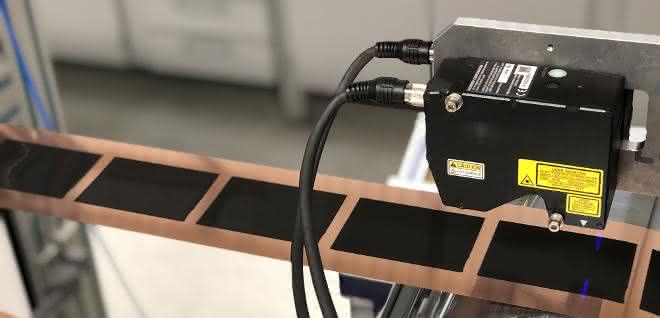
In the manufacture of electrodes for batteries, electrode material is applied as a thin paste in a rectangular pattern to a foil made of copper or aluminum. The pattern is interrupted by short sections of uncoated foil, which are essential for discharging the electrons. For these sections, the coating process must be interrupted and restarted repeatedly. A particular challenge here is to enable sharp edges without smearing the material at very high production speeds.
"Precision in electrode coating is a very important factor for the efficiency and costs of the entire battery cell production process," says Professor Wilhelm Schabel from the Institute of Thermal Process Engineering - Thin Film Technology (TVT-TFT), who is responsible for research on this topic at KIT. "Even small production errors make battery cells unusable. Due to the high level of waste and low throughput, lithium-ion batteries are now more expensive than they actually need to be." It is precisely this area that enables the greatest cost savings in cell production, emphasizes Schabel.
Faster coating using a membrane nozzle
PhD student Ralf Diehm in Schabel's group has now made a decisive advancement. He has equipped and further developed the nozzle for the electrode material with an oscillating membrane that cyclically stops and restarts the application of the coating paste. "As this membrane is much lighter than mechanical valves, very fast reaction times and therefore high speeds are possible," explains Diehm. "Until now, manufacturers were limited to speeds of around 30 to 40 meters per minute. With the new technology, we can achieve up to 150 meters per minute for electrode coating."
In addition to a higher production speed, the elimination of mechanical parts in the application nozzle has other advantages for electrode production: because the membrane can be controlled much more precisely than mechanical valves, production quality is improved and waste is reduced. The technology is now to be transferred from the laboratory to industrial production as part of a spin-off by Ralf Diehm and his team.
Faster drying through systematic process optimization
However, in order for battery production as a whole to benefit from faster electrode coating, the production process must be readjusted in other areas, explains Dr. Philip Scharfer, head of the Thin Film Technology (TFT) group at KIT, who has been researching this topic together with Professor Schabel for many years. "Faster coating requires shorter drying times. Otherwise, the dryer section and therefore the entire system would have to be enlarged accordingly."
Based on fundamental studies of different drying conditions, KIT has already been able to carry out a knowledge-based optimization of the drying process, which reduces the drying time by around 40 percent while maintaining the same electrode properties. In the ProZell II research cluster funded by the Federal Ministry of Education and Research (BMBF), this work is now to be continued together with partners from the Technical University of Braunschweig and the Center for Solar Energy and Hydrogen Research Baden-Württemberg (ZSW) in Ulm.
Celest research platform as a technology driver
Electrode production at record speed combined with high production quality enables considerable cost savings for cell production. Electrodes for up to three times as many battery cells can be produced on a typical production line, helping to meet the growing demand for electromobility. TFT develops its technologies for electrode production - including for future new material systems - as part of the Center for Electrochemical Energy Storage Ulm & Karlsruhe (Celest), one of the world's largest research platforms in the field of battery research. New findings on production technology also flow directly into the Post Lithium Storage (PoliS) Cluster of Excellence, in which KIT is developing the batteries of the future together with the University of Ulm. as


You might also be interested in
Maintenance and Pumps&Valves in February
Final preparations are underway in Dortmund: On February 21, 2024, maintenance will start as the leading trade fair for industrial maintenance and with it Pumps&Valves as the trade fair for industrial pumps, fittings and valves.
 read more...
Cooling and temperature control units
Hygienic packaging sells safely
In few industries are the requirements for hygiene in the production process as strict as in the food sector - the health of consumers has top priority. This results in enormous challenges for all machines and components involved, especially in...
read more...Cooperation between SMC and Yaskawa
Another chapter in the cooperation between Yaskawa and SMC: The new European Yaskawa Europe headquarters is also home to an academy with robots and cobots, to which various SMC solutions are exclusively connected.
read more...Proportional flow control
With the Asco 209 series, Emerson has introduced a proportional valve for flow applications in the medical technology, food and beverage, heating, ventilation and air conditioning (HVAC) industries.
read more...Double piston pump and proportional valve
High-precision gluing of folding boxes
Thanks to their sustainability, cardboard packaging is increasingly replacing plastic packaging. An important production step in the manufacture of folding boxes is the high-precision gluing of the cardboard blanks.
read more...Three leak tests at once
Systems for leak testing modern components for electromobility and hydrogen fuel cells are a key focus of Worthmann Maschinenbau and its subsidiary Maceas.
read more...Bonding and lubricating - precise dosing
Jet valves from Vieweg lubricate and grease electromechanical switches and bond and seal electronic components. More and more customer-specific solutions are being used.
read more...digital networking days Sustainability
Predictive maintenance for semiconductor production
The control valves for ultrapure water are an important supply medium in semiconductor production. While specialists used to check these valves personally on site, an IoT solution now checks the critical components.
read more...Seamless product and process traceability
After exploring the market, a plastics processor decided in 2019 to have WSW Software develop a new MES. The web-based ME system called Valeris is now in productive use and is marketed as an industry-neutral standard solution.
read more...