
Tools and small series in 3D printing
Everything that is imaginable
The US EMS company Jabil is pushing ahead with its digital transformation. The company recently started using 3D printing for the manufacture of tools and small series production. The successes have been rapid: In addition to considerable time and cost savings, Jabil is able to offer its customers significantly greater flexibility.
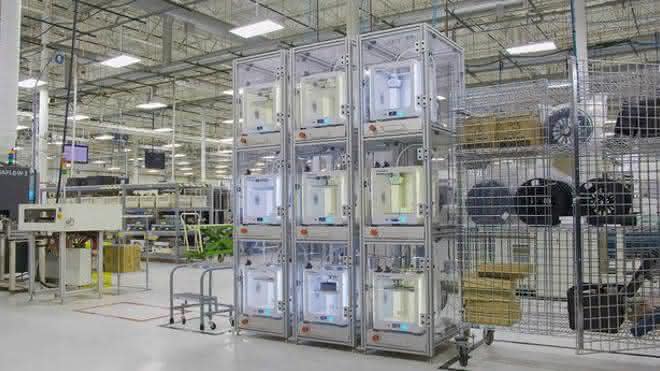
Service providers for contract manufacturing of electronic assemblies, devices and systems are under time and cost pressure from clients. The US contract manufacturer Jabil relies on additive manufacturing with desktop 3D printers. At its Auburn Hills plant in Michigan, the company uses Ultimaker printers to produce parts for low-volume production, but also to print tools, assembly jigs and fixtures for the production process itself. Jabil has had a positive experience after a quick implementation: cost savings, time reduction, faster time to market and even changes in internal processes are the result.
In Auburn Hills, the focus is on customers from the healthcare and industrial sectors, but the company also serves the special manufacturing requirements of companies from the transportation, IoT and measurement technology sectors. The aim is to reduce both time and costs until product launch and to minimize risks. Normally, new products are manufactured in very large quantities in order to reduce unit costs. With 3D printing, however, the economic situation can be changed significantly, as smaller quantities are now also available at affordable prices.
Rethinking traditional manufacturing processes
To enable lower quantities and shorter product lifecycles, the team tested and evaluated the possibilities of additive manufacturing at an early stage. In the past, external workshops were the only producers of jigs, fixtures and tools needed for production. "It can take a machine shop up to three weeks to produce a simple tool," says John Wahl, tooling and manufacturing engineer at Jabil. "For more complicated tools with moving parts, production can take up to two months."
The shorter manufacturing time is one of the most attractive advantages of additive manufacturing. "3D printing reduces the limitations of traditional manufacturing technologies," adds Rush LaSelle, Senior Director Business Development. "Product designers can focus on the results and part performance instead of investing a lot of time in the production process itself." In addition, Jabil's designers were often concerned with different cost models, as the prices for one-off production were significantly higher than the production of tools in larger quantities.
In order to bring products to market faster, the team investigated the possibilities of 3D printing for the production of tools, fixtures and manufacturing equipment. "Just three hours after installing the Ultimaker 3D printers, we had our first order to produce spare parts. The traditional approach would have been to stop production until the required spare part was delivered," says Wahl. Following this success, Jabil used the 3D printers for a variety of applications. This is because individual parts are no longer subject to cost constraints.
Months become weeks
One of the company's first customer successes with additive manufacturing was in medical technology. This involved improvements in the production of a mobile imaging system. The team modeled the process and printed the devices and tools overnight. The ability to implement revision changes quickly was crucial. "We verified a design change and then printed an entire unit in just a few hours," says Wahl. "It used to take months from problem identification to final acceptance of the developed solution. With 3D printing, we completed the entire process in just a few weeks."
In fact, Jabil can now produce tools in advance based on the customer's CAD models. "We can now quickly replace defective parts on the production line or implement a different fixture using 3D printing," says Wahl. To date, Auburn Hills has achieved a reduction of more than 30 percent in tooling costs and an 80 percent reduction in the time it takes to produce the final tools and fixtures. Customers appreciate the ability to repeat prints quickly and frequently. Equally impressive is the freedom in product design. "If the customer can think it, we can print it," says Wahl.


You might also be interested in
New Resin Opens Up 3D Printing for the Optics Industry
With BMF Clear, Boston Micro Fabrication has introduced an optically transparent photopolymer resin for micro-precision 3D printing that achieves a light transmittance of over 90 percent at layer heights of 10 micrometers or more and is suitable for...
 read more...
3D Printing in the Defense Sector
Formnext Launches 2026 Defense Summit
Formnext is expanding its program to include the security and defense sector and will host the first Formnext Defense Summit in 2026. The event will focus on the potential of additive manufacturing for resilient supply chains, industrial...
read more...UltiMaker Doubles Speed in Industrial 3D Printing
With the Factor 4 Plus, UltiMaker is introducing a new version of its industrial desktop 3D printing platform, which operates at up to twice the print speed of the standard model. The platform is designed for use in manufacturing and defense...
read more...Stratasys takes over MarkForged
Stratasys is acquiring MarkForged from Nano Dimension for USD 42.5 million, thereby expanding its portfolio in the field of fiber-reinforced composites. The acquisition also strengthens the company's software and materials expertise in industrial 3D...
read more...Timo Göbel, Head of BMW Additive Manufacturing
"Clearly on course for broad industrialization"
The BMW Group's Additive Manufacturing Campus (AMC) is setting the course for the next stage of industrialization. Under the leadership of Timo Göbel, additive manufacturing is being further integrated into all stages of the vehicle life cycle. In...
read more...Real-time control to make recycling materials economical
The Fraunhofer IAPT is researching AI-based closed-loop processes for industrial 3D printing with recycled plastics. The aim is to achieve less waste, greater process stability and profitable printer farms.
read more...Forum Solutions 4AMIndustry shows ways into industrial application
Additive manufacturing has developed dynamically in recent years and has long outgrown its status as a purely innovative technology in many industries. Nevertheless, companies still face the challenge of integrating AM into their production...
read more...Alliance aims to drive forward industrial 3D printing
Machine components, electrostatically shielded transport containers, large components for the automotive, rail and aviation industries or specific medical products straight from the printer - the potential applications of additive manufacturing are...
read more...Photonic microchips with 3D connector
How a 3D system makes photonic chips industrially viable
A research team from Heidelberg is developing a 3D-printed "connector" for photonic microchips. The solution promises a low-loss, standardized coupling of glass fibre and chip - and could fundamentally simplify the production of photonic integrated...
read more...