
3D printing for medical devices
Linde cooperates with 3D Medlab
Linde is researching the optimization of atmospheric conditions in the additive manufacturing process in order to produce complex lattice structures for medical devices.
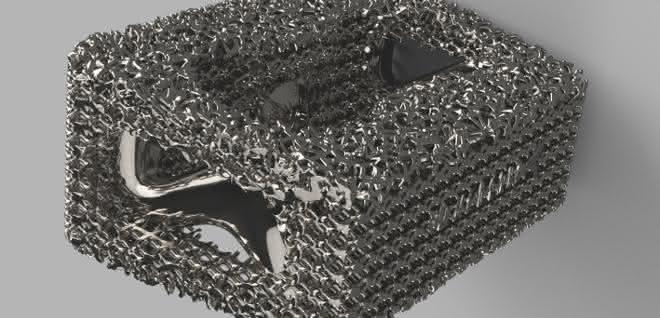
In collaboration with 3D Medlab, the joint project is the first of its kind to develop orthopaedic devices. Grid-like, complex components are designed to imitate human body parts. These can integrate better into the patient's own bone and tissue structure, resulting in fewer rejection reactions and faster healing times.
Additive manufacturing can optimize the production of such components by ensuring high-quality repeatability of the process and requiring less post-processing after printing. However, the atmosphere in the printing chamber must be optimal and reproducible. Atmospheric gases play a fundamental role in the printing process, and any contaminants left in the chamber, even once purged, can have a detrimental effect on the manufactured part. In addition, vapors generated during the production process can remain on the object, making post-production cleaning necessary.
Even extremely small fluctuations in oxygen content can affect the mechanical or chemical properties of oxygen-sensitive metals - such as titanium and aluminum alloys - and influence the composition of the end product. For the Linde/3D Medlab research trials, the titanium alloy tested is Ti-6AI-4V.
"We are proud to be working with 3D Medlab on this important and pioneering project," said Pierre Forêt, Senior Expert Manufacturing, Linde. "As a customer at the forefront of medical device manufacturing, it is critical to avoid anything less than optimal product outcomes. It is therefore a testament to our expertise and know-how in gases that we have been chosen as a partner for this project.
The atmospheric tests will include a new helium/argon gas mixture, specially developed by Linde for the project to make the process smoother and cleaner, and the use of Linde's ADDvance® O2 precision, a unique oxygen measurement and analysis technology, to ensure the optimum gas mixture in the pressure chamber. Together with the new gas mixture, ADDvance O2 precision will provide 3D Medlab with precise, detailed control over the oxygen concentration and moisture content in the pressure chamber.


You might also be interested in
New Resin Opens Up 3D Printing for the Optics Industry
With BMF Clear, Boston Micro Fabrication has introduced an optically transparent photopolymer resin for micro-precision 3D printing that achieves a light transmittance of over 90 percent at layer heights of 10 micrometers or more and is suitable for...
 read more...
3D Printing in the Defense Sector
Formnext Launches 2026 Defense Summit
Formnext is expanding its program to include the security and defense sector and will host the first Formnext Defense Summit in 2026. The event will focus on the potential of additive manufacturing for resilient supply chains, industrial...
read more...UltiMaker Doubles Speed in Industrial 3D Printing
With the Factor 4 Plus, UltiMaker is introducing a new version of its industrial desktop 3D printing platform, which operates at up to twice the print speed of the standard model. The platform is designed for use in manufacturing and defense...
read more...Stratasys takes over MarkForged
Stratasys is acquiring MarkForged from Nano Dimension for USD 42.5 million, thereby expanding its portfolio in the field of fiber-reinforced composites. The acquisition also strengthens the company's software and materials expertise in industrial 3D...
read more...Timo Göbel, Head of BMW Additive Manufacturing
"Clearly on course for broad industrialization"
The BMW Group's Additive Manufacturing Campus (AMC) is setting the course for the next stage of industrialization. Under the leadership of Timo Göbel, additive manufacturing is being further integrated into all stages of the vehicle life cycle. In...
read more...Real-time control to make recycling materials economical
The Fraunhofer IAPT is researching AI-based closed-loop processes for industrial 3D printing with recycled plastics. The aim is to achieve less waste, greater process stability and profitable printer farms.
read more...Forum Solutions 4AMIndustry shows ways into industrial application
Additive manufacturing has developed dynamically in recent years and has long outgrown its status as a purely innovative technology in many industries. Nevertheless, companies still face the challenge of integrating AM into their production...
read more...Alliance aims to drive forward industrial 3D printing
Machine components, electrostatically shielded transport containers, large components for the automotive, rail and aviation industries or specific medical products straight from the printer - the potential applications of additive manufacturing are...
read more...Photonic microchips with 3D connector
How a 3D system makes photonic chips industrially viable
A research team from Heidelberg is developing a 3D-printed "connector" for photonic microchips. The solution promises a low-loss, standardized coupling of glass fibre and chip - and could fundamentally simplify the production of photonic integrated...
read more...