
Additive manufacturing in stop-motion film
3D printing technology from Fraunhofer IGD nominated for an Oscar
Fraunhofer IGD in Darmstadt is following this year's Oscars ceremony with particular interest: "Mister Link" has been nominated for Best Animated Film. Every single facial expression in the film was 3D-printed using the Cuttlefish software from Darmstadt.
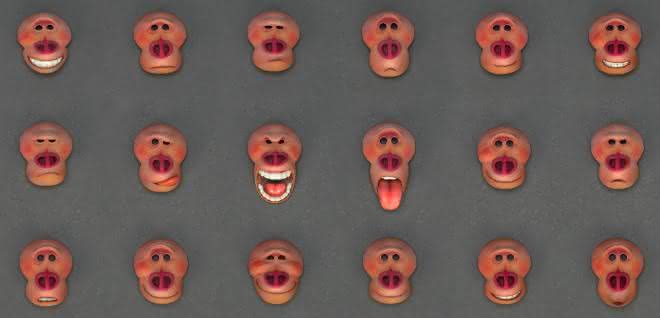
Laika's new animated film celebrates its premiere on April 12, and "Mister Link" will be released in German cinemas at the end of May. During production, the animation studio's fifth stop-motion film used the Cuttlefish 3D printer driver from the Fraunhofer Institute for Computer Graphics Research IGD for the first time to create thousands of minimally different "facial expressions" of one and the same character. The biggest challenge was that each individual color tone of an expression had to correspond exactly to the previous one. Laika decided to use the patented Fraunhofer technology Cuttlefish because of its convincing color consistency.
In stop-motion animation, elaborately produced figures are moved in small steps. Photos are taken after each of these changes so that the individual still images can be combined into a complete movie. The sequence of still images in quick succession creates the illusion of movement. In this way, each 24 images become one second of film. To animate the facial expressions of the characters, Laika produced over 106,000 highly detailed colored faces for "Mister Link" using 3D printing on a fleet of Stratasys J750 3D printers, controlled by the 3D printer driver Cuttlefish. Brian McLean, who was nominated for an Oscar for Best Visual Effects in 2017 for "Kubo - The Brave Samurai", is Director of Rapid Prototype and has extensive experience in using 3D printers in stop-motion films. In 2016, he received the Scientific and Engineering Oscar (Academy Plaque) for his pioneering work in the use of 3D printing in stop-motion animation.

Cuttlefish is a voxel-based universal printer driver that supports various 3D printing technologies. It makes it possible to work with many printing materials simultaneously, to reproduce the geometry, colors and fine color transitions of the original exactly and to simulate the printout on the screen in advance. Translucencies, i.e. partially or completely transparent materials, can also be printed. The light scattering of an object and the change in color and surface structures depending on the incidence of light are taken into account.
Such realistic 3D printing is not only used in the film industry, but also in other areas such as medicine, automotive engineering and the cultural sector. It is an increasingly important manufacturing process for the production of prototypes, products or replicas. With the increasing range of functions of 3D printers, for example the number of printing materials used, the demands on the control software used in additive manufacturing are also increasing. Accurate positioning of the materials in order to correctly reproduce both geometric and optical properties is a challenge due to the immense amount of data. Cuttlefish is streamable, which means that only the information required for printing is calculated. This minimizes memory consumption and printing starts within seconds, even for very complex and large 3D models.


You might also be interested in
Gateway with improved fault diagnosis
Schmersal is launching a new version of the SD gateway for its SD bus. According to the group, users benefit in particular from the improved fault diagnostics that the new SDG Fieldbus Gateway enables.
 read more...
AI trends for engineers: where is the journey heading?
According to Gartner, companies that have adopted AI engineering practices have a competitive advantage: by 2026, they could outperform their competitors by around 25 percent in terms of the number and time required to operationalize AI models....
read more...Industrial-grade version of the Raspberry Pi
"The more performance, the more use cases"
The new version 4 of the open source IPC "Revolution Pi" (RevPi) from Kunbus is set to be launched as an industrial-grade version of the Raspberry Pi in mid-2023.
read more...Digital assistance systems make manual production easier
Increasing productivity in the face of a shortage of skilled workers and a growing number of product variants is a challenge for many medium-sized industrial companies. Software-based assistance systems such as elution two assembly from Elabo offer...
read more...Platform for hydrogen and fuel cells
Around 500 companies presented their solutions for the production, transportation, infrastructure, storage, refuelling and consumption of hydrogen at the Hannover Messe.
read more..."Using DC technology consistently"
The DC-Industrie2 project recently came to an end and the follow-up project, ODCA, has been launched. In an interview with Andrea Gillhuber, Dr. Hartwig Stammberger and Dr. Jan Stefan Michels spoke about the potential of DC technology and its...
read more...Artificial intelligence in Germany
AI arrives in the industry
At the start of the Hannover Messe, Microsoft's Head of Germany Marianne Janik called for greater use of artificial intelligence (AI) in Germany.
read more...Feinmess Suhl at the Control 2023
High-precision testing equipment and monitoring systems
At the Control international trade fair for quality assurance, Feinmess Suhl will be presenting innovations in the field of test equipment for product measurement and systems for test equipment monitoring.
read more...Continuously developing innovations
In the run-up to the Hannover Messe, Andreas Mühlbauer spoke to Oliver Winzenried, CEO of Wibu-Systems, about the innovations the company is presenting in Hannover and the technological trends at the trade fair.
read more...