
3D printing innovations
These are the finalists for the Formnext Awards 2025
In 2025, the Formnext Awards will once again honor companies, business ideas and technologies in six different categories. The finalists will present their exhibits online in the run-up to the trade fair and as part of a special show at Formnext. The public can now take part in the voting.
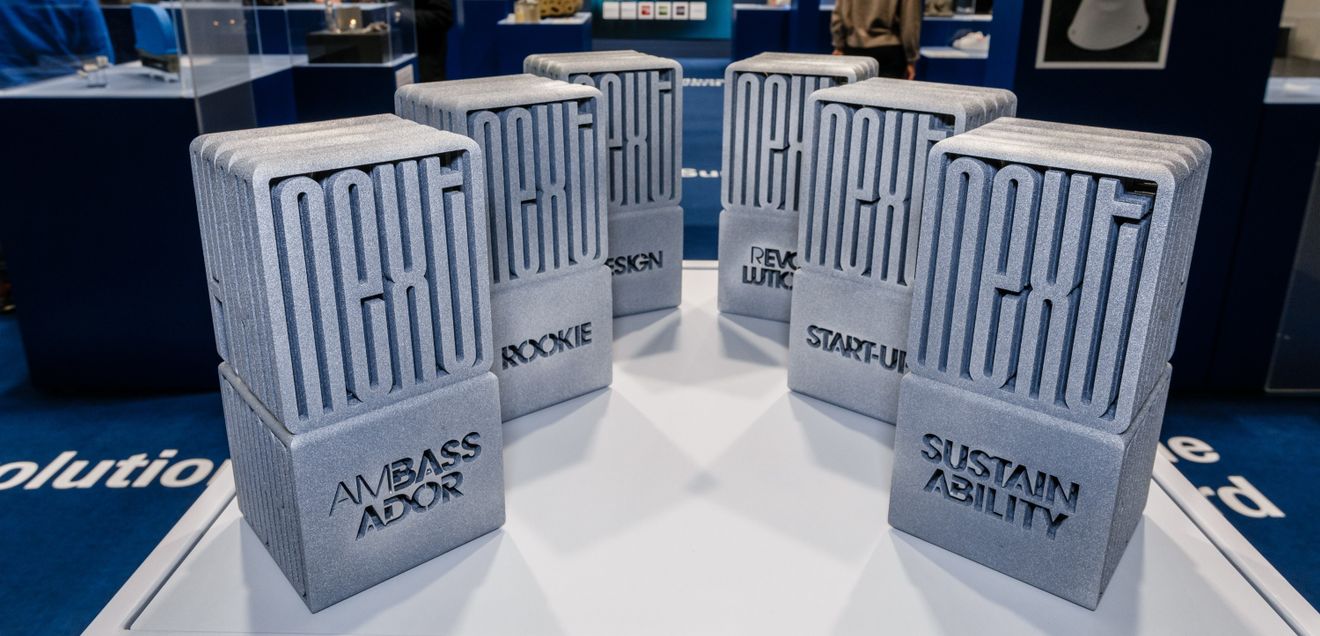
The finalists in the six award categories show the way forward for additive manufacturing. The innovations not only deal with current challenges such as increased sustainability and more efficient production, but also offer very specific applications and specialized manufacturing solutions - for example for robotics or the dental sector.
Formnext visitors can experience all the finalists at the Formnext Awards special show (Hall 11.0, Stand D82). The winners will be announced and the awards ceremony will take place on November 20 at the Industry Stage (Hall 11.0, D72). In addition, the finalists can now be discovered on the Formnext website. Voting is possible for all categories until 20.11.2025, with the public's vote counting as an additional jury vote.
AMbassador Award
The AMbassador Award recognizes outstanding individuals or organizations that have made a unique impact on the industry and users through innovative training and education approaches or their personal advocacy. The finalist is Naiara Zubizarreta, Director of Addimat, the Spanish association for additive manufacturing, which is celebrating its 10th anniversary this year. Since 2015, she has been leading the strategy and growth of the Spanish AM ecosystem and has built a strong community that now has more than 100 members.
Irena Heuzeroth, engineer and Senior Trainer Education Injection Molding | Additive Manufacturing, also made it to the finals with her commitment to training. The IHK Würzburg-Schweinfurt and Das Kunststoff-Zentrum (SKZ) jointly offer the practical course of study to become a "Certified Industrial Technician specializing in Additive Manufacturing". The training program covers the entire 3D printing process chain - from the materials used and their processing to design and processes and topics such as energy, hydraulics and occupational safety.
Gustavo Melo from RWTH Aachen University also wants to make new approaches to AM training possible: He has developed a technology-supported and data-driven methodology.
Design Award
The following finalists in the Design Award category impressed with their exceptional AM designs and AM products: The Limb Kind Foundation, together with Hewlett-Packard and global partners, has launched a 3D printing project in Kenya. Customized prosthetic socket parts for children were produced abroad and transported to Kenya, where they are assembled free of charge by orthopaedic technicians and fitted to the children.
IKM Flux, EOS, Valland and ToffeeX have collaborated to develop a flux vaporizer that measures the energy content of LNG gas much more accurately than conventional devices. The vaporizer, which uses thermo-fluidic topology optimization among other things, can eliminate minor but sometimes very expensive measurement inaccuracies in LNG deliveries.
The Schwäbisch Gmünd University of Art and Design has developed the "Grabbit" hand therapy gadgets, which are designed to help train the hands - for example in the event of illness, injury or age-related weakness. TPU lattice structures and PA12 are combined with ash wood.
(R)Evolution Award
Products, technologies or services that offer particular added value for the user are honored with the (R)Evolution Award. This year's finalists focus on innovations from industrial manufacturing and the dental sector. As part of its Inov.iQ project, the Portuguese company Erofio has 3D-printed a mold for a 100-ton injection molding machine entirely out of metal. The mold, which was created in collaboration with injection molding machine manufacturer Engel, is designed for ultra-thin parts with wall thicknesses of just 1 mm. Thanks to the lightweight design, the tool weight was reduced by 75 percent and energy consumption by 30 percent. At the same time, productivity increased thanks to shorter cycle times.
Laempe Mössner Sinto has developed a 3D printing system for the mass production of sand cores and successfully put it into operation at the BMW Group. The system produces more than 1,100 cores per day, making it one of the fastest binder jetting printers in the world.
With the CoriTec Mythos, Imes-icore presents the world's first fully automated hybrid manufacturing system that combines additive coating (PEM) and precise milling/grinding in a 5-axis process. This technology enables multi-colored, multi-material dental restorations with the highest surface quality, accuracy of fit and aesthetics - from crowns and bridges to implant structures.
Rookie Award
The Rookie Award honors young individuals with promising business ideas who have not yet founded their company or who founded it less than a year ago. The three finalists offer innovative solutions for the medical and dental sector as well as technical optimization of 3D printers: Fidentis' digital production system uses multi-material PBF-LB/M, robotics and automation to produce high-quality, multi-material cobalt-chrome and gold prostheses for the dental sector on a large scale.
To improve the treatment of respiratory distress, for example, 3DMyMask uses 3D facial scanning and AM to produce customized silicone masks. The project is backed by neonatologists, industrial engineers and entrepreneurs who are embedded in the IAM3DHUB ecosystem.
Tesseract has developed easily accessible linear motors that are optimized for FDM printers. The self-correcting motors move directly over a magnetic rail without mechanical transmission, enabling faster and more precise movements.
Start-up Award supported by Fluxo Technologies
With its volumetric additive manufacturing (VAM), Perfi Technologies promises to outperform conventional 3D printing by "printing" every point of an object simultaneously instead of layer by layer. This is said to reduce production time from hours to seconds, eliminate the need for support structures and minimize post-processing.
The young Hungarian company Allonic has also developed a new AM technology: 3D Tissue Braiding is a new, textile-based additive manufacturing technology and aims to make complex robotics simple enough for mass production. In addition, the software tools from Swiss company Nureo AG promise to fully automate the 3D design of parts.
The Thai start-up OsseoLabs aims to improve orthopaedic and maxillofacial surgery with its AI-supported surgical planning and 3D-printed, patient-specific implants. According to OsseoLabs, the OsseoMatrix porous scaffold and OsseoVision platform improve precision and reduce surgery time by 50 percent and planning time by 90 percent. Over 200 clinical cases have already been completed.
Biomotion Technologies FlexCo from Vienna has also focused on the healthcare sector and developed a platform that automates and standardizes the bioprinting of 3D tissue models. The aim is to make drug screening more reliable.
Sustainability Award supported by Renishaw
Smart Materials 3D Printing, Continuum Powders and EOS have reached the final of the Sustainability Award, which recognizes AM applications and products based on their product life cycle. Smart Materials 3D develops innovative, biodegradable 3D printing materials from regional agro-industrial waste materials, thereby making an important contribution to a sustainable circular economy in additive manufacturing.
With its Greyhound Melt-to-Powder (M2P) platform and OptiVantage quality framework, Continuum Powders converts high-quality waste into ready-to-use metal powders.
EOS presents its filter system for the laser sintering of metals, which separates usable powder that is removed with the exhaust air flow and neutralizes reactive by-products of metal-based AM such as condensate, soot and ultra-fine particles directly in the process. These are considered hazardous waste and cause high disposal costs, while recovering the reusable powder saves costs and CO₂ emissions. The new recirculating air filter system that EOS is presenting at Formnext 2025 converts highly reactive condensates into stable metal oxides that can then be disposed of safely. According to EOS, this filtration and the integrated oxidation technology not only protect the environment but are also economically sustainable.
Further information, online voting and presentation of the finalists at formnext.com/awards


You might also be interested in
New Resin Opens Up 3D Printing for the Optics Industry
With BMF Clear, Boston Micro Fabrication has introduced an optically transparent photopolymer resin for micro-precision 3D printing that achieves a light transmittance of over 90 percent at layer heights of 10 micrometers or more and is suitable for...
 read more...
3D Printing in the Defense Sector
Formnext Launches 2026 Defense Summit
Formnext is expanding its program to include the security and defense sector and will host the first Formnext Defense Summit in 2026. The event will focus on the potential of additive manufacturing for resilient supply chains, industrial...
read more...UltiMaker Doubles Speed in Industrial 3D Printing
With the Factor 4 Plus, UltiMaker is introducing a new version of its industrial desktop 3D printing platform, which operates at up to twice the print speed of the standard model. The platform is designed for use in manufacturing and defense...
read more...Stratasys takes over MarkForged
Stratasys is acquiring MarkForged from Nano Dimension for USD 42.5 million, thereby expanding its portfolio in the field of fiber-reinforced composites. The acquisition also strengthens the company's software and materials expertise in industrial 3D...
read more...Timo Göbel, Head of BMW Additive Manufacturing
"Clearly on course for broad industrialization"
The BMW Group's Additive Manufacturing Campus (AMC) is setting the course for the next stage of industrialization. Under the leadership of Timo Göbel, additive manufacturing is being further integrated into all stages of the vehicle life cycle. In...
read more...Real-time control to make recycling materials economical
The Fraunhofer IAPT is researching AI-based closed-loop processes for industrial 3D printing with recycled plastics. The aim is to achieve less waste, greater process stability and profitable printer farms.
read more...Forum Solutions 4AMIndustry shows ways into industrial application
Additive manufacturing has developed dynamically in recent years and has long outgrown its status as a purely innovative technology in many industries. Nevertheless, companies still face the challenge of integrating AM into their production...
read more...Alliance aims to drive forward industrial 3D printing
Machine components, electrostatically shielded transport containers, large components for the automotive, rail and aviation industries or specific medical products straight from the printer - the potential applications of additive manufacturing are...
read more...Photonic microchips with 3D connector
How a 3D system makes photonic chips industrially viable
A research team from Heidelberg is developing a 3D-printed "connector" for photonic microchips. The solution promises a low-loss, standardized coupling of glass fibre and chip - and could fundamentally simplify the production of photonic integrated...
read more...