
Additive manufacturing
3-pressure solution for Nissan
BCN3D, a Spanish manufacturer of 3D printing solutions, has completed the implementation of the Epsilon ecosystem at the Nissan plant in Barcelona.
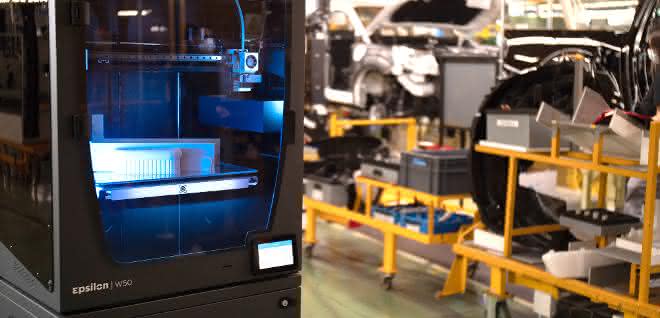
The car manufacturer uses BCN3D's 3D FFF (Fused Filament Fabrication) technology to produce tools, jigs and fixtures for its production line in Spain. So far, 700 parts have been created, some of which cost just 3.45 euros to produce.
In-house thanks to 3D printing
Previously, Nissan outsourced all prototypes and fixtures to mechanical suppliers using traditional manufacturing methods such as CNC and drilling. Although the quality of the finished product was good, lead times were long and inflexible and costs were high. Even simple tools could cost up to 400 euros to machine. By printing some of these parts in-house using 3D printers, Nissan was able to reduce the time to design, refine and produce parts from a week to just one day, cutting costs by 95 percent.
Additive manufacturing laboratory
Nissan's additive manufacturing lab is equipped with a farm of four BCN3D printers, which have proven to be reliable and can run around the clock to meet Nissan's intensive production schedule. The printers are equipped with an Independent Dual Extrusion (IDEX) system, which means that Nissan can print two identical components simultaneously, significantly doubling productivity.
Nissan also uses the recently launched BCN3D Smart Cabinet - a new solution designed to preserve filament printability, extend its shelf life, reduce aesthetic defects and avoid costly reprints.
24-hour deployment
Carlos Rellán Martínez, Manager of Maintenance & Engineering Facilities at Nissan Motor Ibérica Zona Franca, Barcelona, says: "The performance achieved in terms of reliability is outstanding. Our printer runs almost 24 hours a day and we print around 100 different fixtures and tools every year for specific use in our processes.
"Outsourcing tools to a mechanical supplier was 20 times more expensive than 3D printing the same parts, while the waiting time for tools dropped from a week to a day. By introducing 3D printing, we have increased added value and generated low costs without high delivery times. We have amortized the investment in the printers very quickly."
Eric Pallarés, Chief Technical Officer at BCN3D, adds: "The automotive industry is probably the best example of scaling a complex product to meet the highest quality standards. It's fascinating to see how the assembly process of a car - where many individual parts are put together on an assembly line - relies on FFF-printed parts at virtually every stage. After assembling thousands of cars, Nissan has found that using BCN3D 3D printing technology to produce fixtures for complex assembly operations enables consistently high quality parts in less time and at a lower cost."


You might also be interested in
Cutting solutions in 2D and 3D
Microstep showed 2D and 3D cutting solutions in action on sheet metal, tubes, profiles and container bases, including bevel cutting with plasma or waterjet and dynamic fiber laser cutting, as well as drilling, milling and marking demonstrations.
 read more...
Precision machining of bores
Paul Horn is presenting an innovative extension for the Supermini system in the field of ultra-fine machining at EMO 2023. The system has been supplemented by a variant with an ultra-fine ground cutting surface.
read more...Deep drill holes optimized with PCD
When the Schlote Group built a new plant in Harzgerode in 2017, production was geared towards series production of a single component right from the start.
read more...Production goes digital
EMO, the world's leading trade fair for production technology, invites the industry to Hanover from September 18 to 23.
read more...Vibration-free groove turning process
Adjustable damped boring bar
Paul Horn is exhibiting innovations and product enhancements at the EMO in Hanover. Among other things, the company is exhibiting a boring bar that can be adjusted to the vibration amplitudes that occur.
read more...Efficiency with digital twins
Digitalization and automation are the way to increase efficiency and flexibility in machining. The Tebis team will be presenting suitable solutions for mechanical engineering at EMO.
read more...Many highlights in Leipzig
Ceratizit will be presenting the highlights from its portfolio at Intec. In addition to the latest tools for milling, turning and drilling, automation solutions will also be a top topic at the tool manufacturer's stand.
read more...How smart robot simulation works
More intelligent, more efficient, easier to operate - robots are developing rapidly. Among other things, great care is required when setting them up and operating them in order to avoid cost-intensive downtimes. Robot simulation tools are...
read more...Milling, turning and grinding center
Milling, turning, grinding and gear cutting on one and the same machine - in a single clamping operation: Soraluce's multitasking machines are the answer to technically complex workpieces with tight tolerances that require various machining...
read more...